


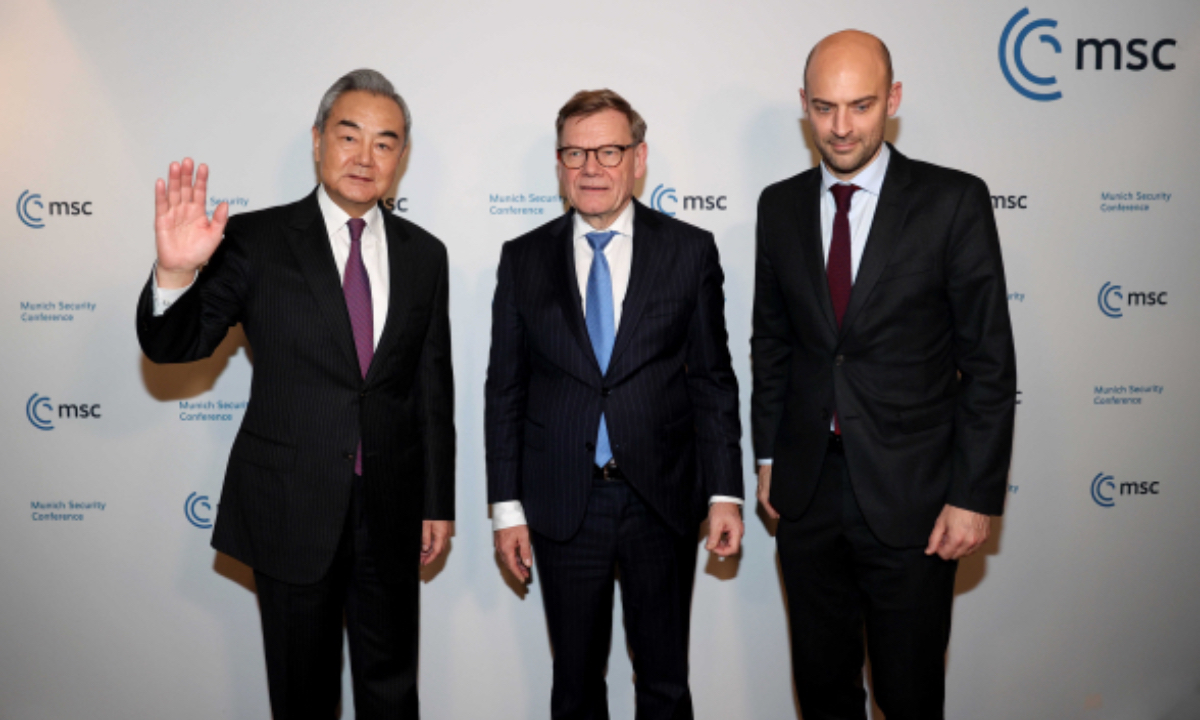
Chinese Foreign Minister Wang Yi meets with German Foreign Minister Johann Wadephul and French Foreign Minister Jean-Noel Barrot on February 13, 2026 on the sidelines of the 2026 Munich Security Conference. (Photo: website of Chinese Foreign Ministry)
The 50 years of interactions and cooperation between China and Europe have proven that the two sides are partners, not rivals. Mutual dependence is not a risk, intertwined interests are not a threat, and open cooperation does not harm security, Chinese Foreign Minister Wang Yi said during a trilateral meeting with German Foreign Minister Johann Wadephul and French Foreign Minister Jean-Noel Barrot, on the sidelines of the 2026 Munich Security Conference (MSC) on Friday, according to a readout released by the Chinese Foreign Ministry on Saturday.
Wang, also a member of the Political Bureau of the Communist Party of China Central Committee, stated that the first-ever trilateral meeting as an innovative step in response to evolving global circumstances and an important opportunity for strategic communication.
He noted that the current international landscape is undergoing the most profound and complex changes since World War II, with unilateralism, protectionism, and power politics running rampant, and the international system centered on the United Nations facing severe challenges. As responsible major countries and major global economies, the three nations bear significant responsibilities for world peace and development.
Wang Yi called on the three sides to uphold the approach of seeking common ground while reserving differences, advocate the value orientation of open cooperation, and promote win-win cooperation, in efforts to provide clear direction for the development of China-EU relations and inject greater stability and certainty into an international situation marked by turbulence and intertwined challenges.
China's development presents opportunities for Europe, and Europe's challenges do not stem from China, Wang said. He called on Germany and France, as influential major EU countries, to act on their own interests and the interest of the EU as a whole, to promote an objective and comprehensive perception of China within the EU, pursue a rational and pragmatic policy toward China, and steadfastly uphold the positioning of China-EU relations as a partnership.
According to Chinese Foreign Ministry, both German Foreign Minister Johann Wadephul and French Foreign Minister Jean-Noel Barrot expressed their willingness to strengthen communication and coordination with China, and reiterated their firm adherence to the one-China policy. The German side stated that it attaches great significance to China's important and positive role in global affairs, while the French side highlighted its commitment to revitalizing a stable and positive China-EU relationship.
The three sides exchanged views on important issues in China-EU relations and other matters of common concern, such as the Ukraine crisis. They all spoke highly of the significance of this meeting and agreed to continue maintaining strategic communication, according to Chinese Foreign Ministry.
Wang Yiwei, director of the Center for European Union Studies at Renmin University of China and an attendee at 2026 MSC in Munich, regarded the trilateral foreign ministers' meeting as a significant innovation in mechanism that promotes dialogue and advances the development of China-EU relations.
Although Europe's strengthened dialogue with China also carries its strategic considerations regarding the frayed transatlantic relationship, it can be foreseen that interactions between China and Europe will become more frequent, the expert told the Global Times.
Wang Yi also held separate meetings with Wadephul and Barrot respectively, during which the Chinese foreign minister stressed to prevent the world from reverting to the “law of the jungle.”
Against the backdrop of the MSC primarily discussing the future of the international order, there are clear voices that the US taking the world back to the law of the jungle will be met with global resistance, Jin Ling, director and senior research fellow of the Department for Global Governance and International Organizations at the China Institute of International Studies, told the Global Times on Saturday.
According to the expert, joint action requires addressing a fundamental issue: what kind of perception of China Europe should have. “If viewed from the perspective of a ‘systemic rival,’ it would weaken the foundation of cooperation. Therefore, China has clearly proposed the positioning of China-EU relations as partners rather than rivals,” Jin added.
In early 2026, leaders from multiple European countries, including Ireland, Finland, and the UK, successively visited China. According to Wang Yiwei's observations, the number of invited Chinese scholars attending this year's MSC has increased, indicating that Europe still holds considerable expectations toward China and hopes to hear more voices from China.
"Compared to the highly disruptive policies adopted by the US in multilateral affairs, China is broadly viewed as a more stable and predictable force," Jin said. "Following the launch of the 15th Five-Year Plan, China is likely to release even more opportunities for opening up to the outside world."
In the short term, Europe will inevitably still need to make compromises with the US, but at the same time, it will accelerate the expansion of networks with other partners, during which China's role can hardly be overlooked, Jin said.