


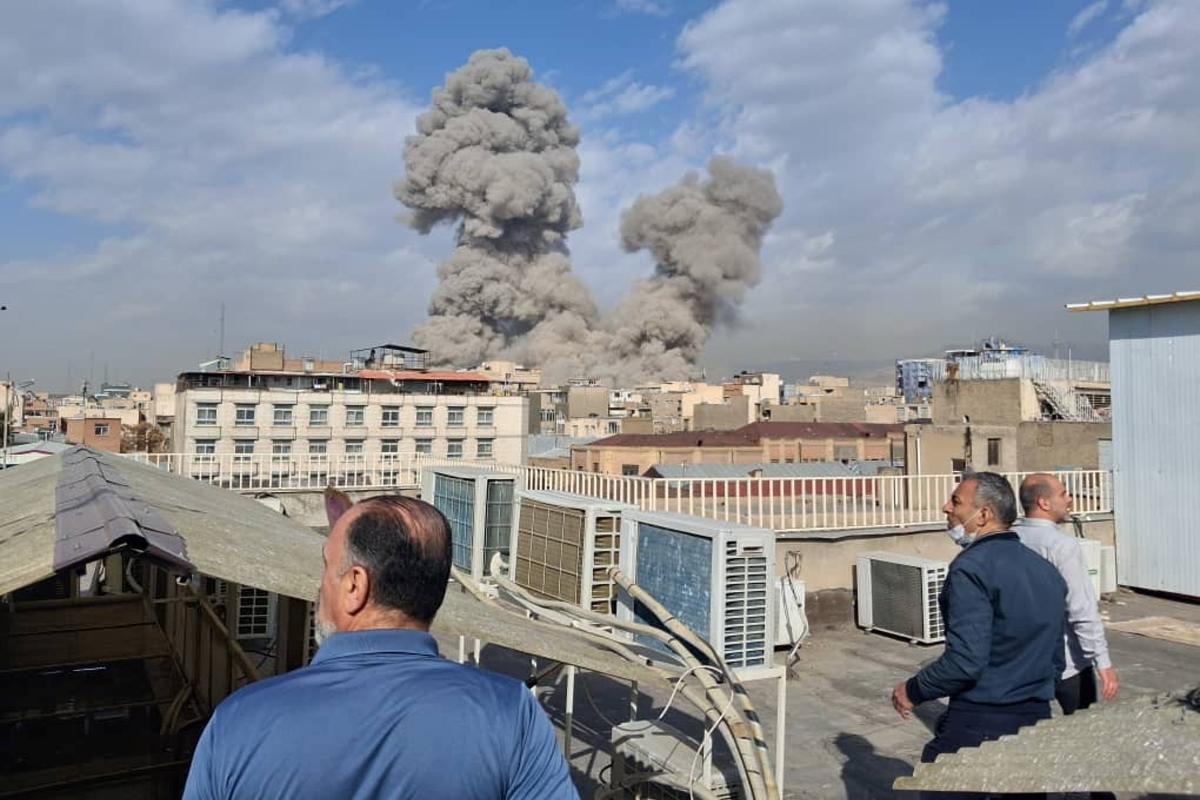
People watch as smoke rises on the skyline after an explosion in Tehran, Iran, Feb 28, 2026. (Photo: AP)
CAIRO, Feb. 28 (Xinhua) -- The United States and Israel on Saturday launched "major combat operations" against Iran, plunging the war-torn Middle East into a new round of violent conflicts.
Iran has retaliated with a series of counterattacks against Israel and U.S. targets across the region, with explosions reported in Bahrain, Qatar, Kuwait, Jordan, the United Arab Emirates (UAE), and Saudi Arabia, among other countries.
U.S. President Donald Trump said the objective "is to defend the American people by eliminating imminent threats" from Iran, and the Israeli Defense Ministry said the country launched a "preemptive" strike against Iran "to remove threats to Israel."
In Tehran, missiles hit areas near the offices of both Iranian Supreme Leader Ali Khamenei and President Masoud Pezeshkian. Iranian sources said that both leaders remain unhurt.
Israeli-U.S. airstrikes also struck a girls' school in southern Iran, killing at least 60 students, with 80 others injured, Hossein Kermanpour, head of the Iranian Health Ministry's public relations, said in a post on social media. Dozens more are reportedly still trapped under rubble.
"In response to the aggression by the hostile and criminal enemy against the Islamic Republic of Iran," the country's Islamic Revolution Guards Corps (IRGC) said, "Iran's large-scale missile and drone attack against Israel has started."
The Iranian armed forces said all U.S. military bases in the region are legitimate targets for Iran. According to Iran's Fars News Agency, Tehran struck military installations in several Gulf Arab countries hosting U.S. military forces, including Qatar, Kuwait, the UAE, and Bahrain. It specifically named Al Udeid Air Base in Qatar and the U.S. Navy's 5th Fleet headquarters in Bahrain as targets.
In response to the sharp regional escalation, several countries have slammed their airspace totally or partially shut, and multiple airlines have cancelled flights to the Middle East.
The spike in tensions has drawn a flurry of reactions from across the world. In a phone call with his Iranian counterpart, Russian Foreign Minister Sergey Lavrov condemned the "unprovoked armed attack" by the United States and Israel on Iran, and urged an immediate halt to the strikes.
The Egyptian Foreign Ministry said in a statement that the escalating tensions risk expanding the scope of the conflict and plunging the entire region into chaos. The only way to ensure security and stability, it added, lies in diplomacy and dialogue.
UN human rights chief Volker Turk condemned Saturday's strikes in the Middle East and urged all parties to return to negotiations, saying that attacks would only bring "death, destruction and human misery."
Omani Foreign Minister Sayyid Badr bin Hamad bin Hamood Albusaidi, the mediator of recent Iranian-U.S. negotiations, expressed his dismay in a post on social media. "Active and serious negotiations have yet again been undermined," he said, urging the United States not to get sucked in further.
The latest flare-up came after the United States and Iran wrapped up their third round of indirect talks earlier this week and agreed to resume negotiations next week.
It is reminiscent of last June when, during negotiations between Washington and Tehran, Israel launched a surprise attack on Iran and triggered the "12-day war," during which the United States bombed Iran's critical nuclear facilities.