


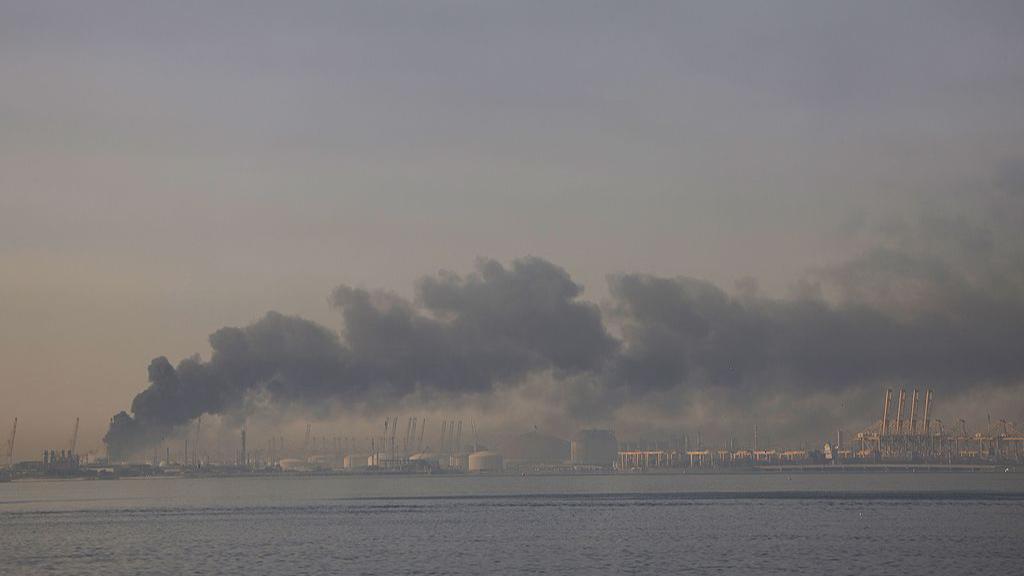
A plume of smoke rises from the port of Jebel Ali following a reported Iranian strike in Dubai, March 1, 2026. (Photo: VCG)
The United Nations and other international organizations, along with leaders and governments of various countries, have condemned the U.S. and Israeli military actions against Iran and called on all parties to resume dialogue to prevent further escalation of the situation.
The United States and Israel launched military strikes against Iran on Saturday. Iran subsequently carried out retaliatory attacks, targeting multiple U.S. military bases in the Middle East as well as related Israeli targets.
The UN Security Council convened an emergency meeting on Iran on Saturday. In his remarks, UN Secretary-General Antonio Guterres noted that the UN Charter lays the foundation for safeguarding international peace and security, stressing "international law and international humanitarian law must always be respected." "There is no viable alternative to the peaceful settlement of international disputes," the UN chief stated, adding that lasting peace can only be achieved through peaceful means, including genuine dialogue and negotiations. Calling for de-escalation and an immediate cessation of hostilities, he warned that "the alternative is a potential wider conflict with grave consequences for civilians and regional stability."
In a statement, the League of Arab States (LAS) expressed deep concern over the current situation in the Middle East, urging the international community to take swift action and defuse the tension and prevent the area form the growing instability and cycle of violence.
WHO Director-General Tedros Adhanom Ghebreyesus also voiced his deep concern for the Middle East situation in a statement, saying all people of all countries deserve to live in peace, free from the threat of violence. Tedros urged leaders of all countries to choose a path of dialogue instead of damage.
UNICEF is deeply concerned by reports of schools being struck in Iran, emphasizing "targeting civilians and civilian objects, including schools, is a violation of international law." UNICEF calls for all parties to restrain warpath and de-escalate the tension.
The Chairperson of the African Union Commission, Mahmoud Ali Youssouf noted in his statement that the military strikes carried out by the United States in coordination with Israeli forces against Iran mark a serious intensification of hostilities in the Middle East. He warned that "further escalation threatens to worsen global instability, with serious implications for energy markets, food security, and economic resilience – particularly in Africa, where conflict and economic pressures remain acute."
Egyptian President Abdel-Fattah al-Sisi made phone calls with leaders of several Arabian states, underscoring Egypt's rejection and profound condemnation of any infringement upon the sovereignty, security, and stability of Arab countries. He noted that "military solutions will not serve the interests of any party" and threaten to plunge the region into a vicious cycle of violence and instability. He stressed the necessity of returning to dialogue and diplomacy to reach political solutions for the current crisis.
Cuban President Miguel Díaz-Canel said on social media that the attacks launched by the United States and Israel violate Iran's sovereignty and territorial integrity. This act once again undermines diplomatic efforts surrounding the Iranian nuclear issue and jeopardizes regional and international peace and security. Given the unpredictable consequences, the international community must take immediate action to stop such behavior and prevent further escalation.
Colombian President Gustavo Petro said on social media that the U.S. and Israel's military action against Iran was "a mistake." He noted it's brutal to cause deaths of a large number of minors, stressing that world peace is a shared cause of all humanity and that dialogue between the United States and Iran on the nuclear issue must continue.
South African President Cyril Ramaphosa made a statement about the attack in Iran, saying that the developments pose a serious threat to regional and international peace and security, with far-reaching humanitarian, diplomatic and economic consequences. He called on all parties to exercise maximum restraint, intensify diplomatic efforts and act in accordance with international law, international humanitarian law, and the principles of the UN Charter. The president reiterated his call for intensified diplomatic efforts to de-escalate tensions and create space for meaningful negotiations.
Prime Minister of Portugal Luís Montenegro said on social media that Portugal calls on all parties to exercise "the maximum restraint," avoid further escalation, safeguard international peace and security, and ensure regional stability, in line with the principles of the UN Charter.
Brazil condemned the U.S.-Israeli attacks on Iranian targets and expressed grave concern over the military action. "The attacks occurred amid a negotiation process between the parties, which is the only viable path to peace," the government said in a statement. The Brazilian government appealed to all parties to respect international law and exercise maximum restraint to avoid escalating hostilities and protect civilians.
Countries including Türkiye, Libya, Algeria, Azerbaijan, Georgia, Uruguay, New Zealand, Peru, Mexico, Chile and Venezuela have also expressed concern over developments in the Middle East, urging all parties to prioritize dialogue and negotiation and to avoid further escalation of the regional situation.
(With input from agencies)