


UNITED NATIONS, March 9 (Xinhua) -- UN humanitarians voiced alarm on Monday that reported strikes on Middle East oil refineries could have serious environmental consequences, including impacts on access to safe water and on public health.
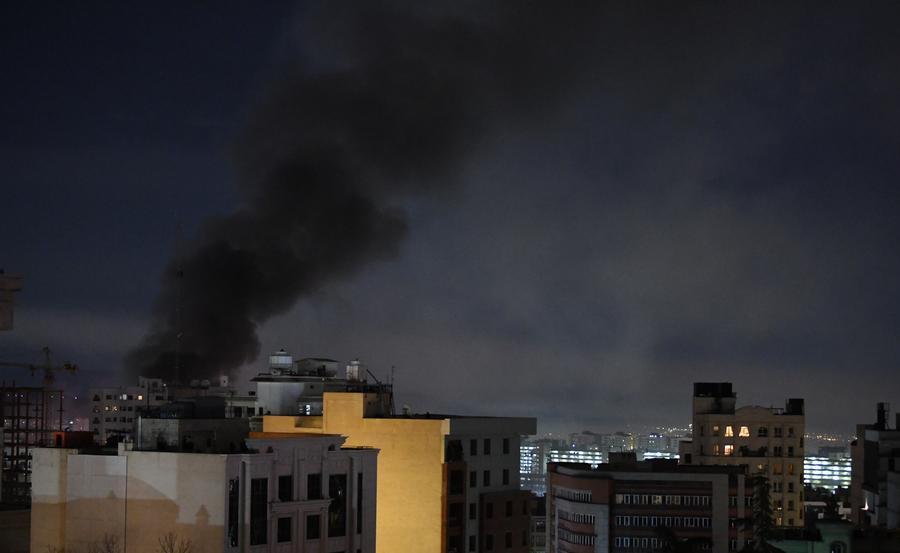
This photo taken on March 7, 2026 shows smokes billowing after Israeli airstrikes in Tehran, Iran. (File photo: Xinhua)
"This comes on top of strikes on water desalination plants reported in several countries," the UN Office for the Coordination of Humanitarian Affairs (OCHA) said.
The office said the region was already facing immense humanitarian needs prior to the latest escalation.
When asked about oil prices surpassing 100 U.S. dollars a barrel since the U.S.-Israeli strikes on Iran on Feb. 28, Stephane Dujarric, chief spokesman for UN Secretary-General Antonio Guterres, said the increase "will impact everything ... including UN operations."
Dujarric said the increase affects the world body's logistics operations including the cost of humanitarian food and the fertilizer needed to help grow it.
"It will be across the board," he said. "It underscores yet again our addiction to fossil fuel, where supplies, you know, are concentrated in just a few regions of the world," he said. "And it should also be an opportunity to redouble our efforts on renewables."
OCHA said that evacuation orders remain in effect for southern Lebanon and the southern suburbs of Beirut, forcing civilians to evacuate on a large scale.
The office said local authorities reported that more than 115,000 people are sheltering in more than 500 collective centers, while more than 500,000 people have registered as displaced. Health services continue to be affected, with five hospitals and dozens of primary healthcare centers having ceased operations.
"The humanitarian situation is rapidly worsening," OCHA said. "Immediate de-escalation is urgently needed."
OCHA said that all parties must respect international humanitarian law and protect civilians, health facilities, and humanitarian personnel. They must also ensure safe and sustained access for humanitarian organizations.
The office said it is responding with partners despite limited resources, but it urgently needs international support to meet rapidly growing needs.
Dujarric said that over the weekend, UN peacekeepers along the Blue Line separating Lebanon and Israel reported observing exchanges of fire, including rockets fired towards Israel and Israeli airstrikes and shelling in their area of operations.
Peacekeepers have also observed incursions into Lebanon by the Israel Defense Forces, including reporting Monday one IDF tank near Kunin in southeast Lebanon, 7 km north of the Blue Line.
OCHA said that the closure of crossings along the Gaza Strip's perimeter continues to undermine humanitarian operations.
"The continued closure of the Zikim crossing is forcing aid workers to re-route critical supplies intended for northern Gaza through the southern crossing of Kerem Shalom, which is still the only operational crossing point. This long route is slower and more costly, and increases reliance on scarce fuel inside Gaza, where movements take place on damaged roads," the office said.
The exit from Gaza of patients who need medical evacuations and the return of Palestinians from abroad remain suspended.