


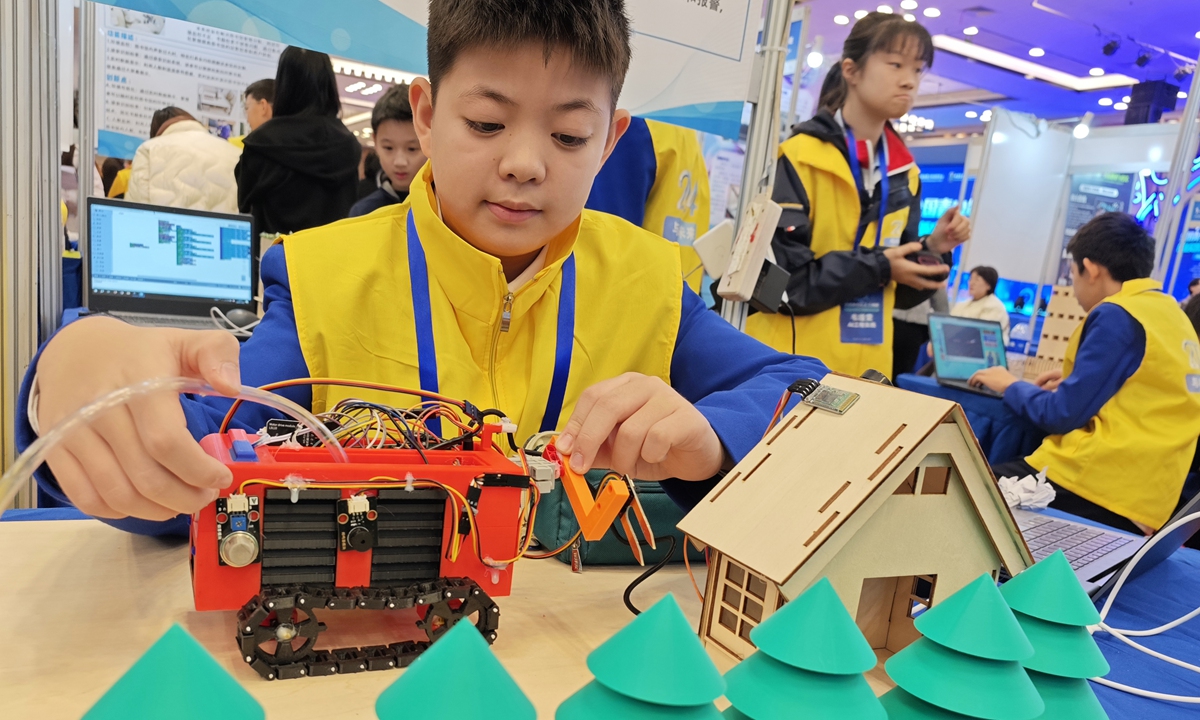
The 2024 National Youth AI Innovation and Practice Exhibition, held in Nanjing from November 22 to 24, supported young people in using AI to explore and solve real-world problems. (Photo: VCG)
For years, the global debate on artificial intelligence has framed China's rise through familiar themes. Scale, data, infrastructure and state backing are often cited, and while these factors have shaped its progress, they have also encouraged a simplified impression of a development path that is far more complex.
China's trajectory in AI is not a variation of Western innovation norms. It emerges from a distinct social contract that links technological development to national purpose, collective benefit and, crucially, the confidence of its younger generation. Findings from an Edelman Trust Barometer Flash Poll late last year show that trust in AI among Chinese youth (aged 18 to 34) stands at 88 percent, far higher than the UK at 59 percent or the US at 40 percent. This represents a fundamental structural gap. No other major economy in the study displayed this level of youthful optimism about the technology that will define the next era of productivity and growth.
This matters because China is entering a demographic transition without modern precedent. Trust in AI among its young becomes a strategic advantage. Economies that trust innovation tend to deploy it more quickly and benefit earlier economically.
AI development takes place within what might be described as a purpose-guided innovation framework, where technology is shaped by national goals, aligned with public expectations and supported through institutional cooperation. I have previously characterized this as part of China's socialist orientation toward technology. Tools are not merely commercial products, but infrastructure designed to lift productivity, improve public services and widen access to opportunities. Success is measured not only by valuation or market share but by civic legitimacy and contribution to national priorities.
China ranks among the highest in believing that generative AI will help address major societal challenges, from healthcare and mental health to aging, poverty reduction and climate change. This does not mean that generative models, as narrowly understood in Western debates, are already the primary engines of these outcomes in China. Much of China's most impactful use of AI to date has come through automation, optimization, computer vision and other applied or "narrow" AI systems embedded in public services, industry and infrastructure.
What the data instead reveals is something more structurally important. Trust in China extends beyond any single AI modality. Generative AI is perceived not as a disruptive exception, but as a continuation of an already legitimized technological pathway, one in which AI, broadly conceived, is expected to serve collective goals. In this context, confidence in generative AI reflects a generalized social license for technological deployment rather than a technical assessment of model architectures.
This helps explain why Chinese respondents express significantly greater optimism about AI's societal value than their counterparts in the US or UK, where AI has become culturally coded as a source of job insecurity, misinformation and social disruption. In China, it is more often interpreted through the lens of institutional capacity and national problem‑solving. The divergence is not primarily about code, but about how societies have learned to situate new technologies within their broader social contract.
China's younger generation is central to this momentum. Digitally fluent and globally exposed, they display a greater appetite for experimentation than their peers in many Western economies. In a country where the labor force is tightening, their embrace of AI is not merely cultural, but crucial for its economic competitiveness.
This does not remove the need for responsible governance. Trust, according to Chinese respondents, comes with expectations of transparency regarding job impacts. The study shows that Chinese respondents, like others globally, want business leaders to be honest about how AI will impact job cuts. Trust is conditional and is maintained through performance and civic responsibility.
China is not seeking to lead in AI by replicating the Silicon Valley model. It is pursuing what I call technomeritism, a system in which technologies earn legitimacy through demonstrable contribution to public goals, institutional alignment and perceived social benefit. In such a system, trust is not blind, but cumulative. Each successful deployment, whether generative or not, lowers resistance to the next.
As the global AI race accelerates, technical capability alone will not determine success. The decisive factor will be whether societies grant emerging technologies the social license required for rapid adoption and integration. Here, China's youthful optimism is not just cultural, but also structural. Its AI trajectory reflects a different social bargain, one rooted in purpose, participation and the expectation that innovation serves collective priorities.
The author is head of Technology, APAC at Edelman. opinion@globaltimes.com.cn