


Japanese Prime Minister Sanae Takaichi is widely thought to face a tough diplomatic moment as she prepares to meet US President Donald Trump during her first visit to Washington as Japan's leader.
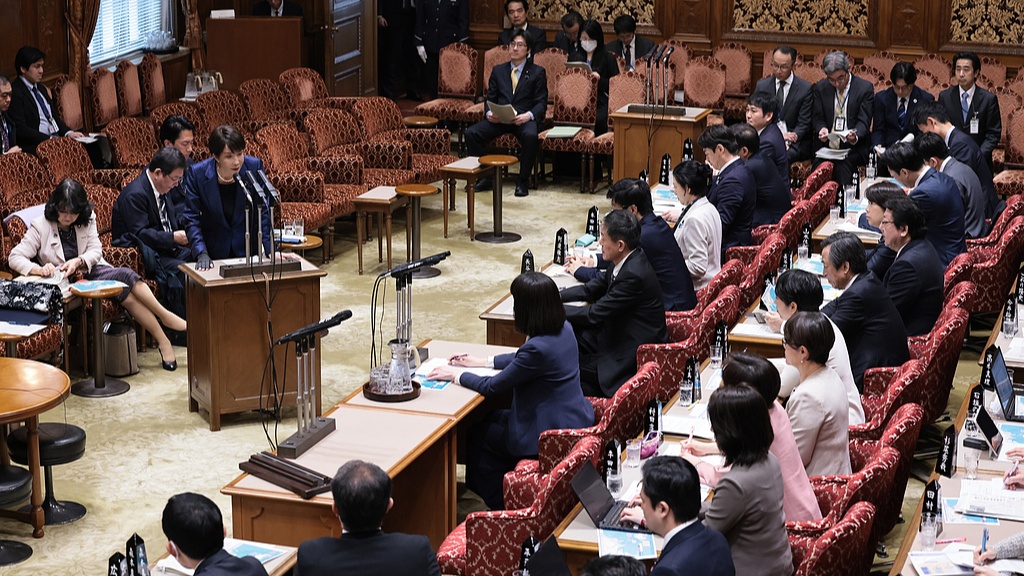
Japanese Prime Minister Sanae Takaichi attends a meeting at the Diet Building in Tokyo, Japan, March 18, 2026. /VCG
The one-on-one meeting has drawn heightened attention due to the ongoing US-Israeli attacks on Iran and growing US pressure on Japan regarding the Strait of Hormuz escort mission.
Though Trump said the US no longer needs help from traditional allies, including NATO and Japan, experts say Takaichi must present Japan as a strong and reliable ally and mollify the US leader.
"It's hard to imagine that Trump is going to be completely satisfied with what Japan can offer," James Schoff, a Japan expert at the Sasakawa Peace Foundation USA in Washington, was quoted by Japan Times as saying.
"His expectations are probably higher than what is feasible in the short term, so this is a true diplomatic test for Prime Minister Takaichi."
So far, Takaichi has been careful not to criticize the US-Israeli strikes on Iran.
Before her departure, Takaichi said in parliament on Wednesday that she would tell Trump what Japan "can and cannot do" in the Middle East.
Sending its Self-Defense Forces abroad is politically sensitive in officially pacifist Japan, where most Japanese support the US-imposed, war-renouncing 1947 constitution, which the country adopted after its defeat in World War II.
In a significant step back from its post-war pacifism, Japan passed security laws in 2015 allowing it to use force overseas in limited circumstances. That is permitted only if an attack, including on a close security partner, threatens Japan's survival and no other means are available to address it. The law permits the military to be deployed overseas – but only after fighting has stopped.
Furthermore, Japan faces a hurdle in international law regarding whether the US military action is authorized by the UN Security Council or justified as self-defense.
Public sentiment is also a factor, with a recent Asahi Shimbun poll showing only 9% of Japanese endorse the US-Israeli strikes.