


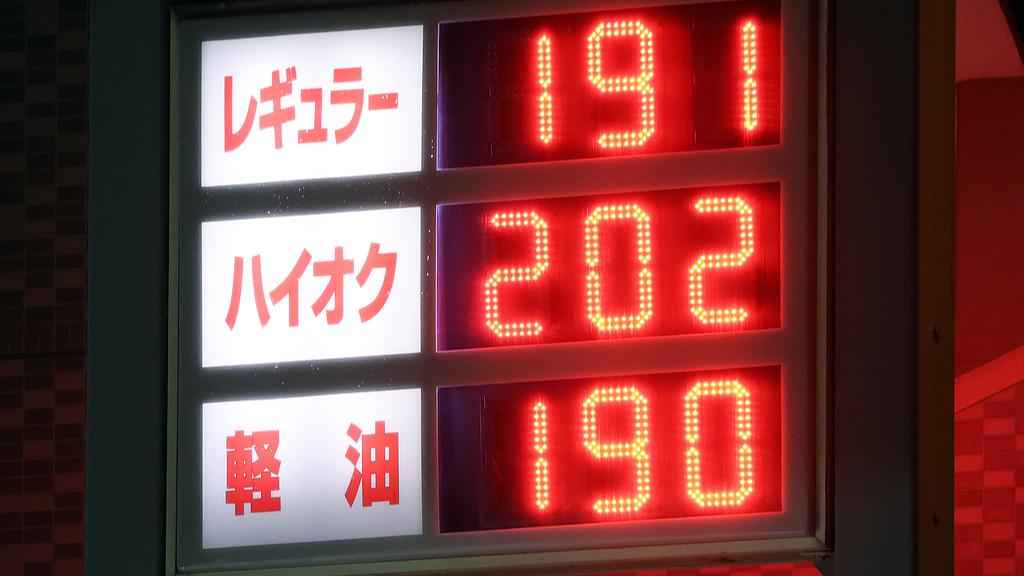
Fuel prices on a board at a gas station at night in Tokyo, Japan, March 16, 2026. (Photo: VCG)
Japanese Prime Minister Sanae Takaichi is visiting the United States to reinforce the US-Japan alliance, but escalating turmoil in the Strait of Hormuz is testing both the strength of that partnership and Japan's energy strategy.
With the conflict between Iran and the US and Israel disrupting oil flows, Tokyo faces mounting pressure to secure supplies while managing rising domestic fuel costs.
On March 16, the Japanese government began releasing 80 million barrels of oil – the largest drawdown since the reserve system was established in 1978 – to offset supply disruptions caused by instability in Hormuz. The emergency measure is expected to cover only about 45 days of consumption, underscoring the stakes if tensions persist.
The move followed an earlier March 11 decision, when Takaichi announced that Japan would act independently rather than wait for International Energy Agency coordination. This marked a departure from decades of multilateral precedent, signaling Japan's urgency in stabilizing domestic supply.
Tokyo has also introduced fuel subsidies to contain price spikes, aiming to keep gasoline around 170 yen per liter ($1.07) and extending support to diesel, heavy oil and kerosene. However, these measures are straining an already tight fiscal position.
Deep-seated vulnerabilities
Analysts say the current crisis is less a sudden shock than an acute flare-up of a long-standing structural weakness: Japan's heavy dependence on Middle Eastern energy.
According to Japan's Ministry of Economy, Trade and Industry, 95.1 percent of Japan's crude oil imports came from the Middle East as of January 2026, with about 73.7 percent transported through the Strait of Hormuz. Any disruption to this route effectively places Japan's energy lifeline at risk.
The situation has become more acute in recent years. As Japan scaled back imports from Russia, its reliance on Middle Eastern suppliers climbed further, to around 96 percent. In this context, prolonged instability in the Strait is not merely a price shock – it poses a systemic supply risk.
Chen Yan, executive dean of the Japan Enterprise (China) Research Institute, said the Takaichi government has yet to learn from the 1973 oil crisis. Japan remains heavily reliant on Arab energy supplies while often taking divergent positions in diplomacy and international politics. "This is a clear contradiction," he said.
The 1973 crisis dealt a severe blow to Japan's economy, prompting Japan to establish its strategic reserve system in the first place. Yet despite decades of policy adjustments, the core issue of supply concentration remains unresolved.
Chen noted that Japan's early release of reserves reflects an effort to quickly contain rising oil prices. Oil underpins not only industry but also agriculture, food logistics and daily transport, especially in rural areas, making households highly sensitive to fuel costs. He warned that surging energy prices could significantly erode Japan's economic growth this year, an outcome the government is keen to avoid.
Economic pressure mounts
The impact of rising energy costs is already spreading across the Japanese economy.
Refiners have been the first to respond. According to Bloomberg, at least one Japanese refinery has canceled planned exports of gasoline, jet fuel and diesel for March to prioritize domestic supply, effectively shifting from export activity to emergency stabilization.
Manufacturing is also beginning to feel the squeeze. Data from the Bank of Japan shows refinery operating rates have declined, while energy-intensive industries such as chemicals, transport and heavy manufacturing face mounting cost pressures if oil prices remain elevated.
The auto industry – home to global giants like Toyota Motor Corporation, Honda Motor Co., Ltd. and Nissan Motor Co., Ltd. – is particularly vulnerable. Its just-in-time production model depends on tightly synchronized logistics, meaning any disruption in fuel supply could quickly cascade into broader production delays.
Households are also under strain. Higher fuel, electricity and gas prices are expected to erode disposable income, potentially weighing on consumption.
Meanwhile, Japanese trading houses are scrambling to secure alternative supplies from the United States, Africa and Southeast Asia. But such adjustments take time and often come with higher procurement and transportation costs.
Risk of a worsening cycle
Financial institutions warn that sustained high oil prices could trigger a negative feedback loop in Japan's economy.
Mizuho Bank estimates that if crude prices remain in the $90-$100 range, Japan's annual trade deficit could widen by nearly 10 trillion yen. A weaker yen would then push up import costs further, reinforcing upward pressure on prices.
In a more pessimistic scenario, economists at Nomura Research Institute project that if oil prices reach $130 per barrel, Japan's GDP could be reduced by 0.65 percentage points within a year, while inflation could rise by 1.14 percent.
With tensions involving the United States, Israel and Iran showing little sign of easing, Chen said it's unlikely that Japan can significantly curb oil prices through reserve releases alone. "If the disruption proves prolonged, it's uncertain whether Japan's current oil reserves will be sufficient to last through the crisis," he said.
Chen added that the current conflict also exposes Japan's weaknesses in renewable energy.
"Japan has been lukewarm or even opposed to renewables such as solar and wind power," he said, adding this shortcoming in turn amplified the impact of the ongoing energy crisis.