


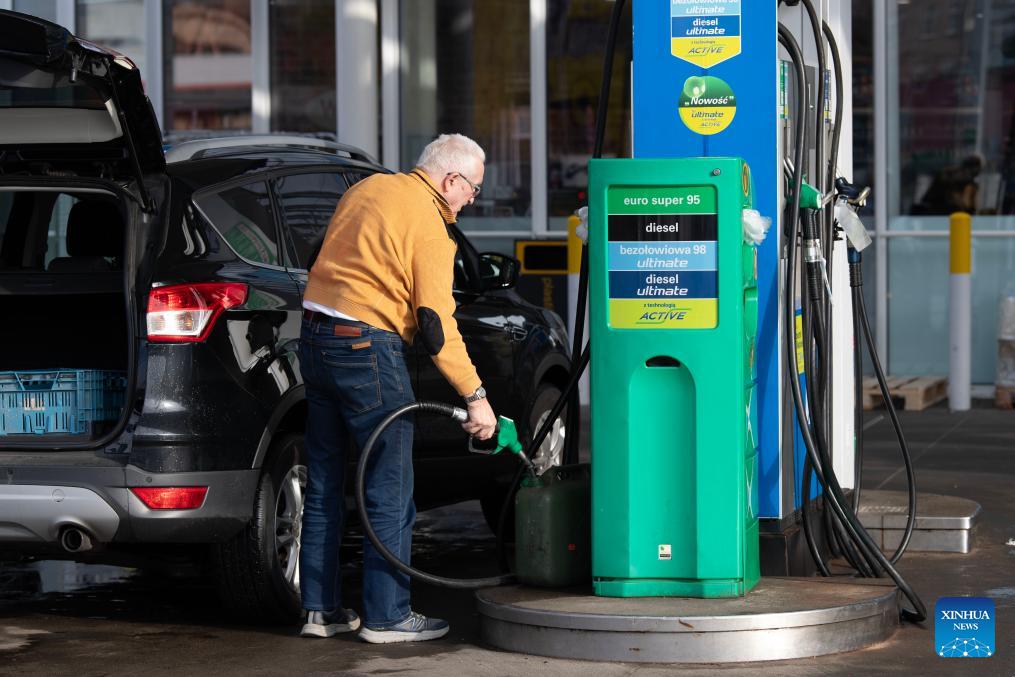
A German driver fills a gas can at a gas station in Slubice, Poland, March 16, 2026. (Photo: Xinhua/Zhang Haofu)
BERLIN, March 20 (Xinhua) -- As the sun sets over the Oder River, the contrast between the two sides of the border becomes strikingly clear. On the German side, gas stations remain mostly quiet. Just a few hundred meters across the bridge in Poland, however, pumps hum with activity -- most from cars bearing German license plates.
Since tensions in the Middle East escalated in late February, global energy markets have been on a significant surge. For Germans already grappling with a complex national energy transition, price hikes at fuel stations nowadays have added extra pain.
At a gas station near Berlin, filling just over half a tank of gasoline now costs 96 euros (about 111 U.S. dollars), up from roughly 70 euros before the U.S.-Israeli war against Iran.
In Frankfurt (Oder), a border city about 90 minutes' drive from Berlin, prices for diesel and gasoline have climbed to 2.149 and 2.029 euros (2.5 and 2.35 dollars) per liter, respectively.
"I'm only refueling here because it's a company car, so I need to comply with accounting and tax regulations," Markus, a local employee, told Xinhua at a gas station in Frankfurt (Oder). "If this were my private vehicle, I'd be across that bridge in a heartbeat. It's about 40 cents cheaper per liter over there."
Just a short distance across the bridge into the Polish town of Slubice, German drivers dominate the gas stations. With gasoline priced around 1.61 euros (1.86 dollars) per liter, the savings are hard to ignore.
"I just saved about 30 euros on a full tank," said Claudia, who works on the other side of the Oder River but drives to Poland to refuel. "Prices in Germany are rising too fast since the war started. Every euro counts right now."
For some, the trip has become more than just a quick stop -- it has evolved into a form of "fuel tourism."
Thomas Genoth, a publishing manager from Halle, Germany, drove over 200 km with his wife to Slubice.
"We fill the tank, buy groceries and household items that are cheaper here, and then enjoy a traditional Polish meal," Genoth said.
Having served in the military in the 1980s, he voiced frustration with the current geopolitical situation. "It feels like the energy pressure always ends up on ordinary people."
Xinhua correspondents observed in Slubice that, in addition to filling their tanks, some German drivers were also filling spare plastic containers with cheaper fuel.
In response, German authorities have stepped up oversight. Spot checks at border crossings are being conducted to curb the illegal transport of fuel. While drivers are free to fill their tanks, they are allowed to carry no more than 20 liters tax-free in additional canisters.
To shield consumers from rapid price fluctuations, the German government is fast-tracking a new relief package, including a proposal to allow gas stations to raise prices only once per day.
"The rising gas prices caused by the crisis in Iran are a concern for many," German Chancellor Friedrich Merz said on X, emphasizing the government's commitment to easing the burden on consumers.