


Austrian scientists have created the world's smallest QR code and they hope it will help revolutionize the way we store large amounts of data.
With a focused ion beam, the research team writes information that is smaller than bacteria and only visible under electron microscopes.
"The smallest bit size is roughly 40-50 nanometer in diameter," says Paul Mayrhofer, Professor of Materials Science at Vienna's Technical University. It's the world's tiniest QR code which has not only made it into the Guinness Book of Records but also sparked interest among big tech companies.
This method, on an area of a single sheet of paper, allows more than two terabytes of data to be stored. But it's not just the size that is of significance. The Austrian research team says the ceramic plate, on which the information is carved, offers unprecedented possibilities.
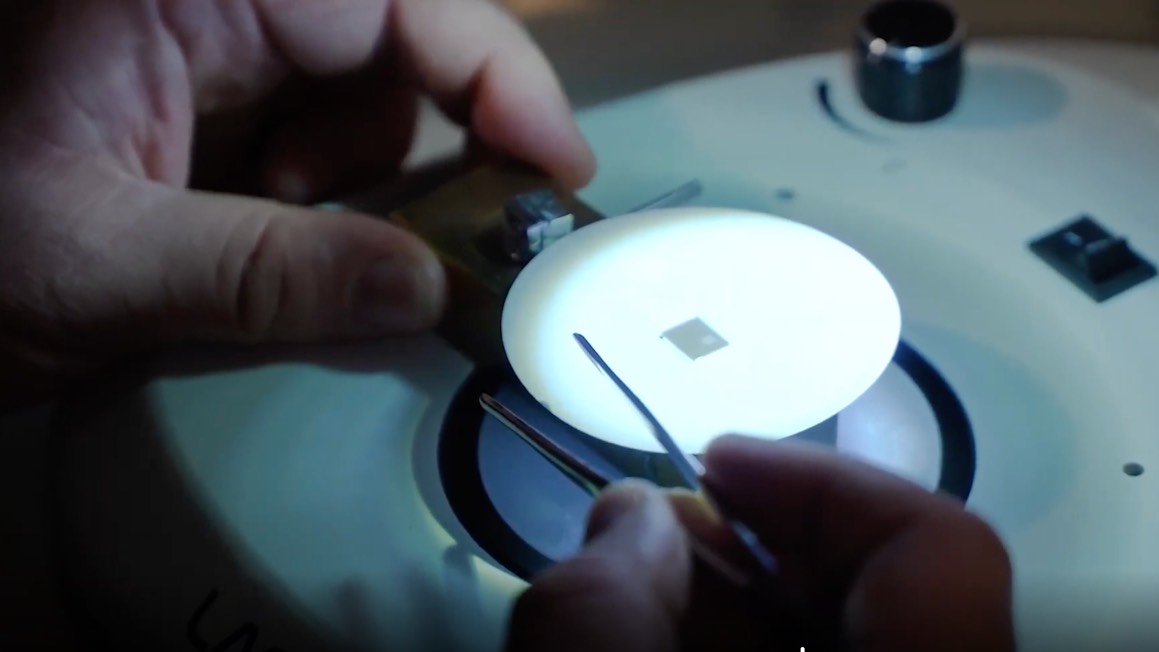
The ceramic plate, on which the information is carved, offers unprecedented possibilities. (Photo: CGTN)
Longer lifespan
"Metals will corrode, polymers will degrade by UV light, but ceramics are resistant," Mayrhofer says. "They can live for millions of years."
Until now, long-term data storage has been unreliable as conventional magnetic or electrical storage devices have a limited lifespan. The research team is now hoping more durable ceramic-inscribed codes will change that.
But for now the process needs further improvement as the current carving process proves too slow and energy-intensive for large-scale data storage. It's something the team is working on.
"For writing and reading, we of course need some energy and we want to lower that energy to a minimum," says the QR code project leader Alexander Kirnbauer. "Therefore new coating materials are necessary."
By increasing the contrast between the coating and the layer underneath, the team hopes to speed up the reading process.
Kimbauer says the new tech is already causing waves
"There is a lot of interest from the industry, also from large data centers like Google - they already showed interest in this technology," he added.
Once it has been refined and tested, it's hoped this new ceramic storage technology will not only be efficient and durable but also environmentally-friendly thanks to minimal energy consumption.