


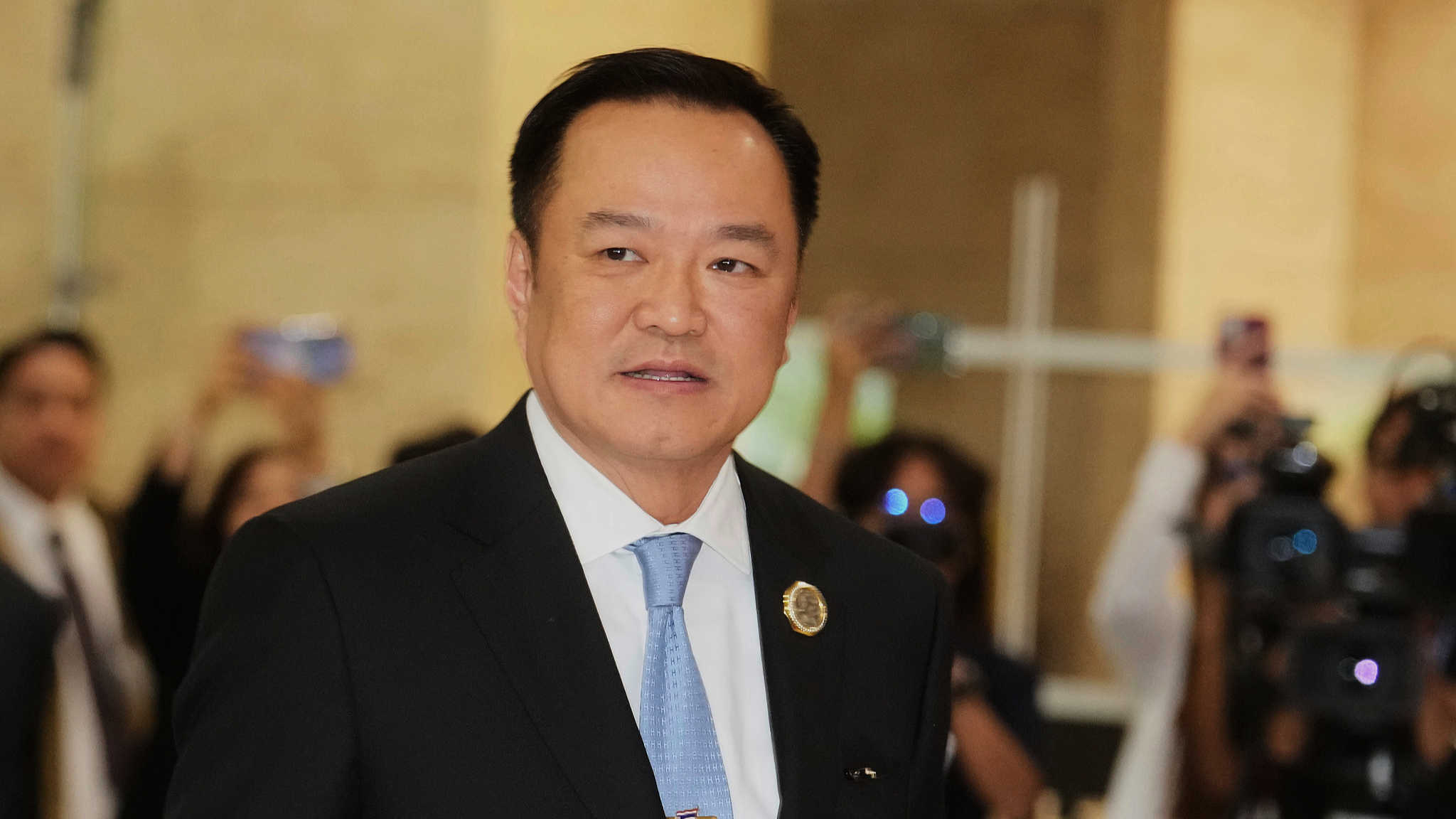
Anutin Charnvirakul arrives at parliament in Bangkok, Thailand, September 5, 2025. (Photo: VCG)
Thailand's Prime Minister Anutin Charnvirakul has secured a second term in office, but his nascent administration inherits a fractured political landscape and a volatile economy threatened by escalating Middle East conflicts.
While his commanding parliamentary victory signals a return to conservative-led stability, a looming energy crisis, structural economic stagnation, and existential legal threats cast a long shadow over the incoming government's viability.
FRAGMENTED COALITION
In a parliamentary session on Thursday, Anutin was re-elected with 293 votes in the 500-member House of Representatives, surpassing a required simple majority.
The 59-year-old Bhumjaithai Party leader comfortably defeated his sole competitor, the progressive People's Party candidate, Natthaphong Ruengpanyawut, who received 119 votes.
Anutin's majority support relied on a 16-party alliance, anchored by 187 votes from his party and 73 votes from its core partner, the Pheu Thai Party, supplemented by other small and micro parties.
The presence of 86 vote abstentions, mostly from the 58-seat Kla Tham Party, a former ally now excluded from the new coalition, and the Democrat Party, highlights potential fragilities and ongoing factional bargaining within the conservative-leaning alignment.
Public opinion appears cautiously optimistic about an end to political deadlock, though expectations for accountability remain high.
According to a nationwide survey published on March 15 by the National Institute of Development Administration, nearly 64 percent of respondents believe the Bhumjaithai-led government will maintain political stability.
However, the public also expects rigorous checks on executive power, as the same survey noted that over 53 percent of the public views the opposition bloc as efficient, with 17 percent identifying the People's Party as the primary source of pressure on the ruling coalition.
ENERGY SHOCK
The incoming administration's most urgent hurdle is an acute domestic fuel crisis triggered by the ongoing military escalation in the Middle East and the effective closure of the Strait of Hormuz.
Thailand depends extensively on imported fossil fuels, with approximately 50 percent of its crude oil and 30 percent of its liquefied natural gas transiting through the blocked strait.
On Thursday, right after his parliamentary confirmation, Anutin convened an urgent meeting to follow up on the matter.
During a press conference, Anutin pledged stricter legal controls to align refinery gate and retail prices and authorized 24-hour operations for fuel transport trucks to clear distribution bottlenecks.
He clarified that the widespread dry pumps were not caused by an actual shortfall in crude imports but rather by panic buying, which drove daily fuel consumption from a normal 67 million liters up to an unprecedented 84 million liters.
The industrial sector remains highly vulnerable. Kriengkrai Thiennukul, chairman of the Federation of Thai Industries, warned that the energy crisis could drive production costs up by as much as 50 percent for heavy industries.
He noted that independent oil distributors are facing severe liquidity crises, restricting fuel access for rural farming and manufacturing sectors.
The Thailand Consumer Council warned on Wednesday that businesses will inevitably pass these skyrocketing production and logistics costs onto consumers within one to three months, leading to noticeable increases in the prices of ready-to-eat meals, construction materials, and essential goods.
ECONOMIC WOES
The energy shock threatens to tip an already fragile economy into stagflation. Thailand's economy is weighed down by deep structural issues, notably an accelerating aging population and a household debt ratio that currently hovers near 90 percent of the kingdom's gross domestic product.
With the International Monetary Fund predicting a sluggish 1.6 percent economic growth rate for 2026, the new administration is banking on the return of the co-payment subsidy program to stimulate depressed domestic consumption and ease the cost of living.
The initiative will provide 2,000 baht to non-taxpayers and 2,400 baht to taxpayers via a digital wallet to subsidize 50 percent of daily consumer purchases.
Experts warn that voters will ultimately prioritize stability and continuity, requiring the government to address deeper structural reforms rather than relying solely on state budget allocations.
To counter these structural challenges, Anutin's Bhumjaithai Party in February unveiled core economic policies, proposing a shift toward "economic security," focusing on electric vehicles, medical services, biotechnology, and the digital economy.
The government aims to unlock 480 billion baht in private investment through the Board of Investment "Fast Pass" mechanism, intended to streamline regulatory approvals for foreign direct investment.
However, the success of this technocratic agenda is conditioned on the government's ability to "break up monopolies," a commitment that skeptics argue will be difficult to fulfill given the party's deep ties to the very elites it would need to challenge.
SCENARIOS AHEAD
The new government is taking shape, following the royal endorsement of Anutin's second term in office as the Southeast Asian nation's 32nd prime minister on Friday.
According to a constitutional roadmap, the formation of the new cabinet and the vetting of ministers' qualifications are expected to be completed in April.
The incoming government will then deliver its policy statement to parliament and formally begin administering the country.
However, a judicial setback threatens this timeline. On Wednesday, Thailand's Constitutional Court voted 6-3 to accept a petition questioning the legality of ballot papers used in the February general election.
The petition alleges that barcodes and QR codes printed on the ballots could potentially be used to trace voter identities and their selections, violating the constitutional right to ballot secrecy.
A court ruling against the Election Commission could result in the annulment of the Feb. 8 election and the calling of a new poll.
As Anutin transitions from caretaker prime minister to a fully mandated leader, his second administration begins its tenure caught between a clear parliamentary mandate and intense macroeconomic headwinds.
The government's immediate survival will hinge largely on its ability to stabilize the domestic fuel supply, manage the Oil Fuel Fund deficit, and prevent the energy shock from triggering runaway inflation.
However, the administration's long-term stability remains highly contingent on navigating a fragmented coalition, surviving legal challenges, and effectively addressing the deep-seated structural debt issues dragging down the Thai economy.