


The US-Israel-Iran conflict entered its 24th day with no end in sight, as Iran defied US threats while Israel weighed operations in Iran and Lebanon expected to last several weeks. 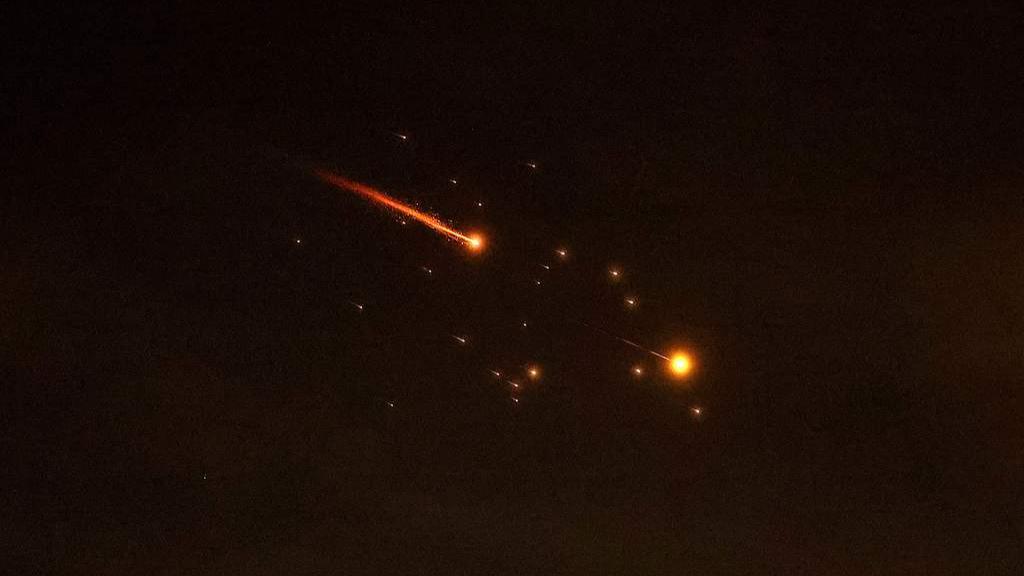
Rocket trails are seen in the sky amid a fresh barrage of Iranian missile attacks above the Israeli coastal city of Netanya, March 23, 2026. (Photo: VCG)
Iran's Islamic Revolution Guards Corps (IRGC) has launched the 75th wave of Operation True Promise 4, targeting Israeli military sites and US Prince Sultan Air Base in Al-Kharj, Saudi Arabia, according to Iranian news network Press TV.
The ongoing conflict is facing a critical period as US President Donald Trump threatened on Saturday evening to hit Iran's electricity grid in 48 hours if the country did not fully open the Strait of Hormuz.
Iran says Strait of Hormuz 'not blocked'
Elaborating on its stance, Iran's Foreign Ministry issued a statement on Sunday, asserting that the Strait of Hormuz is not blocked and navigation continues, though necessary measures have been implemented due to wartime conditions.
The ministry noted that following the US and Israeli military "aggression" against Iran, a dangerous situation has been imposed on the Gulf and the Strait of Hormuz, directly impacting regional shipping safety and security.
Claiming its legitimate right to self-defense against the "aggressors," Iran has targeted US military bases and facilities in the region while adopting a series of measures to ensure that the "aggressors" and their supporters do not exploit the strait to advance their aggressive goals against the country, it said.
The ministry confirmed that Iran has prevented the passage of vessels belonging to or affiliated with "the aggressors" and those participating in "the aggressions" in accordance with the established principles of international law.
Non-hostile vessels belonging to or associated with other countries, it said, can secure safe passage through the strait in coordination with Iranian authorities, provided they have not participated in or supported aggressive actions against Iran and comply with the announced safety and security regulations.
It stressed that the full restoration of sustainable security and stability to the strait requires an end to the anti-Iran military aggression and threats, a halt to the destabilizing actions of the United States and Israel, and full respect for Iran's legitimate interests.
Possible tit-for-tat strikes on civilian infrastructure
Iran said on Sunday it would strike the energy and water systems of its Gulf neighbors in retaliation if the US threats are carried out.
The statement also said Iran would immediately adopt several punitive measures, including the full closure of the Strait of Hormuz, until damaged Iranian facilities are rebuilt and attacks on regional companies with US capital ties.
The prospect of tit-for-tat strikes on civilian infrastructure could threaten the livelihoods of millions of civilians in the region who rely almost exclusively in some cases on desalination plants for water.
For Iran's Gulf neighbors, electricity makes their gleaming desert cities habitable, in part by powering the desalination plants that produce 100% of the water consumed in Bahrain and Qatar. Such plants use seawater to meet more than 80% of drinking water needs in the United Arab Emirates, and 50% of the water supply in Saudi Arabia.
In an interview with CMG, Su Xiaohui, an international affairs expert, said Iran's threats also serve as a warning to regional countries. Su went on to explain that when the US and Israel further expand their military actions, and Iran is forced into a do-or-die situation, it would also mean enormous losses for the regional states.
Su added that Iran hopes that this will prompt these countries to exert greater influence over US and Israeli actions, preventing them from escalating operations that would inflict further attacks and related damage on Iran.
The US Department of State has advised Americans worldwide, and especially in the Middle East, to exercise increased caution.
Israel expects 'weeks more of fighting'
Israeli military spokesperson Effie Defrin said in a press briefing on Sunday that Israel continues to hit Iran nonstop and expects "weeks more of fighting against Iran and Hezbollah."
"The air force is operating relentlessly," Defrin said, adding that since the start of the joint campaign with the US on February 28, Israel had dropped more than 10,000 munitions on "thousands of targets" across Iran.
"We continue attacking all of the regime's systems, infrastructure and commanders," he said.
Hezbollah has fired hundreds of rockets at Israel since it entered the regional war on March 2, prompting an Israeli offensive that has killed more than 1,000 people in Lebanon.
Israel said it had instructed the military to accelerate the demolition of Lebanese homes in "frontline villages" to end threats to Israelis, and to destroy all bridges over Lebanon's Litani River which it said were used for "terrorist activity."