


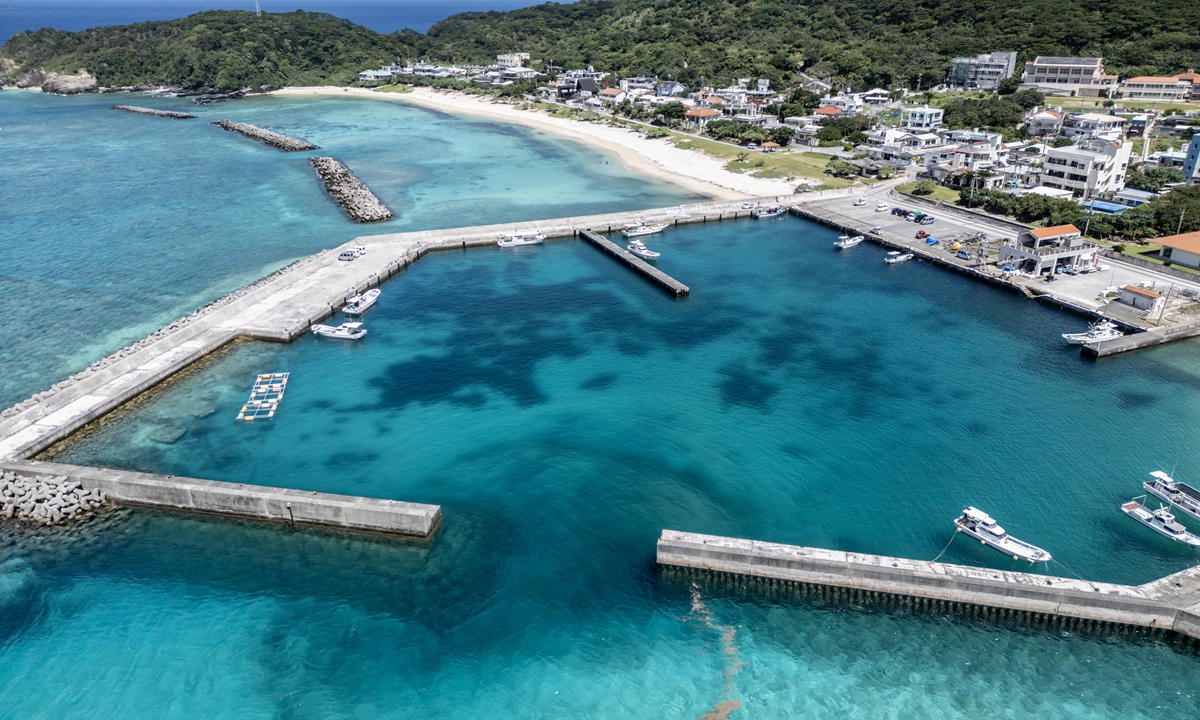
Aka Island, the westernmost island in the Kerama Islands, is part of the Ryukyu Islands. (Photo: VCG)
Under the pretext of strengthening the defensive capability of its Southwest Islands, Japan is effectively making another move abandoning its post-WWII defensive posture.
The Japan Self-Defense Forces (SDF) implemented a reorganization of its major units on Monday, including the establishment of the Fleet Surface Force, while Japanese media outlets claiming the move was made with China in mind. A Chinese expert said the restructuring shows clear offensive and outward-oriented traits, which could fuel an arms race in East Asia and undermine the post-WWII international order.
Among the key changes, the Japan Maritime Self-Defense Force (MSDF) established the Fleet Surface Force including minesweepers and transport vessel with a newly created Amphibious Mine Warfare Group under the unit. The report by Japanese media outlet Kyodo News noted that the move is intended to strengthen the defensive capabilities of the Southwest Islands with China in mind.
According to the report by the Chunichi Shimbun on Monday, the welcome ceremony for the MSDF 's new unit, the Amphibious Mine Warfare Group, held at the port in the morning in Sasebo. About 200 people, including US Navy personnel and local government officials, attended the ceremony held on the day, per the report.
The reorganization marks a key step for the SDF's shift from exclusive defense to cross-domain operations, targeting strengthened defense of the Ryukyu Islands with China in mind, Xiang Haoyu, a distinguished research fellow at the China Institute of International Studies, told the Global Times on Monday.
The unit could also coordinate with the Amphibious Rapid Deployment Brigade of Ground Self-Defense Force (GSDF), which specializes in island defense and is also stationed in Sasebo, according to the Kyodo report, which the Chinese expert highlighted has the strategic geographic intent, noting that Sasebo is Japan's key gateway to the East China Sea and hosts a major US military base, further deepening Japan-US military integration.
By establishing the Fleet Surface Force and its subordinate Amphibious Mine Warfare Group, the MSDF integrates sea control, mine countermeasures and amphibious lift into a unified operational chain, while coordinating closely with the GSDF Amphibious Rapid Deployment Brigade to form an integrated sea-shore-island defense network, Xiang added.
While the MSDF abolished its Fleet Escort Force and Mine Warfare Force, reorganizing them into a Fleet Surface Force to achieve unified command, which was described as a response to the strained availability of vessels and personnel amid growing alert and patrol operations, Kyodo reported, the expert said that the adjustment serves as a pretext for targeting China.
The true aim behind it is to establish a rapid-response force targeting China's Taiwan Straits and the Diaoyu Dao. Combined with the deployment plan of the upgraded Type-12 anti-ship missiles, it attempts to create a multi-layered chain of defense to block the Chinese Navy's access to the Pacific, Xiang said.
Characterized as another reorganization, the Japan Air Self-Defense Force (ASDF) will also establish the Space Operations Wing, according to the official website of Japan's Ministry of Defense. The Space Operations Group, which currently has approximately 310 personnel engaged in outer space monitoring, among other operations, will be expanded to approximately 670 personnel as a unit specializing in space. It also includes the reorganization of the ASDF into the Air and Space Self-Defense Force.
Expert pointed out that such moves could fuel an arms race in East Asia, complicate the Taiwan Straits and Diaoyu Dao situations, disrupt regional strategic balance, prepare Japan for possible involvement in a Taiwan Straits conflict, and contravene its pacifist constitution and undermine post-WWII international order.
A report by The Diplomat noted that the restructure, described internally as a "complete scrap-and-build" of Japan's surface forces, goes far beyond a mere rebranding. Yet the overhaul has prompted unusually candid criticism from retired officers and defense analysts. Their concerns center on three issues: redundancy, personnel strain and command clarity, per the report.
Beyond these operational concerns, the Chinese expert warned that restructuring this time has effectively broken through the core principle of exclusive defense, demonstrating clear offensive and outward-oriented traits. "The principle of exclusive defense has been completely hollowed out," he noted.
Listing some basic facts regarding Japan's faster moves to remilitarize itself, Chinese Foreign Ministry spokesperson Lin Jian said during a February press conference that the lessons of the history are still fresh in memory.
"China and all other peace-loving countries must jointly reject the Japanese right-wing forces' ambitions to remilitarize Japan and defend the outcomes of the WWII victory and hard-won peace in the world," he added.