


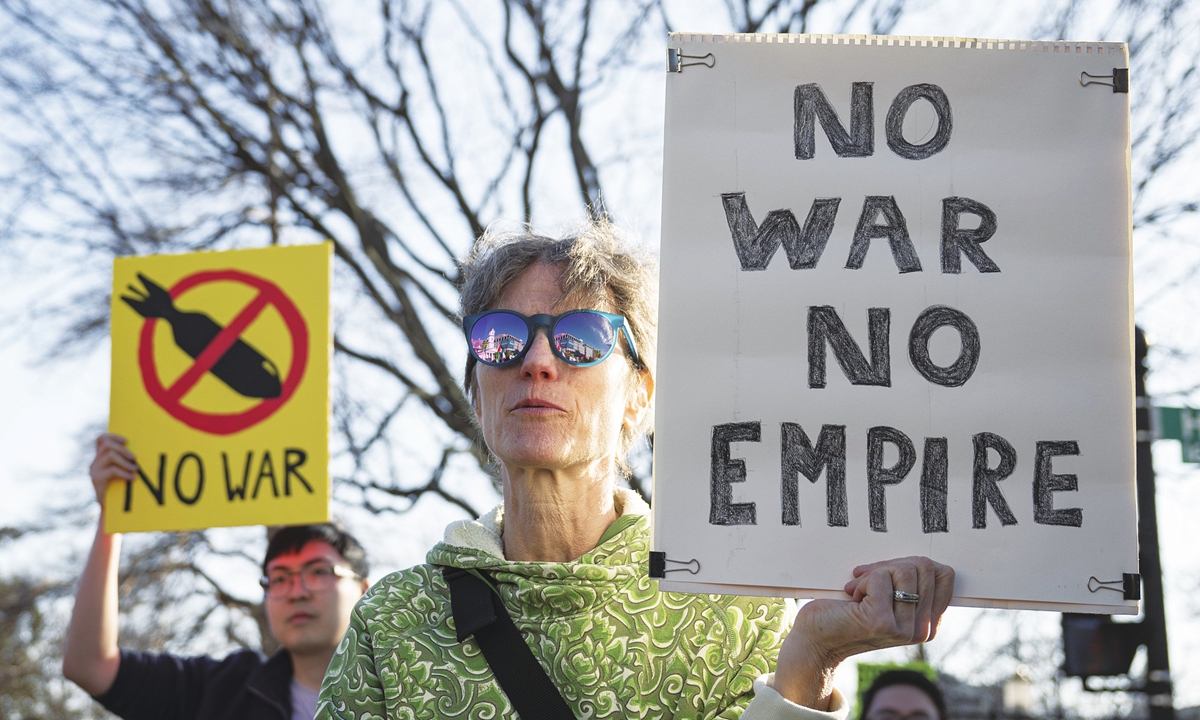
Protesters gather outside the White House in Washington, D.C. to demonstrate against US and Israeli attacks on Iran on March 7, 2026. (Photo: VCG)
Renato Peneluppi, director of the Brazilian Citizens Council in Beijing and member of the Center for China and Globalization
For two centuries, US policy toward Latin America has contradicted its democratic rhetoric by subordinating regional sovereignty to strategic interests. US scholar Stephen Walt's "predatory hegemony" describes how Washington now treats allies and rivals alike as instruments for short-term advantage rather than partners in a cooperative international order.
Predatory hegemony - the systematic exploitation of global institutions, norms and partnerships by a dominant state to extract unilateral advantage - is far from sustaining genuine cooperation. This form of power subordinates sovereignty and entrenches structural inequalities, leaving peripheral states to navigate a system designed against their interests. One of its most enduring expressions is the relentless drive by external powers to appropriate the natural wealth of the Global South - critical minerals, rare earths, strategic energy resources - without allowing the value to be retained, processed or transformed within the territories that hold them.
Now, the Global South has begun to reinterpret long-standing power asymmetries. In an increasingly multipolar world, this reckoning is no longer merely academic - it is a call to reimagine the terms on which nations engage, resist and ultimately reshape the order that governs them all.
Historically, US leadership evolved through phases. During the Cold War, Washington supported European reconstruction while backing authoritarian regimes in Latin America - including Brazil's 1964 coup and Operation Condor - revealing how geopolitical calculations trumped democratic principles.
The US later structured globalization through institutions and financial mechanisms that reinforced the centrality of the dollar. Within this structure, the Washington Consensus promoted neoliberal reforms across Latin America, encouraging market liberalization and privatization while deepening economic asymmetries. Many countries remained suppliers of raw materials, while technological and financial value became concentrated in advanced economies closely integrated with the dollar-centered system.
In recent years, however, this model has taken a more explicitly predatory turn. Instead of reinforcing shared rules, US policy increasingly instrumentalizes international norms to advance unilateral objectives. Trade regimes, sanctions mechanisms and security frameworks are deployed selectively, transforming what were once framed as global public goods into strategic tools of influence.
Latin America provides several contemporary illustrations of this dynamic. The persistence of the US embargo against Cuba - maintained despite decades of near-unanimous condemnation in the UN - illustrates how unilateral economic pressure can override multilateral consensus, applying international rules selectively according to geopolitical alignment.
Military cooperation further extends this strategic footprint. Agreements enabling troop deployments in Paraguay and the framing of regional crises through "narco-terrorism" narratives, such as in Ecuador's recent security escalation, risk normalizing expanded external security structures under the banner of legitimate regional concerns.
Together, these cases demonstrate how Washington's strategic use of existing rules transforms global norms into instruments of unilateral advantage. Predatory hegemony operates not only through direct coercion but also through structural influence over political, economic and security frameworks.
When the architect of global institutions applies rules selectively for unilateral advantage, confidence in those frameworks weakens - transforming structures designed for cooperation into mechanisms of instability and mistrust. Ultimately, predatory hegemony contains the seeds of its own decline. By prioritizing short-term advantage over shared rules, Washington accelerates the diversification and strategic autonomy it seeks to prevent.
Jan Oberg, director of the Sweden-based think tank Transnational Foundation for Peace & Future ResearchThe moral image and perceived legitimacy of the US haven't been this low since 1945. There are many perspectives on this unique situation.
First, despite its skill in marketing itself as a global force for good, it is striking how long it has taken for many to recognize a sad truth: The US has consistently acted as an exceptionalist imperial power, as the most war-fighting country in contemporary history and a self-appointed global policeman.
If empires are not predatory from the outset, they become so over time. Alongside economic exploitation and fragmentation, the US empire has relied heavily on military power.
Second, what the world is witnessing are the final systemic spasms of that empire. No one wants to repeat what the West has long done: universalizing its own norms while undermining them at home, from media freedom to democratic consultation. Fortunately, the world of one system and one truth is over.
Empires have always fallen. Macro-historical indicators include over-militarization, over-extension, declining legitimacy, shrinking cultural influence and a compulsive urge to lecture others - while remaining unable to learn from one's own failures or from others. Any system's No.1 is bound to decline if it lacks humility, empathy and adaptability.
The third perspective is that, in this Titanic-like phase of decline, the undemocratic regime's central logic is militarized resource control. The US has secured influence over Ukraine's resources; it "wants" Greenland and Canada; and it has already forcefully appropriated resources in Venezuela and along Gaza's coast. Its current war on Iran can likewise be seen as driven by a wishful ambition to control the country's vast resources. This is doomed to fail, but at an enormous cost. What is the purpose of this resource-grabbing? To secure the future of the US when the world has basically turned its back to it. One might call this a "United States of Autarchy," seeking to replace interdependence and cooperation with a seemingly self-sufficient empire - sacrificing lives, international norms and laws for material satisfaction. Yet, this vision is ultimately delusional, as the rest of the world moves toward interdependence and deeper mutually beneficial cooperation.
Those best placed to help the US empire go down with a whimper rather than a bang - its European allies - have regrettably failed. The EU and Euro-NATO, despite their rich history, culture and resources, have never become a "New Benevolent West." They still see the US as "the Father."
Can anything soften this rather dark scenario? In my view, at least two factors could. A broad, pan-Western movement of nonviolent resistance and civil disobedience against US policies, especially militarism, and the continued and accelerated cooperation of the non-Western world.