



An Iranian man carrying loaves of bread walks past an anti-US mural featuring Iran-US talks, next to the former US embassy in Tehran, Iran, February 26, 2026. /VCG
Just four days before the conflict involving the United States, Israel and Iran reaches its one-month mark, new reports have emerged that Washington has delivered a 15-point ceasefire proposal to Tehran via Pakistan and is floating a one-month truce to pave the way for negotiations.
Meanwhile, Iran has doubled down on its position, insisting the only way to end the war is by recognizing Iran's legitimate rights, providing war reparations and securing firm international guarantees against future acts of aggression.
Washington and Tehran have put forward sharply competing terms, creating deep divisions that make a diplomatic breakthrough highly uncertain, according to Middle East experts.
Under the current circumstances, conditions for US-Iran dialogue are not yet mature, Wang Jin, director of the Center for Strategic Studies at Northwest University in China, told CGTN on Wednesday.
Israel's hard-line opposition to any early truce could threaten to further complicate efforts to defuse one of the Middle East's most dangerous confrontations in years, said Yu Guoqing, executive director of the Chinese Association of Middle East Studies and a researcher at the Chinese Academy of Social Sciences' Institute of West Asia and African Studies.
Here are CGTN's conversations with the two experts, edited for clarity and conciseness.
CGTN: The US-Iran negotiation process appears caught in a Rashomon-style contradiction: Washington has signaled its willingness to negotiate, while Tehran has denied any serious talks were underway. The Trump administration is widely viewed as more eager for talks. How do you view this contrast? Have the two sides launched substantive negotiations? What are the core considerations behind their differing public positions?
Wang: I do not believe the two sides have begun substantive negotiations.
Third parties may be helping mediate and convey messages, yet given that the two sides can hardly bridge their differences in the short term, substantial dialogue is unlikely, especially direct high-level talks as claimed by the US side.
Yu: The positions of the US, Israel and Iran regarding the conflict and a potential ceasefire contain a mix of genuine and tactical signals, with information sources updating rapidly by the hour. Careful vetting of such information is therefore very necessary.
Generally speaking, both the US and Iran are seeking a ceasefire or temporary end to hostilities and seeking to hold negotiations. The US appears more urgent in its stance, as it currently faces multiple challenges, including domestic political pressures, constraints on military mobilization and limited ability to sustain ongoing combat operations. For these reasons, it has taken a more proactive approach.
CGTN: The US has reportedly delivered a 15-point peace plan to Iran via Pakistan, covering Iran's nuclear program, missile capabilities and regional activities. For its part, Iran has reaffirmed that it will only end hostilities in exchange for full war reparations, the complete lifting of economic sanctions and internationally binding guarantees against future US interference in its internal affairs. What irreconcilable differences exist between their core demands? How likely is a negotiated consensus?
Wang: The core root of the disagreement between the US and Iran lies in their conflicting understandings of the cause of the current war, which has led to divergent views on accountability and contrasting positions.
Iran holds that the war was provoked by the US and Israel, and therefore Washington and Tel Aviv should bear the losses and provide compensation.
The US and Israel, however, particularly the US, believe the war stems from bilateral disputes and that the priority should be resolving those differences.
Yu: This gets to the heart of the issue. The gaps between US and Iranian demands, most of which have been previously reported, remain very wide.
The US, according to media reports, has proposed a one-month ceasefire as a basis for negotiations with Iran, centered on a 15-point plan that can be divided into four main areas:
First, Iran must dismantle its existing nuclear capabilities, pledge not to develop nuclear weapons, ban uranium enrichment activities on its territory and surrender its stockpile of 60% enriched uranium, reportedly around 400 kg, which Washington has long sought to control.
Second, the US demands that Iran halt support for its allies, including Hamas, Hezbollah, Iraqi militia factions and the Houthi movement.
Third, Iran must limit the size and range of its ballistic missile program, particularly missiles capable of striking Israel and those with a range exceeding 1,500 kilometers.
Fourth, and most urgently for the US, Iran must lift any blockade of the Strait of Hormuz and ensure normal navigation through the strategic waterway.
For its part, Iran's core conditions for ending the war could be understood through the following four aspects:
First, the US and Israel must permanently end hostilities and not use negotiations or a ceasefire to rearm for future attacks.
Second, Iran is entitled to war reparations, as it views that the war was initiated first by Israel and the United States.
Third, the US must fully lift all economic sanctions against Iran.
Fourth, the US must not interfere in Iran's internal affairs, especially attempts aimed at regime change, something Tehran would not accept.
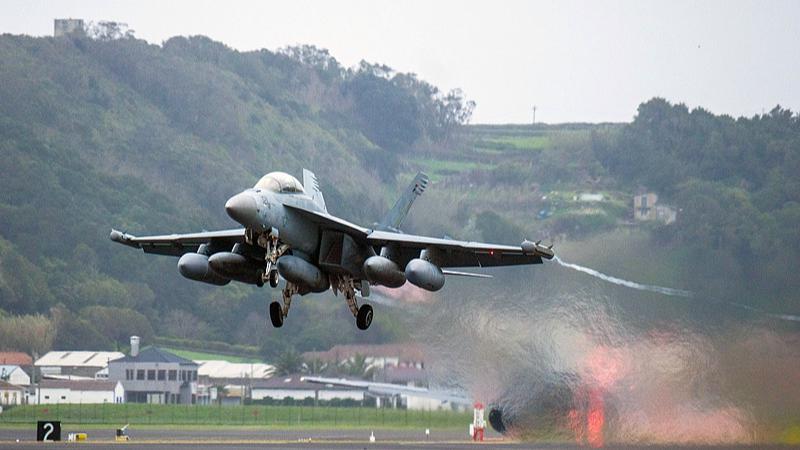
A military aircraft at the Lajes Air Base in Praia da Vitoria, Terceira Island, in the Azores archipelago, Portugal, March 21, 2026. Due to its location in the mid-Atlantic, the base has become a central logistical hub for the US, seeing the largest deployment of US aircraft since its military operations began in Iran on February 28, 2026. /VCG
CGTN: The US military reportedly continues to deploy additional forces to the Middle East, while Iran presses ahead with military operations. Does the simultaneous pursuit of military confrontation and diplomatic overtures contradict the signals for negotiations? What objectives do both sides aim to achieve through this "talk-and-fight" strategy?
Wang: Washington seeks to use military pressure to force Iran into concessions. For Iran, the current conflict is viewed as a critical war to safeguard national security. These differing perspectives have resulted in contrasting attitudes toward the war.
The US hopes to gain an opportunity for dialogue with Iran by combining pressure with diplomatic overtures. Iran, by contrast, is determined to eliminate the military threat from the US and Israel to the greatest extent possible through military counterattacks. Under the current circumstances, conditions for dialogue are not yet mature.
Yu: On one hand, the US has repeatedly leaked information claiming Iran has agreed to negotiations, that it has engaged with third parties and that talks are imminent. Pakistan has also signaled it could arrange US-Iran meetings. On the other hand, US military operations have continued unabated, with advanced US amphibious assault ships approaching Iran's coasts.
According to reports, the US was weighing landing operations to seize Kharg Island, Iran's critical energy hub, which lies approximately 25 kilometers from the Iranian mainland. Gaining control of this strategic Persian Gulf energy base would allow Washington to exert intense political and military pressure on Tehran.
In effect, US military operations amount to maximum pressure designed to force Iran into surrender-style concessions.
Whether a major ground offensive will be launched likely depends on the progress of upcoming negotiations. Ground operations remain an option under the Trump administration, but whether they materialize requires further observation over time.
CGTN: Although Israel is not directly involved in the US-Iran negotiation initiative, it has long maintained a hard-line stance on Iran's nuclear program and regional activities. What role does Israel play in this process, and how will it influence the course of US-Iran negotiations?
Wang: Israel's position differs from that of the United States. Israel seeks to weaken Iran as much as possible or bring about regime change in the country, which explains the gap between Washington and Tel Aviv in their determination to continue the war.
Nevertheless, since the US is the main driving force behind the current conflict, Israel may offer opinions and suggestions, but the ultimate decision-making power still rests with the US side.
Yu: Israel has been a main planner and driver of the current conflict and effectively dragged the US into joint military action against Iran. Its position is therefore a key factor determining whether the war can end soon.
Multiple recent reports indicate Israel is not eager for an immediate ceasefire, especially before achieving its core strategic objectives. Its main demands include:
First, permanently and completely eliminating Iran's nuclear capabilities, including existing enriched uranium stockpiles and potential nuclear infrastructure.
Second, fully destroying Iran's existing and potential ballistic missile capabilities so that Iran can no longer strike Israeli territory from the air.
Third, cutting off all Iranian support for Hamas, Hezbollah, the Houthi movement, and Iraqi militia factions and ending Iran's anti-Israel military activities abroad.
And fourth, bringing about political change in Iran, ending the hostile posture toward Israel that has existed since the Islamic Revolution.
These strategic goals are highly unlikely to be achieved in the short term, which explains why Israel is reluctant to end military operations immediately.
If US-Iran ceasefire negotiations proceed in the coming period, it cannot be ruled out that Washington and Tehran may first announce a truce and follow-up measures. However, Israel might say it will reserve the right to launch further unilateral military strikes against Iran.