


ISTANBUL, March 27 (Xinhua) -- Behind a glowing screen in Istanbul, 61-year-old puppeteer Cengiz Ozek brings the centuries-old Karagoz shadow play to life, marking World Theatre Day with flickering figures that bridge tradition and imagination.
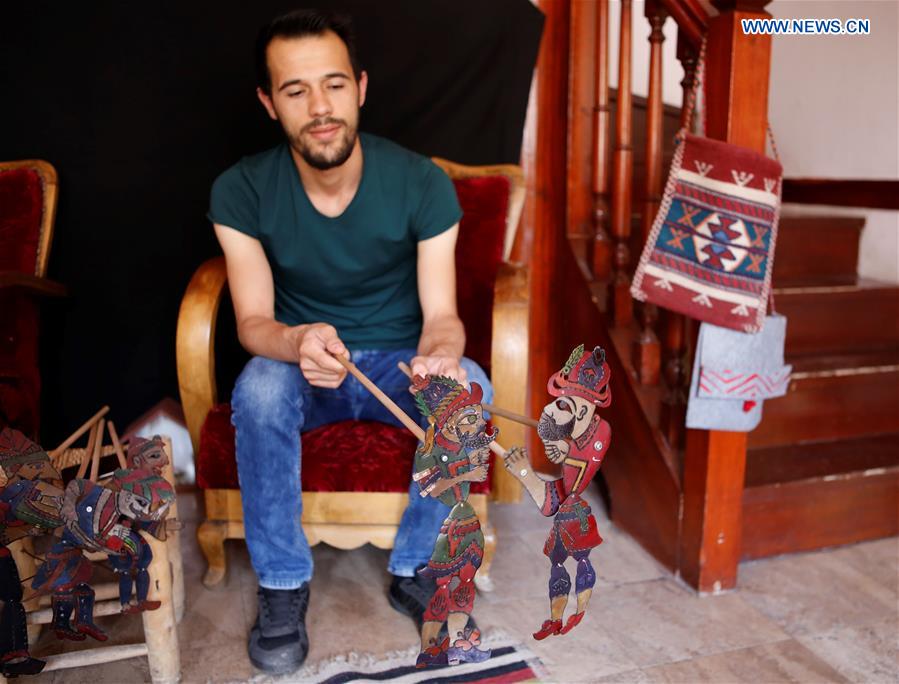
An artist shows the puppets of traditional shadow puppet show in Ankara, Turkey, on July 25, 2018. (File photo: Xinhua)
Recognized by UNESCO as an Intangible Cultural Heritage of Humanity, Karagoz, an art form rooted in the ancient traditions of East Asia and refined during the Ottoman Empire, continues to evolve while preserving its deep-rooted Eurasian character.
For Ozek, a master of Ottoman miniature painting turned puppeteer, the journey to the shadow screen was a natural progression. Having spent a lifetime immersed in classical aesthetics, he sees the flickering shadows of Karagoz as a rhythmic extension of a much older "silent" art.
"My starting point wasn't actually Karagoz; it was the silent art of Ottoman palace miniatures," Ozek told Xinhua. Traditionally static, these hand-painted illustrations gain movement, sound, and a sense of time through shadow play.
As the founder of the Istanbul Karagoz Puppet Foundation, Ozek is working to establish the Istanbul Puppet Museum and Theatre, a project aimed at creating a permanent home for this ancient craft.
To keep this shadow play alive, Ozek confronts modern "monsters." Among his creations is the Garbage Monster, a figure symbolizing environmental degradation and the pressures of megacities. "The audience laughs, but they also think," Ozek noted. "This is the modern adaptation of traditional satire."
Beyond Istanbul, Ozek views Karagoz as a vessel for cultural memory. He draws a fascinating parallel between the mythical "Vakvak tree" of Islamic lore and the "Ginseng Fruit" from the Chinese classical masterpiece Journey to the West.
In Karagoz performances, the Vakvak tree, a mythical plant bearing human-headed fruits, appears as a decorative set piece that greets the audience, signaling that the stage is a gateway to a mystical universe.
For Ozek, the Vakvak tree represents the "strangeness of the outer world" and the mystery of the unknown, while the Chinese ginseng fruit reflects the "infinity of the inner world" and the search for eternal life. "I feel as if two different worlds are intersecting in the same dream," Ozek said.
"If I were to paint these two trees, I would place one on a misty, dark island and the other in a silent, light-filled garden. Between them stands the human being, looking toward the unknown while searching for eternity," he said.
This connection is also visible in the design of the puppets themselves. A common pattern in Karagoz costumes is the "Chinese Cloud," a stylized, curling motif that traveled from East Asia to Anatolia centuries ago.
"Anatolian tales are part of a shared Eurasian culture," he said. "Seeing a Chinese cloud motif on a Turkish shadow puppet reminds us that our traditional arts were shaped by undeniable interactions with Chinese civilization."