


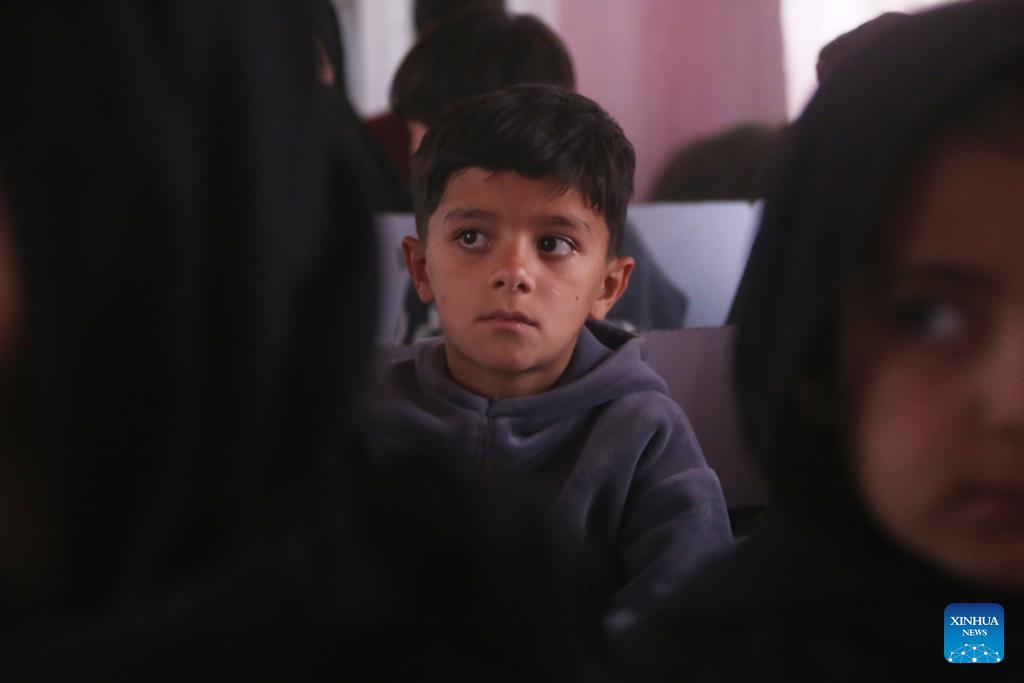
An Afghan child attends a class at an educational center in Kabul, Afghanistan, March 26, 2026. (Photo: Xinhua)
KABUL, March 28 (Xinhua) -- In a modest neighborhood of Kabul, a quiet transformation is taking place, not through large institutions or international funding, but through the determination of a small group of young people who refuse to let poverty define the future of their community.
Inside a small classroom, children sit closely together, repeating words with focus and excitement. Their notebooks may be simple, but their dreams are not.
"I came here to study English and to become a doctor in the future," 12-year-old Sana, who studies at the center with her two sisters, said.
The classroom is part of a network of free educational centers founded by 29-year-old doctor Ehsanullah Abedi and a group of young Afghan graduates who have turned their education into a means of service, proving that even with limited means, a determined community can shape a better future for its children.
After completing their studies and working in hospitals, they chose a different path. Rather than focusing only on personal careers, they began saving money to establish small, community-based education centers for those who could not afford to study.
"We are very satisfied with our teachers, as most of them cooperate with us either for very small payments or on a voluntary basis," Abedi said. "At these centers, students receive instruction in core school subjects and foreign languages."
For many parents in this area, education remains out of reach, a difficult reality that weighs heavily on those who want a better future for their children. For these families, watching their children learn brings a sense of relief and a renewed belief that their children's future can be different.
What began as a modest effort has grown into four centers across Kabul, now serving around 2,000 students, nearly 1,500 of whom are girls.
Marwa, 9, smiles as she expresses her satisfaction with her teachers. Encouraged by her family, she attends the center to learn English. "I have been coming here for two years to study English, and my family and I are very happy."
A defining feature of the initiative is that all services are offered free of charge. Books, lessons, and learning materials are provided at no cost, removing a major barrier faced by low-income families.
"In many households, if there are several children, the family can only afford to educate one," Salma Ahmadi, a 28-year-old civil engineering graduate who has been teaching at the center voluntarily for three years, told Xinhua. "Considering the conditions in this area, we decided to teach all subjects for free."
The effort is sustained through collective support. Local residents contribute by reducing rental costs for the buildings, while the founders continue to invest their time and personal savings.
Classes are typically held for one to two hours per subject, but they are marked by strong engagement and a clear sense of purpose. For students, each lesson represents progress; for teachers, it is a commitment to service.
Beyond academics, the centers provide an important social space, particularly for girls. They offer a supportive environment where students can learn, interact, and build confidence.
Ahmadi said the impact goes beyond education. "I feel very happy because these activities give them hope for the future and reduce psychological pressure," she said. "Many girls who stay at home suffer from mental stress, but by learning skills like tailoring and other crafts, they gain both a skill and a potential source of income."
In addition to academic subjects, students are introduced to practical and creative skills such as tailoring, drawing, and painting, helping them develop both confidence and potential pathways for future income.
The long-term impact of the initiative is also reflected in its continuity. Some students, after completing their studies, return to the centers as teachers, contributing to the same system that once supported them.
"We are a group working voluntarily, without any external funding, offering free education purely for the benefit of the community," Abedi said.
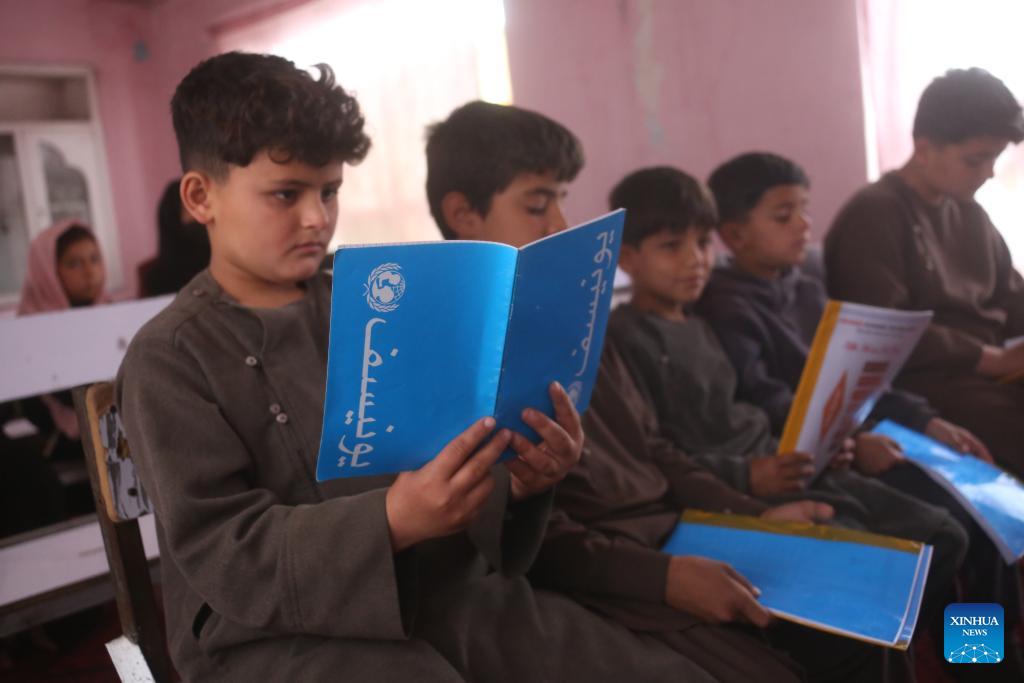
Afghan children attend a class at an educational center in Kabul, Afghanistan, March 26, 2026. (Photo by Saifurahman Safi/Xinhua)
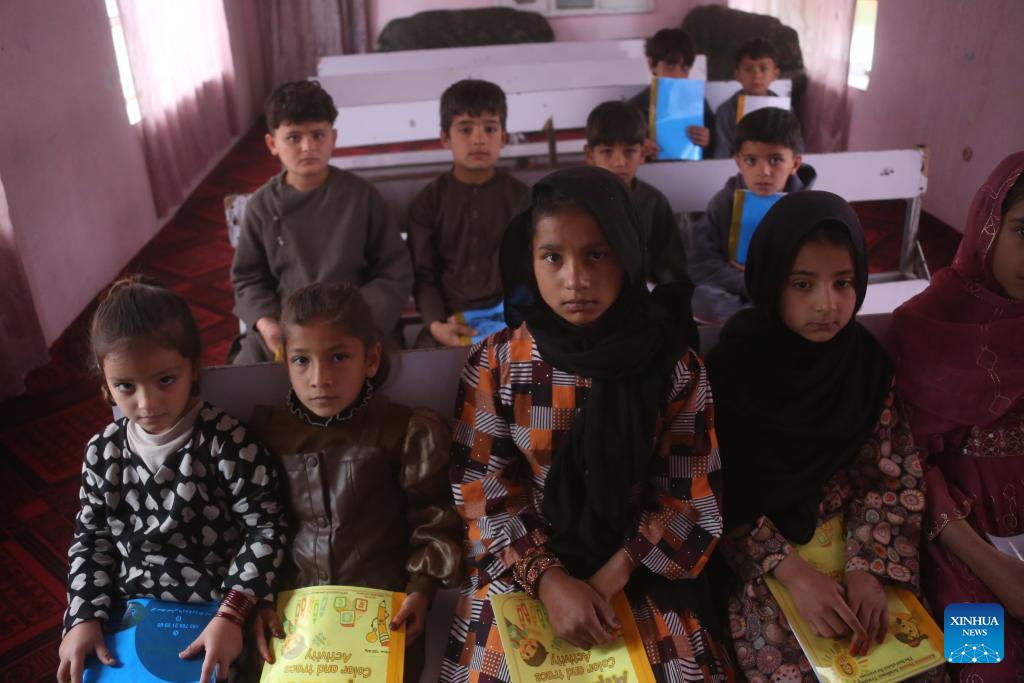
Afghan children attend a class at an educational center in Kabul, Afghanistan, March 26, 2026. (Photo by Saifurahman Safi/Xinhua)