


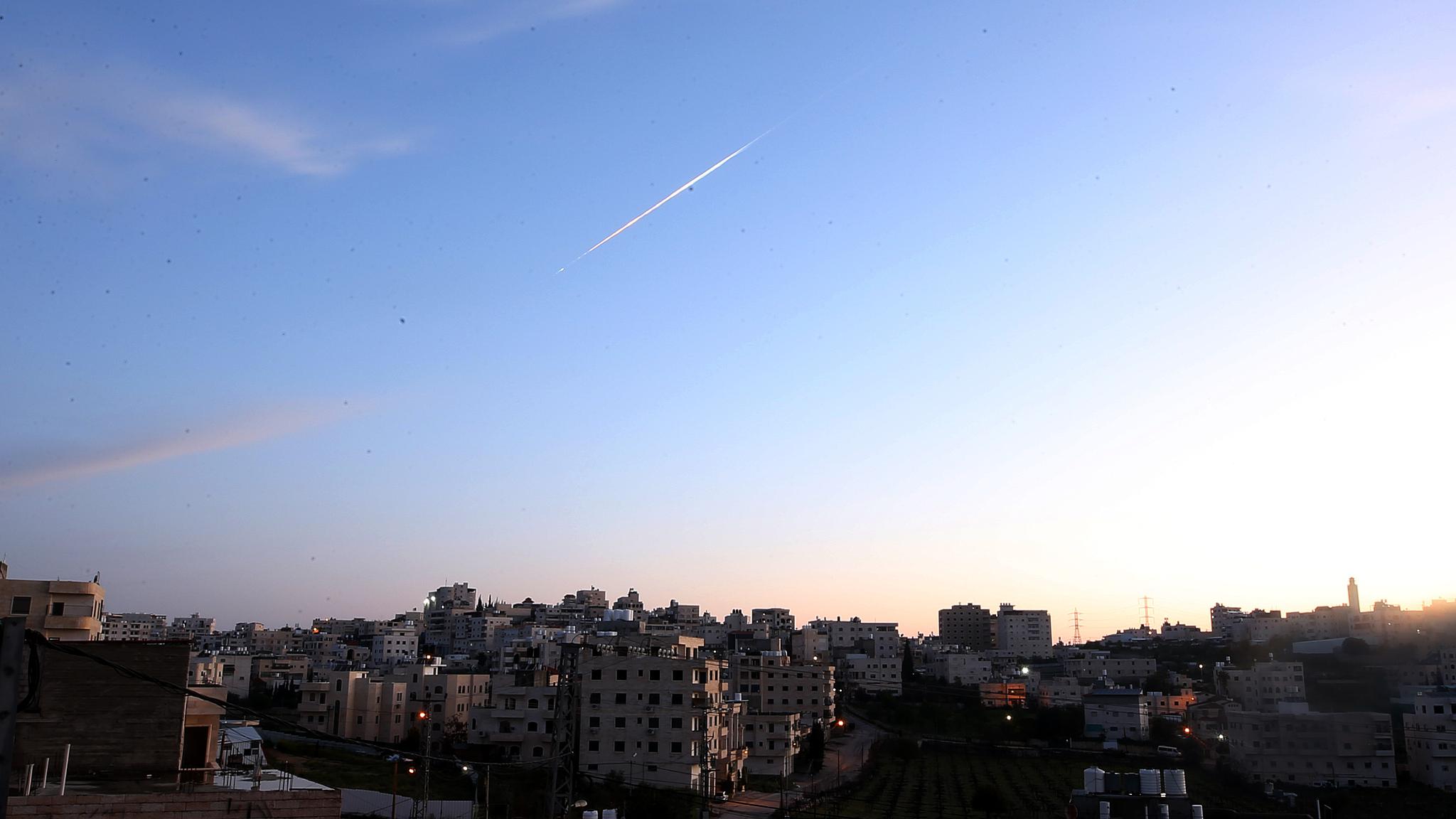
A view of missile traces launched from Yemen at Israel sighted in the sky over Hebron, West Bank, March 28, 2026. /VCG
CAIRO, March 28 (Xinhua) -- Yemen's Houthi group on Saturday claimed a barrage of ballistic missiles targeting "sensitive Israeli military sites" in southern Israel, marking its first such attack since Israel and the United States began large-scale attacks against Iran on Feb. 28.
Houthi military spokesman Yahya Sarea said the operation was launched as part of direct military intervention "in support of the Islamic Republic of Iran and the resistance fronts in Lebanon, Iraq and Palestine."
With the U.S.-Israel-Iran war entering its second month, the Houthis' involvement adds a significant boost to Iran's counterstrike capabilities and could shape the war's trajectory.
Here's a look at the potential cards the Houthis could play in supporting Iran's attacks on U.S. and Israeli targets.
DIRECT ATTACKS ON ISRAEL
Direct attacks on Israel are currently the Houthis' primary means of engagement against the country.
During the recent Israel-Hamas conflict that erupted in 2023, the group reportedly used ballistic missiles, cruise missiles, drones, and hypersonic missiles to strike Israeli targets, including the southern city of Eilat.
While Israel claimed that most such attacks were intercepted, there were still reports of casualties and infrastructure damage.
Saturday's attack suggests that the Houthis may continue direct strikes against Israel.
BLOCKADE OF BAB EL-MANDEB STRAIT
During the Gaza conflict, the Houthis leveraged their position along the Red Sea coast to attack vessels they claimed were linked to Israel and the United States, severely disrupting shipping in the region.
Should the ongoing conflict escalate further, the group is likely to resume similar actions.
In a more extreme scenario, the Houthis could move to block the Bab el-Mandeb Strait, a key chokepoint between Europe and Asia.
Since Iran has effectively blocked the Strait of Hormuz, the Bab el-Mandeb Strait has become a crucial route for oil exports from Gulf countries. If the Houthis were to block the Bab el-Mandeb Strait, which they have suggested is possible, the global energy market could face even more severe disruptions.
STRIKES ON U.S. MILITARY BASES
Based in Yemen, the Houthis are geographically closer than Iran to several U.S. military bases in the Middle East, which means if the Houthis deem it necessary, they could launch direct strikes on U.S. assets in the region.
Although the Houthis have not taken such action so far, it could become a potential option in extreme circumstances to support Iran in targeting U.S. and Israeli interests.
However, any military action against the U.S. bases would likely be viewed by host countries as a violation of sovereignty, triggering regional backlash and exposing the Houthis to significant risks.
Yemeni political analyst Salah Ali Salah described the group's involvement in the war as a "high-risk gamble" that could draw it into a broader regional confrontation.
"The cost may outweigh the expected benefits," said Salah, a researcher at the Sanaa Center for Strategic Studies, warning of a "high-risk scenario" that could lead to open regional conflict.