


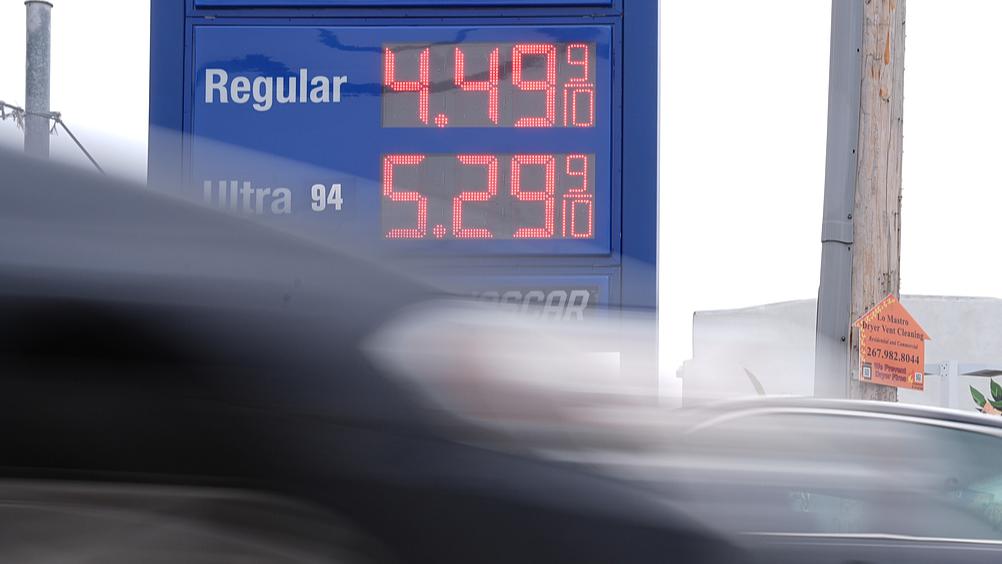
Vehicles pass a gasoline price board at a filling station in Philadelphia, US, March 27, 2026. (Photo: VCG)
Gas prices across the United States are climbing at their fastest pace in years, fueled by the ongoing US-Israel-Iran conflict. This conflict has not only disrupted oil transportation through the Strait of Hormuz but also threatens to disrupt shipping through the Bab al-Mandab Strait, as Yemen's Houthis, expressing solidarity with Iran, launched their first attacks on Israel over the weekend.
On Monday, US West Texas Intermediate was at $102.56 a barrel, up $2.92, or 2.93%, following a 5.5% gain in the previous session.
Brent crude futures jumped $3.09, or 2.74%, to $115.66 a barrel by 2353 GMT after settling 4.2% higher on Friday. Due to the ongoing conflict in Middle East, Brent has soared 59% this month, the steepest monthly jump, exceeding gains seen during the 1990 Gulf War.
As Houthis fired missiles at Israel over the weekend, JP Morgan analysts led by Natasha Kaneva told Reuters that "the conflict is no longer concentrated in the Persian Gulf and around the Strait of Hormuz, but now extends into the Red Sea and the Bab el-Mandeb – one of the world's most crucial chokepoints for crude and refined product flows."
It remains uncertain whether Americans are willing to pay the price for a war that the US has launched alongside Israel against Iran, but they are certainly feeling the strain of rising oil prices.
In some US states, March has been a tough month for motorists, with prices soaring by about $1 per gallon or more, according to The Hill.
Data released by the American Automobile Association on Friday showed that the average price of regular gasoline in the US is $3.978 per gallon, marking a 33.4% increase compared to one month ago. On the same day, the average price of regular diesel across the country was $5.38 per gallon, up 43.2% from one month ago.
"Nothing weighs more heavily on consumers' collective psyche than having to pay more at the pump," Mark Zandi, chief economist at Moody's Analytics, and his colleagues wrote in a commentary.
"It's hard to argue with that," Yuri Marin, a truck driver from southern Colorado, told CGTN. He said rising fuel costs affect everyone, but especially him: it used to cost him $40 just to get to work, but now it's closer to $60.
Ismael Algarin from south Florida told CGTN pointed out that housing has become increasingly unaffordable, leading to widespread displacement. "The middle class is gone," he said. Gabriel Canis echoed this sentiment, saying, "Look at the diesel prices right now, it's out of control. Who can afford this?"
Noting the average gasoline price in the US has surged more than 30% in just three weeks, Wan Zhe, a senior economist at Beijing Normal University, told CMG that these high oil prices have directly reversed the previous trend of falling inflation in the US and will significantly alter market expectations of interest rate cuts. Wan added that a prolonged high-interest-rate environment will likely suppress the US real estate market, corporate financing, and stock market valuations.
Noting that this is a US midterm election year, Wan pointed out that gasoline prices are among the most sensitive livelihood indicators for American voters, as high oil prices directly erode disposable income, squeeze non-energy consumption, and raise production costs for businesses.
Wan also emphasized that the global monetary policies are being forced to adjust due to high oil prices, further suppressing valuations in global financial markets, increasing volatility in both stock and bond markets, and heightening global financial vulnerabilities – thus slowing global economic growth.