


One month into the conflict between the United States, Israel and Iran, Africa is already feeling the pinch. Fuel prices are rising, supplies are tightening, and economists warn the worst is yet to come.
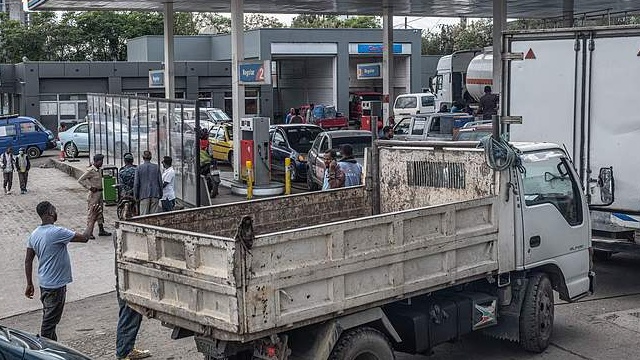
Vehicles crowd a petrol station in Addis Ababa, Ethiopia, March 27, 2026. (Photo: CFP)
Multiple African countries are reporting shortages and rising fuel costs. In Kenya, independent fuel retailers warn that about 20% of outlets were short on supplies after the government kept pump prices steady despite surging global costs. Mauritius has introduced energy-saving measures, while South Sudan's capital Juba is facing electricity rationing.
When Fuel Costs Spill Over
Dr. Hassan Khannenje from the HORN International Institute for Strategic Studies told CGTN that Africa has been here before and has always paid a disproportionate price.
"We understand how instability in the Middle East, and even in Europe, has affected energy markets before. Africa has always been disproportionately affected," he said.
He warns the impact will go beyond fuel. Africa increasingly relies on the Middle East not just for energy, but for fertilizer, which is a critical input for the continent's agriculture sector.
"A number of these items depend on the stability of the source, which happens to be the Middle East," he added.
The chain reaction, Khannenje says, is already predictable. Higher transport costs push up the price of basic goods and that often leads to higher inflation.
"Increased cost of transport means goods and basic items are going to go higher. That is going to lead to inflationary pressures on these economies, making life increasingly difficult," he said. "In turn, that can lead to social unrest, and even the potential collapse of governments that are unable to meet the basic needs of their populations," Dr. Khannenje said, adding that the impact on businesses and ordinary people is direct and unavoidable.
Price And Supply: The Twin Threats
South African energy analyst Mohamed Mahdi says the crisis comes down to two things: price and availability.
"Sometimes countries are able to procure oil at the price being asked, but other countries are not able to. The combination of price and available supply is ultimately affecting those countries' abilities to replenish their oil reserves," he said.
The picture across the continent is uneven. Oil producers like Angola and Nigeria stand to benefit from higher prices. But for the majority of African countries that import oil, Mahdi says the impact is devastating.
Nigeria's Dangote Refinery offers some relief, with South Africa pursuing a supply deal and other countries making contact, but Mahdi cautions it is not a magical solution.
"The Dangote Refinery will reach its limit in terms of how much it can provide to other African countries," he said.
African Governments Step In
Some African governments have moved quickly to cushion the blow.
Namibia's government announced it would temporarily reduce fuel levies by 50% for at least three months until the end of June, in a bid to protect consumers from higher pump prices.
Ethiopia's Prime Minister Abiy Ahmed took to social media to urge citizens to limit fuel consumption. The government subsequently introduced a fuel subsidy of roughly $0.63 per liter for diesel and $0.47 per liter for petrol.
South Africa's government on Tuesday, also announced measures to address fuel price increases. In a statement, the National Treasury and Department of Mineral Resources and Energy announced it would cut the fuel levy by $0.18 for one month. The general fuel will now be $0.064 per liter, and diesel levy will be slashed to $0.054 per liter.
But Mahdi warns that government intervention can only go so far.
"The country can only assist so much with a raw commodity whose price is high," he said. He points to the European model as the more sustainable approach. "If you follow the example of some countries in Europe, where they dropped levies by 50%, that is sustainable, because you are reducing the percentage governments take out of the energy cycle. In most cases, these are inflated levies."
The concern, he says, is that subsidy-driven relief masks the deeper problem rather than solving it and becomes harder to sustain the longer the conflict drags on.
The Road Ahead
If the conflict persists, Mahdi says the situation will worsen, and not just for Africa but globally.
"We will have a choking of supply. Africa needs to start looking at alternative forms of energy," he said, pointing to biofuels and electric vehicles as long-term solutions. "Let's not wait for the situation to get worse. Let's incentivize the biofuel industry across the continent."
For now, the fuel shortages show no sign of easing. Washington and Tehran remain in talks, with no resolution in sight.
For Africa, every day the war continues is another day the continent pays a price it did not choose.