


TOKYO, April 1 (Xinhua) -- Demonstrations were held in Japan on Tuesday evening as citizens voiced strong opposition to the government's decision to deploy long-range missiles in the country.
Earlier on the same day, Defense Minister Shinjiro Koizumi told reporters that long-range missiles with counterstrike capabilities had been deployed in Kumamoto and Shizuoka prefectures, a move that has sparked domestic opposition.
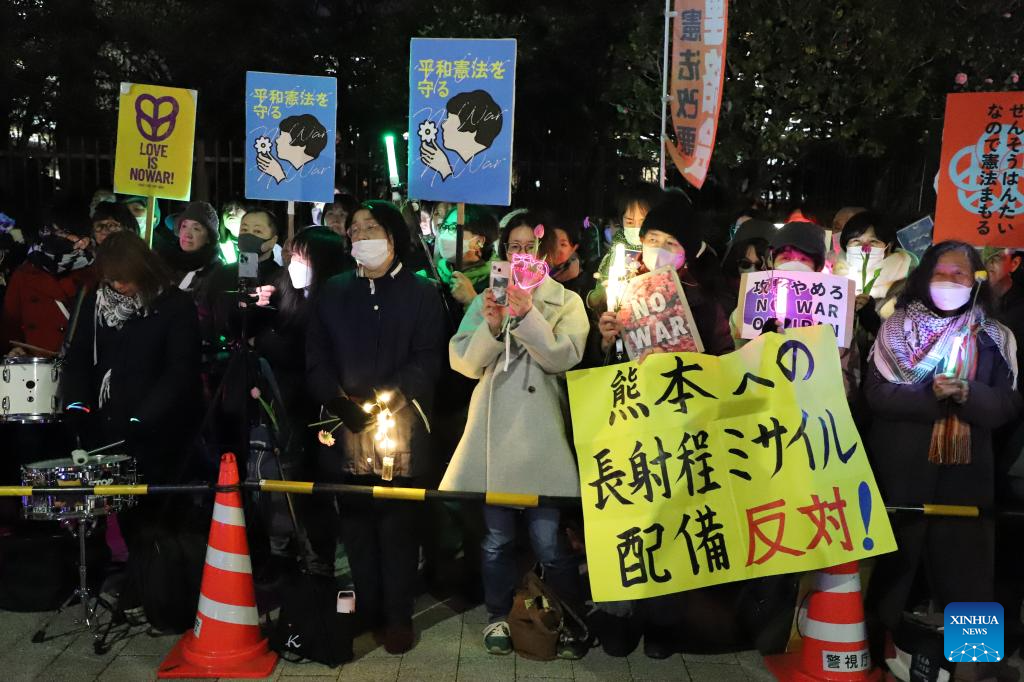
Demonstrators attend a rally outside the National Diet in Tokyo, Japan, March 10, 2026. (File photo: Xinhua)
According to Japanese media reports, the Defense Ministry stationed a ground-launched version of the upgraded Type 12 land-to-ship guided missile at Camp Kengun in Kumamoto and hyper velocity gliding projectiles for island defense at Camp Fuji in Shizuoka Prefecture.
Kyodo News described the move as Japan's first acquisition of a counterstrike capability, signaling a shift from the country's exclusively defense-oriented policy under its war-renouncing Constitution.
In Tokyo, large crowds gathered outside the Defense Ministry despite heavy rain, chanting slogans such as "Stop the deployment of long-range missiles!" "Give the public a reasonable explanation!" and "No to preparations for war!"
"In recent years, the Japanese government has frequently mentioned the so-called 'East Asia crisis' and 'Taiwan contingency,' constantly inciting unrest, but we don't understand where these crises come from?" Protester Hiromi Yamazaki told Xinhua that the deployment exposes "the dangerous nature of the Japanese government."
Another protester, Ikeda, argued that the deployment prioritizes military expansion while totally disregarding the concerns of residents. Protester Kazuya Tsukamoto added that the issue had not been a major topic in the recent House of Representatives election and appeared to have been pushed forward rapidly, creating a sense of a fait accompli. He criticized the top-down approach as "highly unreasonable."
A female protester from Ibaraki Prefecture expressed concern that similar deployments could occur near her home, where there is a Self-Defense Forces base. She warned that the move could be unconstitutional and raised fears about its broader implications.
Local media reported that residents near both Camp Kengun and Camp Fuji also staged protests, demanding the withdrawal of the missile deployments. At Camp Fuji, one protester angrily accused the government of breaking promises to local communities and proceeding without even holding explanatory meetings.
Meanwhile, Masahiro Sakata, a former director-general of Japan's Cabinet Legislation Bureau, stated that under Article 9 of the Constitution, Japan should only possess capabilities necessary for self-defense. However, he noted that with the gradual loosening of restrictions on collective self-defense, Japan could now use force even when it is not directly under attack.
The deployment of long-range missiles, he warned, makes it possible for Japan to strike overseas targets, suggesting that Article 9 has effectively become hollow.