


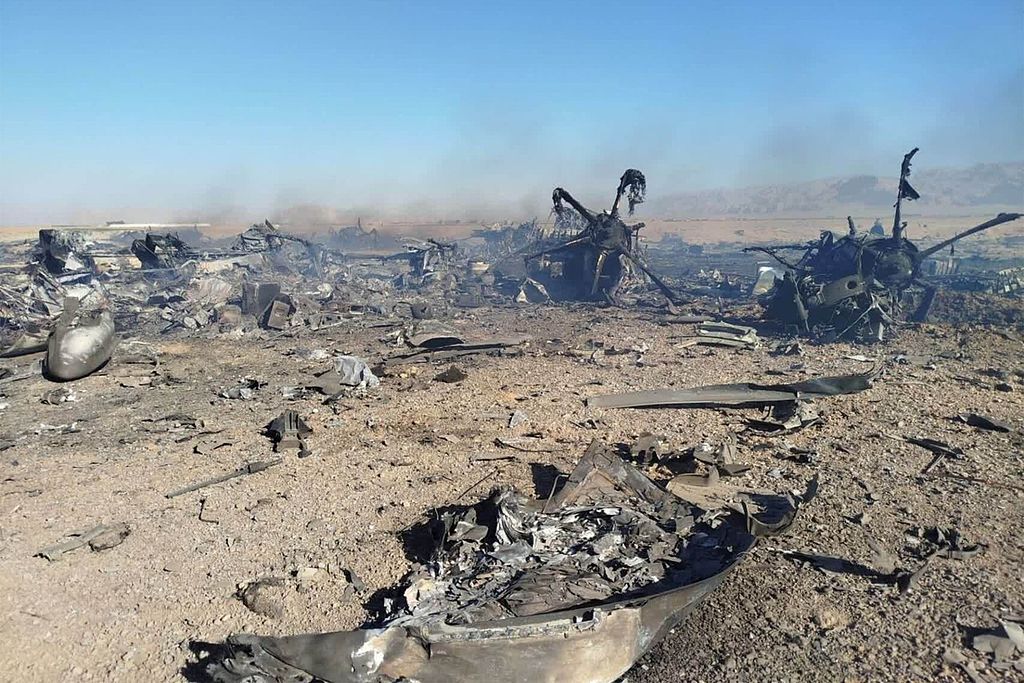
This handout photo provided by Iran's Revolutionary Guard Corps official website Sepah News on April 5, 2026 reportedly shows the wreckage and remains of targeted and crashed aircraft in central Iran. (Photo: VCG)
Tensions in the Middle East continued to escalate on Sunday, as Iran claimed that it has shot down 12 US aircraft of various types since April 3 while US President Donald Trump threatened to attack Iran's energy facilities and bridges after signaled another delay to its ultimatum over the Strait of Hormuz, even as both sides hinted at ongoing diplomatic contacts.
Tehran reiterated on Sunday that it would continue to leverage its control over the Strait of Hormuz, a vital global energy chokepoint, as a strategic tool in the confrontation. Mehdi Tabatabaei, deputy for communications at the Iranian president's office, stated that Iran would only reopen the strait after receiving compensation for war damages. He said the compensation will be paid from ship tax revenues.
Trump, meanwhile, extended the deadline he had set for Iran to reopen the strait by one more day. He warned that if Tehran fails to comply by the evening of April 7, the United States would target Iranian power plants and bridges.
At the same time, Trump said Washington is engaged in "serious negotiations" with Iran and suggested a deal could be reached before the deadline. However, he also warned that failure to reach an agreement could lead to devastating consequences.
Two sources familiar with the talks said mediation efforts are being conducted through intermediaries in Pakistan, Egypt and Turkey, with communication channels also open between Trump's advisers and Iran's foreign minister.
The US, Iran and regional mediators are discussing a potential 45-day ceasefire that could lead to "a permanent end to the war," Axios reported on Sunday, citing anonymous US, Israeli and regional sources.
US crew from downed F-15 rescued at heavy loss
April 5 marked a critical moment for Washington, as US forces announced the successful rescue of a second crew member from a downed F-15E fighter jet after two tense nights. Analysts say the rescue may have averted a potential hostage crisis that could have significantly shifted US public opinion towards the war and weakened Washington's position in negotiations.
Iranian reports detailed a series of US aircraft losses. It's reported that after a US Air Force F-15E "Strike Eagle" two-seat fighter jet was downed over Iran on April 3, Iranian forces subsequently shot down two US C-130 transport aircraft, one A-10 "Warthog" attack aircraft, four "Black Hawk" helicopters, two "Little Bird" helicopters, and two MQ-9 "Reaper" drones.
The United States has not confirmed these figures. However, a report by The New York Times indicated that at least four US aircraft were recently lost, including two reportedly shot down and two destroyed by US forces after becoming inoperable during rescue operations.
According to the Wall Street Journal, the US deployed MC-130J aircraft - each costing over $100 million - in the rescue mission. The MC-130J is designed to insert and extract troops in hostile environments and can be refueled midair. The aircraft is also equipped with advanced defensive systems, including sensors to counter air-defense threats such as heat-seeking missiles. An American official said the US destroyed two of its MC-130J aircraft during the rescue mission, without providing details on how the planes were lost, according to the report.
The New York Times stressed the risks of sustained military operations deep inside hostile territory. It said in an analysis that such setbacks highlight the unpredictability of war and the increasing difficulty for Washington to maintain control over an expanding conflict.
Read more: US calls F‑15E crew rescue a success; Iran deems it a failure
Iran's counter-strikes
On the battlefield, Iran's Islamic Revolutionary Guard Corps announced it had launched the 97th wave of its "True Promise-4" operation on April 5, involving large-scale missile and drone strikes. Iranian statements claimed multiple US and Israeli targets and assets in Gulf countries were hit.
Among the reported strikes, Iran said it targeted a covert gathering site for US officers near a naval base in Kuwait, causing heavy casualties. It also claimed that a cruise missile struck a vessel linked to Israel near Jebel Ali Port in the United Arab Emirates. Another strike on April 4 allegedly resulted in 25 US casualties at a personnel gathering point in the UAE.
Israel has also come under increasing pressure. Iranian forces said their drones carried out precise strikes on petrochemical facilities and fuel storage sites near Dimona, a strategically important area for Israel's southern energy supply.
Israeli emergency services also reported that a residential building in the northern city of Haifa was severely damaged during the latest Iranian missile attack, injuring at least 10 people. Despite multiple interceptor launches, Israel's air defense systems failed to stop the incoming missile in that instance.
Diplomatic efforts
Amid the escalation, Iran's Foreign Minister Seyed Abbas Araghchi held talks with his Russian and Indian counterparts, discussing the ongoing conflict. Araghchi accused Washington and its allies of targeting civilian infrastructure and urged the UN Security Council to take a more responsible approach grounded in international law.
Russian Foreign Minister Sergey Lavrov called for an immediate halt to "illegal" attacks on civilian targets, particularly warning against strikes on sensitive facilities such as the Bushehr Nuclear Power Plant. Moscow also suggested that the US side abandoning its ultimatum-style rhetoric could help ease tensions in the Gulf.
India's foreign minister emphasized the importance of efforts to restore stability and security to the region, expressing his country's support for the ongoing efforts at the regional and international levels to stop the war.
OPEC+ plans to increase oil production
The conflict also prompted oil-production countries to take actions. The Organization of the Petroleum Exporting Countries and its allies (OPEC+) announced plans to increase oil production by 206,000 barrels per day in May following a virtual meeting of key producers.
However, analysts caution that the increase may remain largely symbolic. Since late February, the closure of the Strait of Hormuz has sharply reduced exports from major Gulf producers such as Saudi Arabia, the United Arab Emirates, Kuwait and Iraq - countries that previously held most of the bloc's spare production capacity. In addition, missile and drone attacks have inflicted damage on regional energy infrastructure.
Officials from several Gulf states noted that even if hostilities cease and the strait reopens immediately, it could take months to restore normal operations and meet production targets. Other producers, including Russia, face constraints due to sanctions and infrastructure damage linked to the ongoing conflict in Ukraine.
As military confrontation intensifies alongside fragile diplomatic efforts, the situation remains volatile, with significant implications for regional stability and global energy security.