


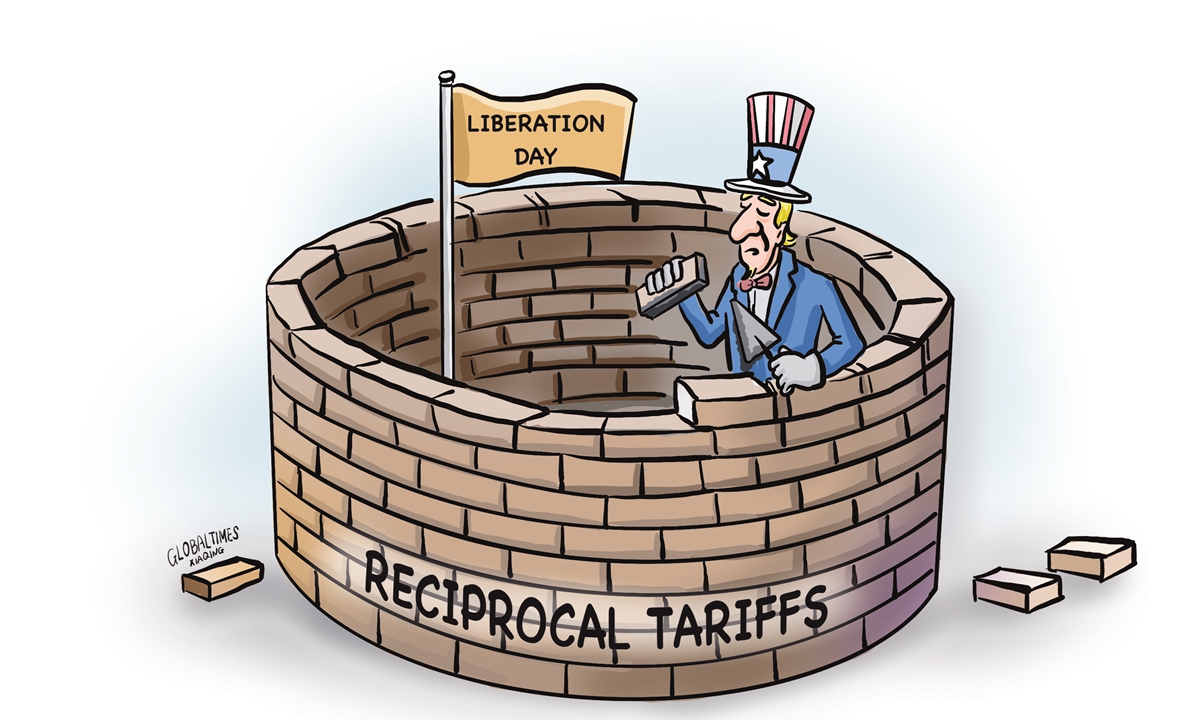
Illustration: Xia Qing/GT
On April 2, 2025, US President Donald Trump signed an executive order implementing the "reciprocal tariff" policy, triumphantly branding the moment as "Liberation Day" for the US. On Thursday, the White House released an article claiming that the US is "winning once again a year after Liberation Day." However, does this event truly present a victory for the US and its people? The Global Times invites experts and scholars around the world to share their retrospective on the actual "legacy" of the "Liberation Day" from various aspects.
Anthony Moretti, an associate professor at the Department of Communication and Organizational Leadership at Robert Morris UniversityOne year ago, Americans were told by their president that "Liberation Day" would, among other things, make them wealthy. In addition, the trillions of dollars that would enter the country because of tariffs were going to make a huge dent in the national deficit. Oh, and jobs and factories were soon going to appear everywhere across the nation.
No. No. And no. The data are clear: Items big and small now cost more; the unemployment rate has ticked upward; the national deficit is the highest it's ever been.
One year later, Americans cannot ignore the fact that their nation is now less respected globally and no closer to a manufacturing revolution (that will never arrive). Add to that what can be called the wild and untamed horse of presidential power continues to run roughshod domestically and internationally. And the recent launching of a war alongside Israel against Iran has further strained the financial well-being of the nation and its citizens.
The grim truth is that Americans were liberated from nothing one year ago. The unveiling of unnecessary tariffs on friend and foe has not, cannot and will not succeed.
On that fateful April day one year ago, the [US] president sought the idea that the White House was unconstrained in its powers over trade. The administration's decision to resuscitate dormant provisions, with the International Emergency Economic Powers Act being the most noticeable, to justify its tariff barrage guaranteed that Congress would play no role in determining the necessity or legality of tariffs.
Why? Because that is how the system of checks and balances works: The executive branch cannot act as if it is the only governmental authority in the land. The US Supreme Court did remind the White House about its overreach when it ruled earlier this year that most of the tariffs unleashed by the president were unconstitutional. Americans should be thankful that the Supreme Court understood that any unrestrained presidential power could cause significant domestic and international damage.
Einar Tangen, a senior fellow of the Center for International Governance Innovation, a Canadian think tankAt its core, "Liberation Day" reduced decades of structural economic and social issues to a single grievance narrative: The US had been "ripped off."
The trade deficit became both symbol and scapegoat - blamed for deindustrialization, wage stagnation, inflation and economic decline. However, casting blame does not solve systemic issues created by years of political negligence. American prosperity had been sacrificed on the altar of conflicts and "easy" money. One year later, Washington's policies have only made things worse.
Domestically, the dominant outcome has been anger - persistent and politically corrosive. Rather than easing economic anxiety, Washington's policies have intensified it. Inflation, reinforced by tariff-driven price increases, continues to erode purchasing power. Consumer confidence has become a volatile see-saw, rising with political messaging but falling under the reality of rising costs, higher interest rates, and fragile job security. Employment data reinforces this tension, and the markets reflect the same contradictions.
Politically, "Liberation Day" has deepened polarization and reshaped the tone of public discourse. For supporters, it confirms a belief that the US had been exploited and that disruption was necessary. For critics, it marked a retreat from economic reality. The result is a widening divide in which long-term policy solutions struggle to gain traction against grievance-driven narratives.
Yet continued political support underscores a deeper reality: This was never purely economic. It tapped into identity and control - the perception that the US needed to reassert itself against an unfair system. That perception has sustained core political support despite mixed economic outcomes.
So what has been "liberated"? Not the American household, now paying thousands more each year for the same standard of living. Not the industrial base, still constrained by structural realities. Not the policymaking process, increasingly shaped by polarization and legal challenges. Not the US' global standing, which has grown more uncertain.
Grievance, however, has flourished. It has gained structure, legitimacy and political force - energizing the "victim" narrative, while narrowing debate and deepening division.
One year later, "Liberation Day" stands not as a moment of renewal, but as a marker of transition - moving away from stability and toward continuing economic, political and social uncertainty.
Evandro Menezes de Carvalho, an invited coordinating professor at the Faculty of Applied Sciences of the Macao Polytechnic UniversityBehind the rhetoric of "liberation," what emerges is not reciprocity, but the consolidation of a new phase of US unilateralism.
Far from mirroring foreign tariffs, many of the measures imposed by the US exceed those of its trading partners. In some cases, they even target countries with which the US enjoys a trade surplus. This is not about restoring balance; it is about redefining the rules of the game in favor of Washington, regardless of established multilateral norms.
By framing unilateral tariff measures as a form of "liberation," the US implicitly portrays itself as constrained by the very multilateral trade system it once championed. This helps explain its repeated threats to withdraw from the World Trade Organization. As one US official put it, "President Trump threw away the illusions of 'free trade' to finally put Americans and America First." What is being discarded, however, is not an illusion, but a framework that ensured relative stability and predictability in global commerce.
The White House claims that these tariffs have protected American workers, generated revenue, and revitalized domestic manufacturing. But reality tells a different story. Unemployment rate and economic growth figures challenge the official narrative, and public perception also diverges from official optimism. This raises a fundamental question: Whose "liberation" is being celebrated? Which America is truly being put first?
The consequences extend beyond trade. As US foreign policy increasingly embraces coercive unilateralism, including the use of force without regard for multilateral institutions, its global credibility continues to erode. Leadership by example is being replaced by leadership through pressure. Yet, this strategy risks backfiring. The resilience of the countries facing US coercion suggests that the international system is entering a new phase.
What is unfolding is not a "Liberation Day" for the US, but a gradual emancipation of the world from a unipolar order. In that sense, the real "Liberation Day" may still be ahead, not for one nation, but for the international community as a whole.