


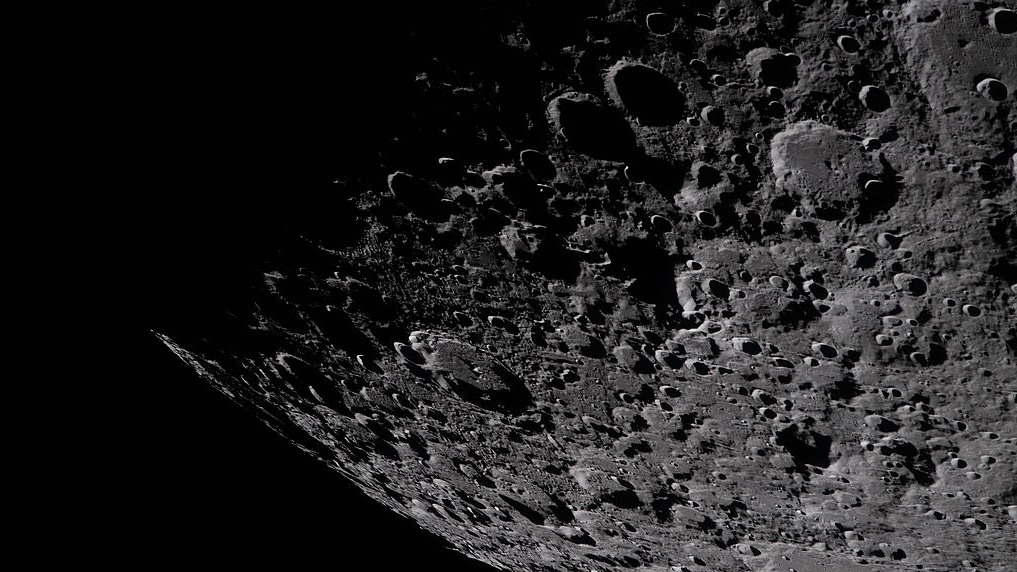
The heavily cratered terrain of the eastern edge of the South Pole-Aitken basin of the moon captured by the Artemis II crew. (Photo: VCG)
Israeli and US scientists have found that ice has been slowly building up at the moon's poles for at least 1.5 billion years, according to a statement from Israel's Weizmann Institute of Science on Tuesday.
Published in Nature Astronomy, the study points to "cold traps," which are deep, sunless craters near the poles where temperatures drop to around minus 160 degrees Celsius, as the best places to find ice, read the statement.
Using data from NASA's Lunar Reconnaissance Orbiter, the researchers found that older dark regions contain more ice, suggesting gradual accumulation rather than a single event.
This ice could be turned into water, oxygen and fuel, and NASA plans to explore these areas under its Artemis program, read the statement.
The scientists hope future missions will collect samples to determine the water's origin and how it could support human activities in space, read the statement.