


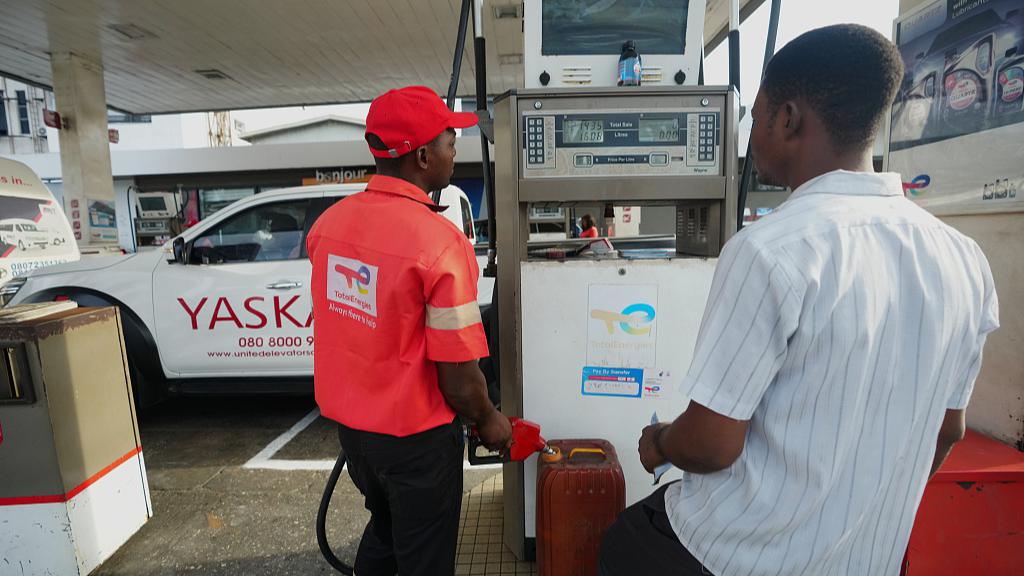
An employee fills a can with fuel at a petrol station in Lagos, Nigeria, March 23, 2026. (Photo: VCG)
High temperatures are nothing new for Nigeria, Africa's most populous country which is just above the equator. However, according to the Nigerian Meteorological Agency (NiMet), the situation is worsening. It warned in a 2025 report that from 2016 to 2025, nine out of ten years were "among the 12 warmest on record."
Analysts attribute the rising temperatures in Nigeria's commercial capital, Lagos, to climate change, its coastal location, dense population, limited greenery, and heavy traffic.
The constant use of generators worsens the problem because the petrol-guzzling machines emit heat and greenhouse gases.
Public transport, meanwhile, is shambolic, with most commercial vehicles dilapidated and lacking functioning air conditioning.
Temperatures reached 35 degrees Celsius in Lagos at the end of March, according to NiMet.
They reached 38 degrees Celsius in the capital Abuja, while Sokoto in the northwest hit 44 degrees Celsius, with NiMet describing the conditions as "unhealthy."
Rising fuel prices
Nigeria's unique economic situation as Africa's fourth-largest economy, combined with a dilapidated power grid that is much less stable than those of some of its poorer neighbors, has led to widespread use of private generators, at least among those who can afford them.
That number may be dwindling as fuel prices soar due to the Iran war. Gasoline prices have nearly doubled in the capital, from around 850 naira ($0.62) per liter to over 1,300 – a record high in a country where it was sold for about 195 naira at the start of 2023.
Health warnings
The heatwave could also worsen Nigeria's malaria problem. According to the World Health Organization, climate change – through increased rainfall, temperatures, and humidity – can sometimes speed up malaria transmission by helping mosquitoes to breed faster.
Nigeria recorded about a quarter of the world's malaria cases and 30% of global deaths in 2024, according to the WHO.
The upcoming rainy season provides some relief as storms cool down temperatures.
However, it will also present its own challenges, like flooding.