


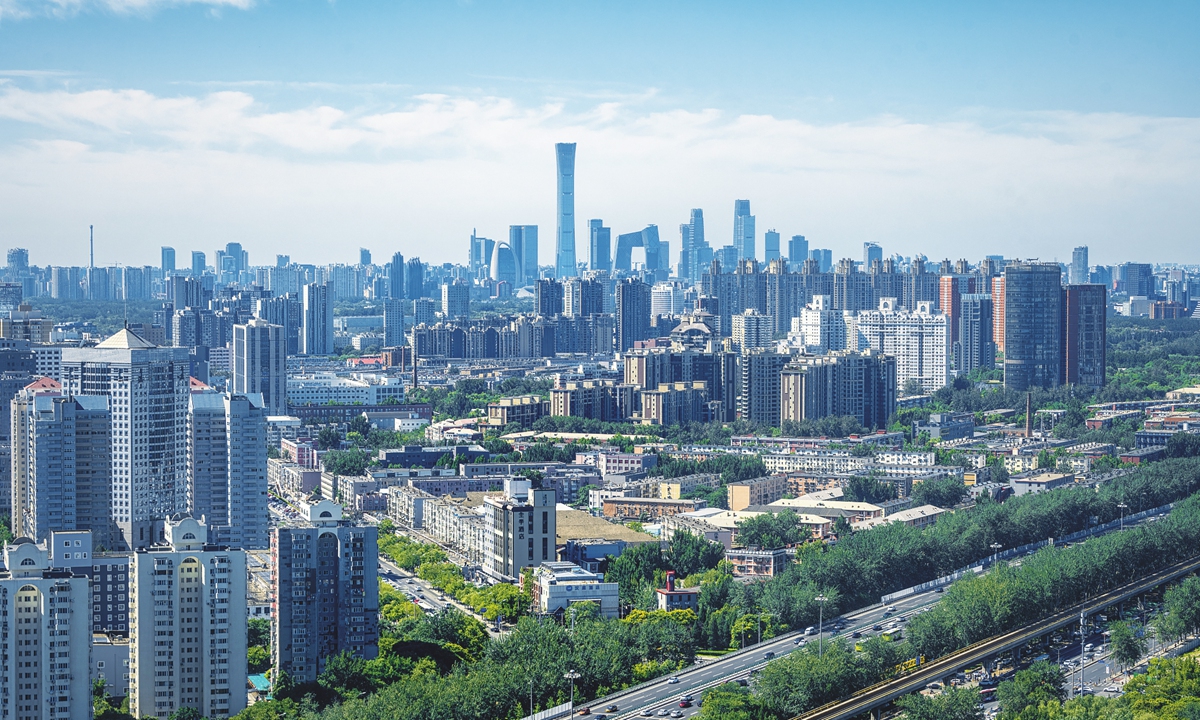
An aerial view of the cityscape of Beijing, China Photo: VCG
Editor's Note:
Spanish Prime Minister Pedro Sánchez arrived in Beijing on Saturday, starting his five-day visit in China. This is his fourth visit to the country in four years. In an exclusive interview with Global Times ( GT) reporter Su Yaxuan, Spanish scholar Augusto Soto ( Soto), director of Dialogue with China Project, discusses the frequency and significance of China-Spain interactions. "Sánchez's brand of pragmatism has parallels with Chinese pragmatism in its embrace of the concept of 'shared benefits,' rejecting the zero-sum game," Soto said.
GT: How should we understand the significance of these frequent visits to China by a Spanish prime minister?
Soto: Against a global backdrop of rapid technological development and significant economic opportunities, yet set against a challenging energy and security context, the visit to Beijing and other cities this time can be said to be multidimensional, encompassing not only bilateral relations and the EU-China relationship, but also beyond.
The frequency of these meetings is hardly surprising. First, of the 27 EU countries, only nine maintain a comprehensive strategic partnership with China, and Spain is one of them. Indeed, the relationship between Spain and China has matured to such an extent that there is potential to strengthen it further.
GT: You previously mentioned that the West should view China with an open mind and a fact-based approach. Since the beginning of 2026, several European officials and business leaders have visited China. What is the current overall perception and attitude of the West toward China?Soto: First and foremost, we must bear in mind that diversity is one of the defining features of the West. Alongside the EU's remarkable progress since the end of the Cold War, this diversity has remained. Now, in the face of the US government's imperialist and irrational policies, various EU countries are reassessing their view of international relations.
Meanwhile, China has amply demonstrated in recent decades that it is a major power committed to the fundamental principles of the UN Charter. It has evolved from being on the fringes of the international system in the early 1980s to occupying a central position in world affairs. Today, it is the largest trading partner for most countries; it wants to prosper and to see others prosper too. It is the only permanent member of the UN Security Council not to have fired a single shot in an international conflict for almost half a century.
The view that China is a stabilizing force on the world stage, and a partner with whom relations should be deepened despite occasional differences, is beginning to prevail across most of the EU. This perception has taken time to gain ground, but the trend is clear. Evidence of this can be seen in the regular visits to China by key leaders from Europe and other continents.
As relations progress and become more fruitful, there is always room for improvement at all levels. I would simply like to point out that there is scope for greater interaction between the media, universities and think tanks, as well as further expansion in tourism, on the part of both the EU and China, among the many possible areas recognized by both sides.
GT: In your article written during Sánchez's April 2025 visit to China, you mentioned that Spain holds unique importance in China-EU relations, emphasizing that the Spanish factor of the EU is more significant today than it was before. Currently, Spain maintains a relatively pragmatic stance toward China within the EU. To what extent can exchanges between China and Spain encourage other European countries to adopt a more pragmatic approach toward China?Soto: In recent decades, Spain has produced some exceptional diplomats, including the versatile figures of Juan Samaranch, Javier Solana and Josep Borrell. All three are well known in China and across different continents and are renowned for promoting dialogue and understanding between countries. Solana and Borrell have left an interesting diplomatic legacy, which is important for relations with China.
Sánchez's brand of pragmatism has parallels with Chinese pragmatism in its embrace of the concept of "shared benefits," rejecting the zero-sum game. Furthermore, both countries oppose external impositions and agree on the principles of reciprocity and continuous, uninterrupted dialogue.
The results of this deepening of political, cultural, technological, commercial and investment dialogue are demonstrably impacting the pragmatic perspective that other European countries may adopt toward China.
GT: Previously, amid strong US pressure on the Iran issue, Spain has clearly chosen to decline certain demands. What is your assessment of Spain's efforts to safeguard its strategic autonomy and diplomatic independence under external pressure? What lessons might Spain's stance offer other European countries?Soto: Madrid has long been under unacceptable pressure from the current US government. Canada, Denmark and Greenland have also experienced similar pressure. The wider Middle East has also been affected, with an unnecessary and serious global crisis being provoked.
Spain believes in the persistence of dialogue and reciprocity between countries, rather than imposition.
Currently, Spain is a good example of strategic autonomy in Europe. Madrid has opposed thoughtlessly increasing its NATO contribution budget to 5 percent, arguing that existing European national budgets are more than sufficient and that raising them to more than double or triple current levels would harm the prosperity and social protection of respective societies.
Washington's neo-imperialism came as a shock to European countries and the rest of the world. Now, several European countries are beginning to shift their attitude toward strategic autonomy, mirroring the Spanish vision.
GT: On international hot spot issues, how can China and Spain strengthen their communication and coordination, uphold international fairness and justice, and play a constructive role in promoting peace talks and resolving regional conflicts?Soto: Spain and China believe in peace, shared prosperity and multilateralism.
As well as being the main trading partner for most of the world, China has significant communication and coordination capabilities. It is currently the second-largest contributor to the UN peacekeeping budget. Over the past decade, Beijing has played a recognized role in various conflicts, including facilitating the rapprochement between Saudi Arabia and Iran.
Spain, for its part, is an important platform for international dialogue. The 1991 Madrid Peace Conference was a diplomatic milestone in that it brought delegations from Israel, Palestine, Syria, Lebanon and Jordan [and Egypt] together face-to-face for the first time. Sponsored by the US and the Soviet Union, the conference aimed to initiate the peace process in the Middle East following the Cold War.
Clearly, Spain and China can exert bilateral influence and take the lead in encouraging other countries to play a constructive role in major crises. The crisis in the Middle East is the most significant, and it may yet have a far greater impact on the world than we can currently foresee, although it is not the only regional conflict. Spain and China are well placed to contribute.