


TOKYO, April 13 (Xinhua) -- Japan's post-WWII identity as a "peace state" could fade if its ongoing military expansion continues, a Japanese scholar has warned, as the country's record-high defense budget sparks growing domestic concern.
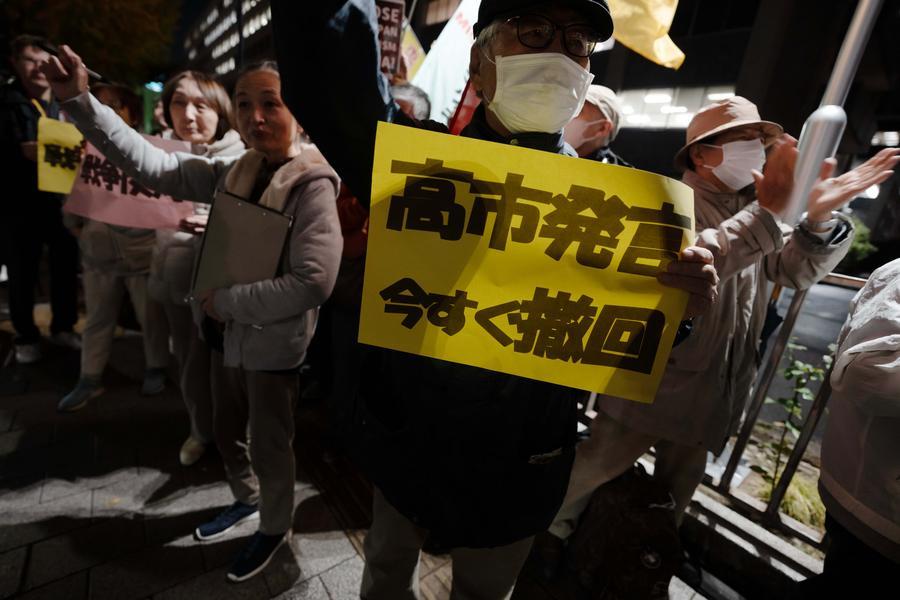
People attend a protest in front of the Japanese prime minister's official residence in Tokyo, Japan, Nov. 25, 2025. (Photo: Xinhua)
In a recent interview with Xinhua, Kiyoshi Sugawa, senior research fellow at the East Asian Community Institute of Japan, said the sustained increase in defense spending is unsustainable and may steer the country onto a highly dangerous path if left unchecked.
Japan's parliament recently approved the fiscal 2026 budget, with defense expenditures exceeding 9 trillion yen (about 56.3 billion U.S. dollars) for the first time, a historic high that has triggered widespread debate at home.
Sugawa, an expert on Japan's defense policy, traced the current surge in military spending back to the government's adoption of three key national security documents in 2022. Under the military buildup program, Japan aims to pour a combined 43 trillion yen into defense outlays from fiscal 2023 through 2027 and to hike defense-related spending to 2 percent of GDP by fiscal 2027.
He noted that the trend has accelerated further since Prime Minister Sanae Takaichi took office.
"Behind this are both pressure from the United States and changes in Japan's domestic political landscape," Sugawa said. He pointed to a growing conservative shift in Japan, with some political forces advocating a departure from the country's long-standing pacifist principles and calling for Japan to become a "normal country."
According to Sugawa, the current administration's overall approach to defense is one of "comprehensive military strengthening." Against this backdrop, the government has repeatedly described Japan as facing "the most severe and complex security environment since the end of World War II," using this assessment to justify expanded military capabilities.
Sugawa, however, argued that the government's framing places undue emphasis on neighboring countries while overlooking the real threats.
"From multiple perspectives, the threat from the United States is becoming more tangible," Sugawa said, noting that even within the alliance, Washington exerts pressure on Japan in areas such as trade, tariffs and investment. "Japan should be investing resources in domestic development, but it is forced to allocate enormous financial resources in the U.S., which in itself is a form of economic and diplomatic pressure." He added that, in certain respects, the U.S. could also become a "potential risk" in the security domain.
In parallel with rising defense expenditures, the Japanese government is planning to revise the implementation guidelines for the "three principles on transfer of defense equipment and technology" as early as April, further easing restrictions on arms exports.
Under the proposed changes, Japan would in principle allow the export of lethal weapons without prior parliamentary approval. Instead, decisions would be made by the National Security Council, with the Diet informed only after approval. In exceptional cases, exports to countries involved in ongoing conflicts could also be permitted.
"This is effectively close to having no restrictions," Sugawa said, expressing strong concern about the developments. He believes that such policies could exacerbate tensions when it comes to some highly sensitive issues.
"Japan's postwar identity as a 'peace state' will cease to exist. I feel a profound sense of crisis about this," he added.
Sugawa also pointed to mounting domestic pressures, including rising prices and growing public dissatisfaction, warning that continued military expansion may not be economically sustainable.
"While defense spending increases, the Japanese people may become poorer, and industries may continue to decline," he said. "If resources keep flowing into the military rather than areas like education, Japan's future will only face further deterioration."
He concluded that the government's current policy choices risk putting the country on a very dangerous trajectory.