


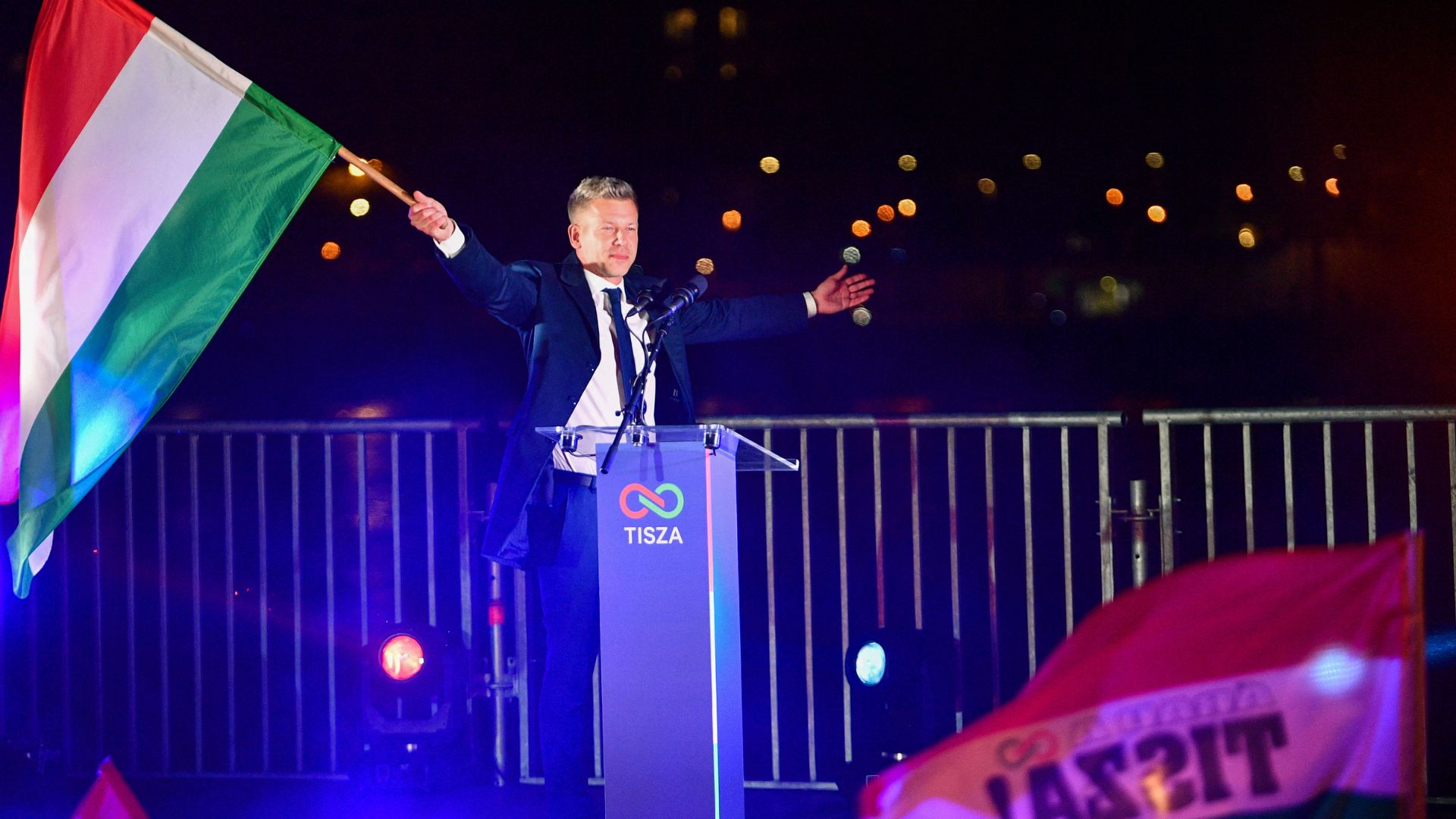
Peter Magyar, leader of the pro-European conservative TISZA party, waves the national flag during celebrations at the election night party in Budapest. (Photo: Ferenc Isza/AFP)
Hungary's veteran nationalist leader Viktor Orban lost power to the upstart center-right Tisza party in Sunday's national election after 16 years in office, marking a setback for his allies – including other nationalist European leaders and US President Donald Trump.
Orban, 62, was celebrated by conservatives across Europe and the United States as the mastermind of the "illiberal" model of democracy, but lost favor at home with voters who grew weary of economic stagnation, international isolation and oligarchs amassing wealth.
His landslide defeat handed Tisza's Peter Magyar, 45, a comfortable majority in Hungary's 199-seat legislature, opening the door for meaningful reforms of a system that some in the European Union said subverted democratic norms.
With nearly all ballots counted, Tisza – a conservative but pro-European party formed in 2020 – was set to win 138 seats, more than the two-thirds majority Magyar would need to undo Orban's constitutional overhaul.
Record turnout on Sunday underscored how many Hungarians saw the election as a watershed moment for their country.
"We have done it. Tisza and Hungary have won this election," Magyar told tens of thousands of supporters who danced and cheered alongside the elegant Danube River embankment in central Budapest.
Many held candles while loudspeakers blasted Frank Sinatra's My Way as Magyar walked towards the stage. "Together, we have replaced Orban's system and together we liberated Hungary, we have reclaimed our country," he said.
Magyar had warned voters that Orban's confrontational stance towards Brussels would take the country further away from the European mainstream. Orban countered that Tisza would drag Hungary into an unwanted war with Russia, a charge Magyar denied.
"The election result is painful for us, but clear," Orban said at the Fidesz campaign offices. Some of his supporters who had gathered outside cried while watching his speech on TV screens.
Shockwaves across Europe and beyond
The end of Orban's 16-year rule will have significant implications not only for Hungary, but for the European Union, Ukraine and beyond.
Many European leaders are hoping for an end to Hungary's adversarial role inside the EU, possibly opening the way for a $105 billion loan to Ukraine that was blocked by Orban.
Mujtaba Rahman, a managing director at Eurasia Group, said Magyar will be able to deliver on his promises to clean out corruption and remove Orban's Fidesz party loyalists from key positions – especially with that two-thirds majority weakening the outgoing party's grip on constitutional positions, which could not have been be countered with a simple majority.
Rahman said Magyar "was extremely cautious pre-election – but without the need now to try to appease Fidesz voters, we think Hungary will cautiously move more into the European mainstream on most subjects."
Some diplomats in Brussels cautioned issues such as migration may remain thorny. "Hungary will continue to be a challenging partner, but a partner with whom the other member states can work," one said.
Ukrainian President Volodymyr Zelenskyy congratulated Magyar on Sunday and pledged to work with him to strengthen Europe and uphold peace and security. "It is important when a constructive approach is victorious," Zelenskyy wrote on Telegram.
Defeat for Orban could also mean the eventual release of EU funds to Hungary suspended over reforms that Brussels said undermined democratic standards, something closely watched by financial markets.
Reaction outside Hungary
Polish Prime Minister Donald Tusk said Magyar's win continues a trend of European electorates turning away from authoritarianism – citing his own election in 2023 followed by wins for Romanian centrist president Nicusor Dan and Moldova's pro-European ruling party.
"Everyone feared there was a trend toward authoritarian, corrupt regimes," Tusk said. "That's not the case. First Warsaw, then Bucharest, Chisinau, now Budapest."
Other European leaders were slightly less pointed but equally hopeful of increased cooperation, with European Commission President Ursula von der Leyen saying "Hungary has chosen Europe. Europe has always chosen Hungary."
French President Emmanuel Macron said Magyar's victory "shows the attachment of the Hungarian people to the values of the European Union and for Hungary's role in Europe," while German Chancellor Friedrich Merz said "Let's join forces for a strong, secure and, above all, united Europe."
Norwegian Prime Minister Jonas Gahr Stoere looked forward to "close and constructive cooperation in pursuing peace and stability, democracy and the rule of law on our continent," while Finnish PM Petteri Orpo said the result "gives Hungary the opportunity to return to our community of values and security as a constructive actor."
Estonian Prime Minister Kristen Michal said "Hungarians have made a historic choice for a free and strong Hungary in a united Europe, rejecting forces that ignore their interests," and Lithuanian President Gitanas Nauseda said "There are a lot of things we could and should do for the sake of democracy, justice and peace."
China's foreign ministry spokesperson Guo Jiakun said China is willing to, on the basis of mutual respect, equality and mutual benefit, strengthen high-level exchanges with the new Hungarian government, enhance political mutual trust, expand practical cooperation and boost people-to-people and cultural exchanges to better benefit the two peoples.
Magyar also received cautious congratulation from those who had previously worked closely with Orban, including Czech Prime Minister Andrej Babis.
"Facing such a strong opponent as Viktor Orban was never easy, yet he earned the trust of the majority of Hungarians and carries great hopes and expectations," Babis said on X.
"He must not disappoint. I respect the election result and look forward to our cooperation, because the relationship between Hungary and Czechia is close, and I will always work constructively with whoever voters choose."
Slovak Prime Minister Robert Fico, another Orban ally, struck a similar tone – congratulating Magyar and respecting the electorate's wishes.
"With full respect, I take note of the decision of the citizens of Hungary ... and am ready for intensive cooperation with the new Hungarian prime minister, whom I congratulate on the election result," Fico said in a statement.
Russia said it hoped it could continue what it called its "pragmatic ties" with Hungary's new political leadership.
"Hungary has made its choice, and we respect that choice," said Kremlin spokesman Dmitry Peskov. "We look forward to continuing our highly pragmatic engagement with Hungary's new leadership."
Orban had been Russian President Vladimir Putin's main ally in the EU and had also won public endorsements from Donald Trump's administration, culminating last week Vice President JD Vance visiting Budapest and speaking at an Orban campaign rally, even telephoning Trump while on stage.
In Washington, Democrats framed Orban's loss as a harbinger for the US midterm elections in November.
"Pay attention, Donald Trump. Wannabe dictators wear out their welcome," Senate Minority Leader Chuck Schumer said, while US House of Representatives Minority Leader Hakeem Jeffries added "Far-right authoritarian Viktor Orban has lost the election. Trump sycophants and MAGA extremists in Congress are up next in November."