


ISLAMABAD, April 16 (Xinhua) -- As signals emerge from Washington, Tehran and Islamabad about a possible new round of U.S.-Iran negotiations, uncertainties continue to cloud when and where the talks might take place, and whether they could yield tangible progress.
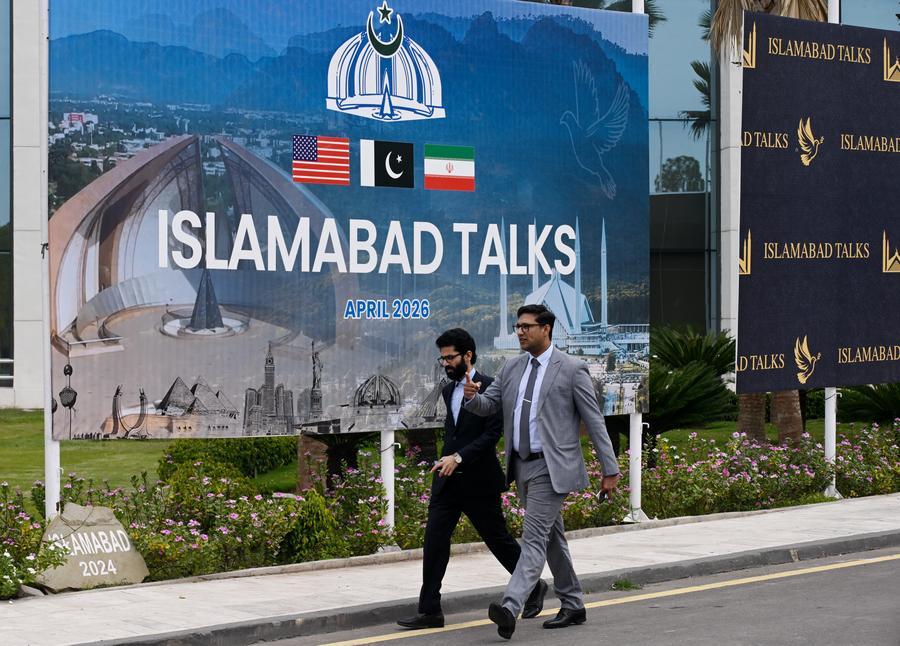
People walk past the press center for the talks between the United States and Iran in Islamabad, Pakistan, April 11, 2026. (Photo: Xinhua)
OPEN TO RENEWED TALKS
Since the last round of U.S.-Iran talks on Saturday, contacts between the two sides continue. On Wednesday, the White House said the Trump administration feels "good about the prospects of a deal" with Iran, while U.S. Vice President JD Vance said Tuesday that he would seek a "grand bargain" with Iran and is expected to lead any potential new in-person talks.
On Tehran's side, Foreign Ministry spokesperson Esmail Baghaei reiterated Iran's openness to discussing parameters of its nuclear program, and emphasized the country's right to peaceful nuclear energy and called for sanctions relief as an essential component of any broader settlement.
Amid these exchanges, Pakistan has continued its peace efforts with Army Chief Asim Munir's tour to Iran on Wednesday and Prime Minister Shehbaz Sharif's tour to Saudi Arabia, Qatar and Türkiye that started on the same day.
Meanwhile, Pakistani Foreign Office spokesperson Tahir Hussain Andrabi on Thursday confirmed the positive signs over the past two days on the Israel-Lebanon front, saying it is "encouraging." A reduction in tensions in Lebanon could help advance the negotiation process, he said.
U.S. President Donald Trump said Wednesday that Israel-Lebanon talks are scheduled for Thursday -- the first major high-level engagement between the two sides in decades, according to the U.S. State Department.
WHEN AND WHERE?
On Thursday, Iran's Ambassador to Pakistan Reza Amiri Moghadam said Islamabad remains the only venue for talks with the United States, adding that "we only trust Pakistan."
Large-scale combing operations were launched across multiple areas of Islamabad on Thursday, with police patrol units and special squads deployed throughout the city, according to local authorities. Xinhua reporters also observed that special checkpoints have been established at key locations, where Army and Rangers personnel are stationed alongside Islamabad Police officers.
On the same day, Pakistan's Foreign Office spokesperson said no dates have been finalized for the next round of talks between the two sides, and consultations are ongoing for a mutually agreed schedule.
Considering the Pakistani prime minister's absence from Wednesday to Saturday, some analysts believe it is unlikely that high-level U.S.-Iran talks would be held in Islamabad during this period. But a possibility remains that the two sides could first engage in working-level talks, with senior officials from both countries arriving later to finalize any outcomes.
A DEAL-MAKING ROUND?
Analysts said that compared with the previous round -- widely viewed as an exercise in showing bottom lines -- the next phase, if realized, could move into more technical, deal-oriented discussions.
A source familiar with the matter said that backchannel consultations following the Islamabad talks have helped narrow differences, bringing the two sides closer to a potential framework agreement that could be formally presented at the next meeting.
The last round of negotiations underscored that control of the Strait of Hormuz and Iran's nuclear program remain the two central points of contention. On the Hormuz issue, the Trump administration has employed a blockade strategy, seeking to counter Iran's leverage over the strait. On the nuclear issue, Vance on Monday reiterated U.S. "non-negotiable" demands of the removal of enriched uranium from Iranian territory and the implementation of verification measures to ensure Iran cannot obtain a nuclear weapon.
A Pakistani diplomat told British media that Islamabad is actively exploring a compromise formula on the nuclear issue and encouraging both sides to engage in lower-level technical consultations to bridge gaps.
Jamil Ahmed Khan, a Pakistani expert on international affairs, said the previous round of talks was largely about strategic signaling, where both sides tested each other's red lines, demonstrated leverage, and engaged in a degree of political theater. If a new round materializes, he said, discussions could shift toward structured and technical engagement.
This phase represents a transition from coercive diplomacy to problem-solving, where both sides attempt to translate their positions into a workable framework, he said.