


The impact of the blockade of the Strait of Hormuz could be far-reaching, affecting multiple industries, disrupting global supply chains and slowing economic growth, in addition to pushing up global oil prices, an energy economics expert said in an interview with People's Daily on Tuesday.
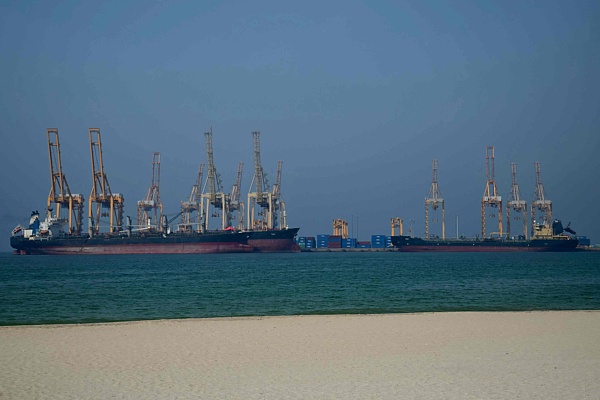
Tankers dock at a container terminal along the Strait of Hormuz on June 23, 2025. (File Photo: CFP)
Shipping traffic through the Strait of Hormuz has been declining since February 28 amid the US-Israel-Iran conflict, raising concerns about disruptions to one of the world's most critical energy transit routes.
The US announced a blockade of the Strait of Hormuz starting Monday following stalled talks between Washington and Tehran in Islamabad over the weekend. The move has further heightened regional tensions and added to uncertainty in global energy markets.
Guo Haitao, director of the Institute of Energy Economics and Finance at China University of Petroleum (Beijing), said the blockade has directly affected global crude oil supply by disrupting tanker traffic through the strait.
The Gulf region, currently embroiled in the US-Israel-Iran conflict, holds nearly 60 percent of the world's oil reserves and about 40 percent of its natural gas. The Strait of Hormuz is the only outlet from the Persian Gulf, through which more than a quarter of global seaborne oil and about one-fifth of liquefied natural gas shipments pass.
Guo noted that in the medium to long term, even if the blockade is lifted, oil prices are unlikely to return quickly to pre-conflict levels. Inventory drawdowns and shifting market expectations are likely to keep average annual oil prices elevated.
The blockade is already triggering cascading effects across various sectors.
The oil and gas industry is directly affected, as disruptions to crude transport impact refinery operations, while tighter natural gas supply puts pressure on related sectors. "Refineries are facing crude supply disruptions," Guo said.
The global shipping and logistics industry has also been hit. Disruptions caused by the blockade extend beyond oil and gas transport to the broader movement of goods, he said.
Shipping companies including Maersk and Hapag-Lloyd have temporarily suspended or rerouted some vessels passing through the Strait of Hormuz as tensions remain high.
The insurance sector is also facing rising risks. War-related concerns have sharply increased premiums, with some insurers withdrawing coverage, further constraining maritime activity.
Guo said the international marine insurance industry has been significantly affected since tensions escalated.
Petrochemical and manufacturing industries are also being impacted. "Oil is not only a fuel but also a key industrial raw material. Rising prices increase production costs across downstream sectors, including automobiles and construction materials," he said.
Agriculture and the food sector are also exposed. Guo noted that many fertilizers rely on natural gas or oil as inputs, meaning supply disruptions could affect global agricultural production. He added that while this impact is less visible to the public, it could be far-reaching.
At the macroeconomic level, higher oil prices are expected to drive up inflation and weigh on economic growth through increased production costs.
Guo said the global nature of the oil market means higher prices caused by the blockade will raise the cost of global economic growth.
He stressed that the situation remains highly uncertain. "If tensions ease and the blockade is lifted quickly, oil prices may fall rapidly. However, if the confrontation persists, elevated oil prices could continue to weigh on the global economy," Guo said.