


Iran's Supreme National Security Council (SNSC) said on Saturday the country is determined to exercise control and supervision over traffic through the Strait of Hormuz until the war is definitively ended and a lasting peace is achieved in the region.
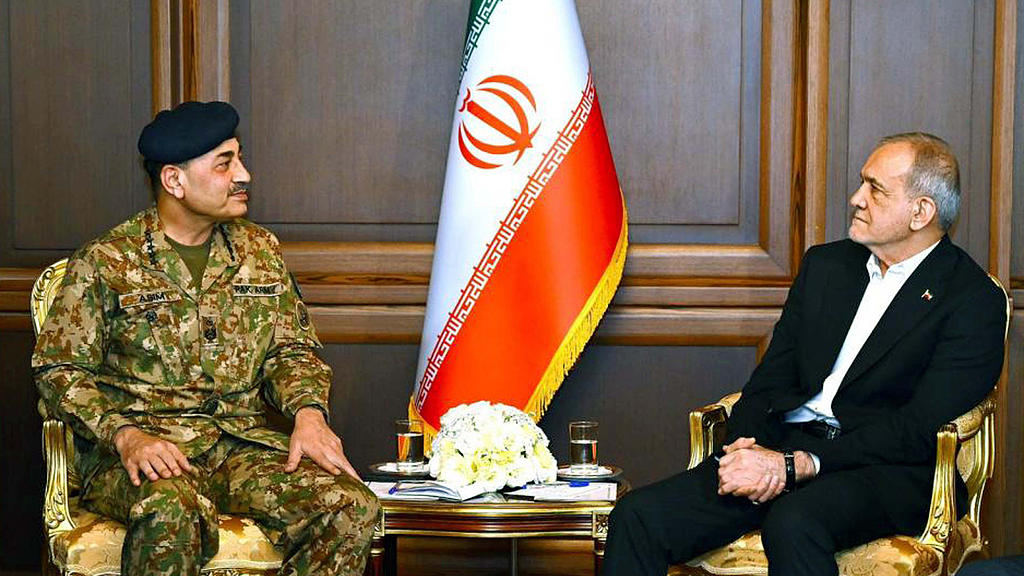
Iranian President Masoud Pezeshkian (R) talks with Pakistan's Army Chief Field Marshal Syed Asim Munir in Tehran, Iran, April 18, 2026. (Photo: VCG)
The statement, reported by Iranian media, came after Iran's main military command, Khatam al-Anbiya Central Headquarters, announced earlier in the day the resumption of strict control over the Strait of Hormuz, citing the continuation of a US naval blockade against Iran.
The SNSC said it will control the strait by demanding vessel information, issuing passage permits, charging fees for security and environmental services and directing traffic according to its regulations and wartime protocols.
The SNSC noted that a major part of the equipment for US bases in West Asia is supplied via the Strait of Hormuz, which it said poses a threat to Iranian and regional security.
It also said Iran has received new US proposals, delivered through Pakistan during a recent visit by its Army Chief Field Marshal Syed Asim Munir, and is reviewing them.
It added that Iran's negotiating delegation will not make any compromise and will defend the country's interests with full force.
In response, US President Donald Trump said that Washington is talking to Tehran and Iran cannot "blackmail" the United States with the Strait of Hormuz.
"We're talking to them. They wanted to close up the strait again ... and they can't blackmail us," Trump said at an event at the White House.
Earlier on Friday, both Washington and Tehran confirmed that the strait had been completely open for all commercial vessels. However, Trump said on Truth Social that the US naval blockade would "remain in full force." In response, Iran warned of closing the strategic waterway again if the US blockade continues.
Vessel tracking data showed that around 10 ships turned back on Saturday while attempting to pass through the waterway, following Tehran's renewed control over it.
Amid the escalating tensions, the US military is preparing in the coming days to board Iran-linked oil tankers and seize commercial ships in international waters, according to a Wall Street Journal report on Saturday.
The move will enable the US to take control of Iran-linked vessels around the world, including ships carrying Iranian oil that are already sailing outside the Persian Gulf and those carrying arms that could support Tehran, the report said.