


Vientiane (People's Daily) - China's first 500-kilovolt cross-border alternating-current interconnection project – the China-Laos 500 kV interconnection project – was commissioned on Monday. It is also the largest cross-border power grid project in terms of construction scale and the highest-voltage project between the two countries. The project increases bidirectional power exchange capacity from 50 megawatts to 1,500 megawatts, enabling the delivery of about 3 billion kilowatt-hours of clean electricity annually – equivalent to reducing approximately 2.5 million metric tons of carbon dioxide emissions. The project will support Laos' transition to greener energy sources and facilitate the optimized allocation of clean energy on a larger scale.
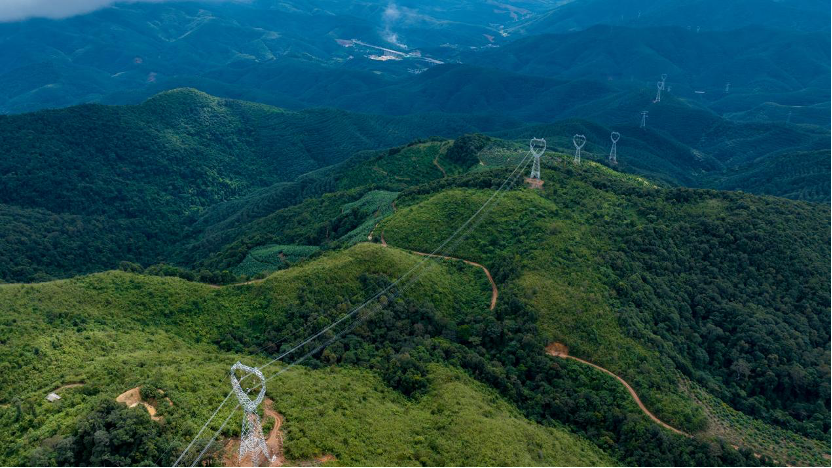
China-Laos 500 kV interconnection project aerial view. (Photos: China Southern Power Grid)
The commissioning coincides with 2026, which is designated the Year of China-Laos Friendship to celebrate the 65th anniversary of the establishment of diplomatic ties in 1961. The 500 kV interconnection is a significant project outlined in the action plan for building a China-Laos community with a shared future. This project marks another important milestone following the completion of the China-Laos Railway, highlighting the deep cooperation and high-quality collaboration between the two countries under the Belt and Road Initiative.
Construction began on February 26, 2025. The transmission line spans 177.5 kilometers, with 145 km in China and 32.5 km in Laos. It connects Yunnan Province in China to Oudomxay and Luang Namtha provinces in Laos. To facilitate this connection, a new 500 kV substation and two 230 kV lines have been built in Laos to integrate with the northern grid. The Chinese section of the project is built and operated by China Southern Power Grid (CSG), while the Lao section is managed by Electricite du Laos Transmission (EDL-T).
The two sides collaborated closely to integrate environmental, social and governance practices throughout the entire project life cycle, setting a benchmark for green infrastructure in the region. During the design phase, the route was optimized to avoid protected areas and residential zones, preserving about 170.4 hectares of forest. During construction, an innovative transport model was used, with more than 30 drones and two helicopters transporting over 5,000 tons of materials, reducing ecological disturbance by more than 90 percent.
Driven by digital and smart technologies, the project transformed traditional construction methods through smart site management. In the Lao section, EDL-T adopted CSG's technology to develop a localized smart construction site system. This system enables dynamic monitoring of operations and key areas, promotes mechanized construction to reduce safety risks, and improves efficiency.
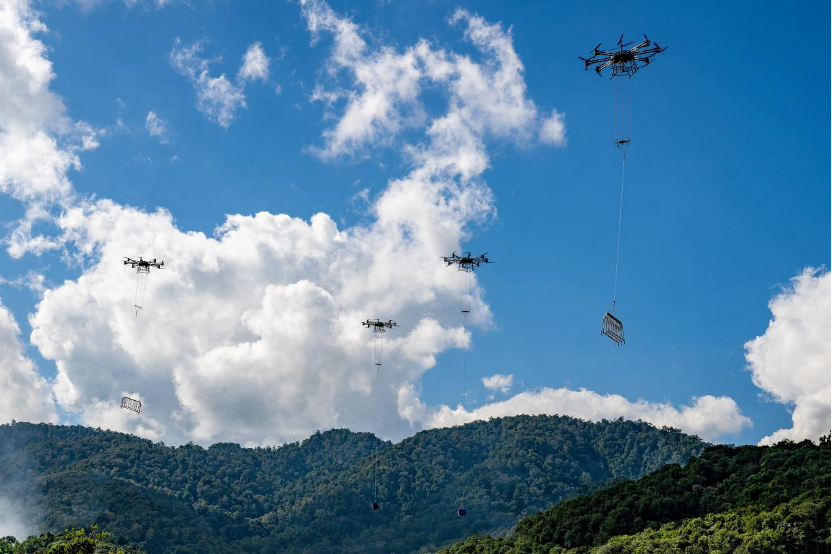
Drones transport construction materials over rugged terrain in China's section of the project.
In the Chinese section, CSG retrofitted construction machinery with intelligent technology. The company integrated IoT sensing to control all construction elements and established a real-time panoramic sensing network along the construction corridor. At the 500 kV Xishuangbanna Substation, robotic dogs and drones ensured precise and efficient inspection and acceptance processes.
During construction, both sides prioritized local hiring and professional management, employing over 500 Lao workers. The project provided skills training and hands-on exercises for over 1,600 Lao workers, enhancing local skills and developing the power sector workforce.
With support from the China-Laos Joint Laboratory on New Power System Technology, CSG and EDL-T conducted technology research and talent development to strengthen Laos' power sector capabilities. They also compiled a Chinese-Lao bilingual power engineering dictionary with the Kunming University of Science and Technology and the Confucius Institute at Souphanouvong University, bridging language and standards gaps.
On April 20, CSG opened China's southern regional power market to foreign participants, enabling new-energy power from northern Laos' clean energy base to enter trading schedules for the first time. This integrated physical transmission channels with market mechanisms, enabling regular cross-border trading from northern Laos and laying groundwork for exploring a Lancang-Mekong power market.
The project embodied the guideline: "Wherever major projects go, small community benefits follow." Local procurement created stable partnerships with Lao quarries and machinery rental companies, boosting employment and related industries.
When the project team found poor drainage in Namor district, they worked with local government, donated funds and upgraded road drainage facilities. This reduced flood risks and improved community living conditions.
In December 2025, a new primary school opened in Namor Tai village near the China-Laos border. This 3,185-square-meter campus, funded by EDL-T donations, improved local education access as part of the project's livelihood initiatives.
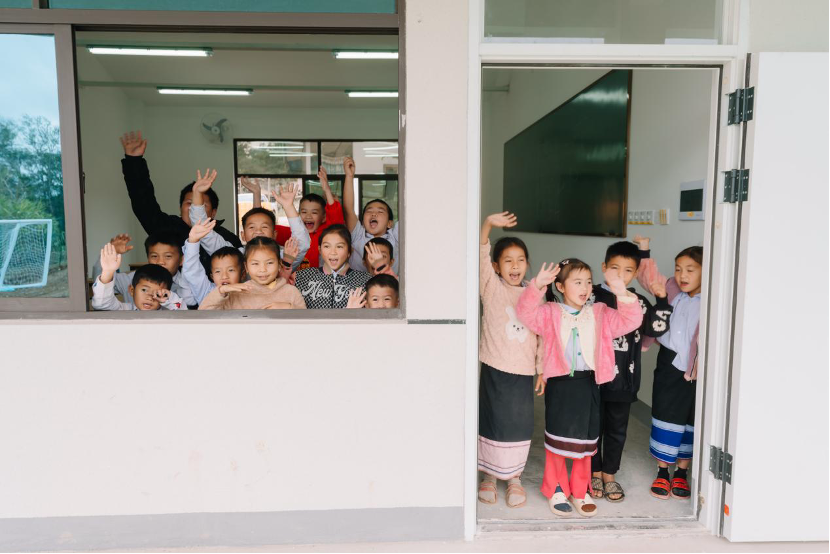
New primary school in Namor village, Laos, opened December 2025 as a 500 kV project community benefit.
In the same month, CSG donated five "Zhixing Reading Rooms" to schools in Namor district and Vientiane. Stocked with Chinese-Lao bilingual books and smart reading devices, these libraries use energy-saving materials to create modern reading spaces.
With CSG support, Laos launched its first sign-language TV program, helping 80,000 hearing-impaired people "see" the world. CSG also hosted a delegation from the "Hands of Hope" School for the Deaf in Guangzhou to learn effective education methods.
In the future, CSG and EDL-T will deploy advanced technologies to upgrade Laos' power grid, support its energy transition and deepen regional interconnections. Their work will build a high-quality China-Laos community with a shared future.