


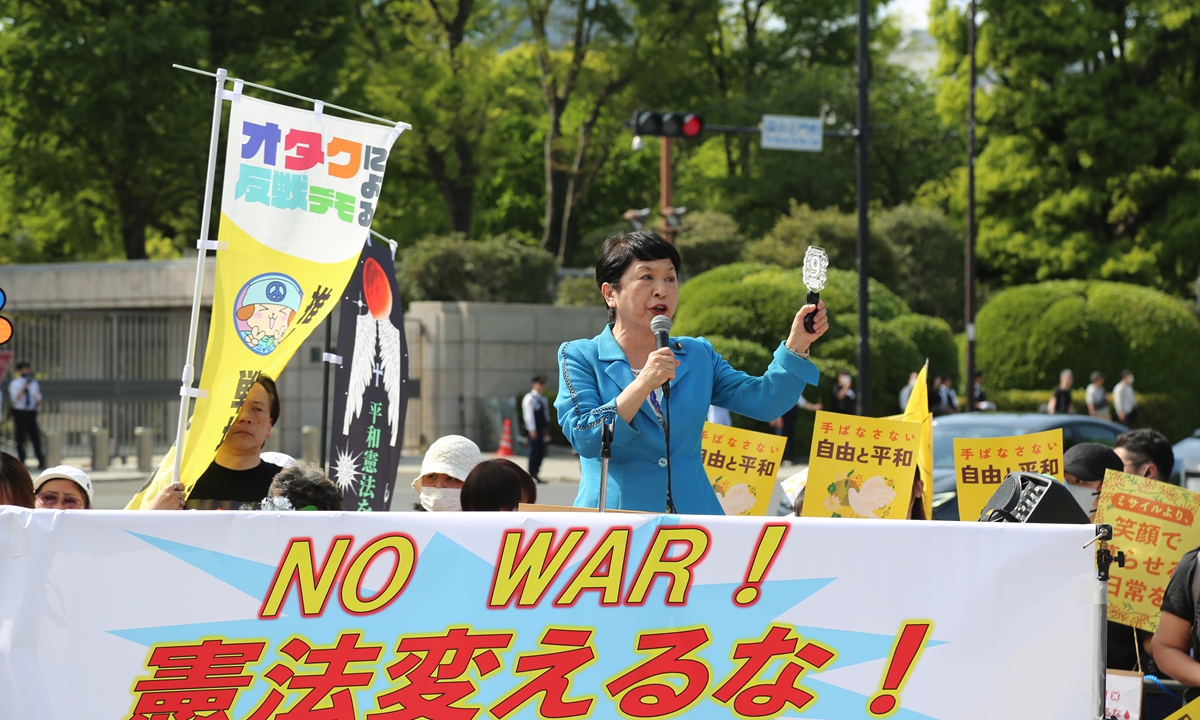
On April 19, 2026, more than 30,000 people gather in front of the National Diet Building in Tokyo to protest against moves by the Sanae Takaichi government to push for constitutional revision and lift restrictions on the export of lethal weapons, which they see as undermining Japan's pacifist Constitution. (Photo: VCG)
The Japanese government on Tuesday officially revised the Three Principles on Transfer of Defense Equipment and Technology and their implementation guidelines, allowing overseas sales of weapons, including those with lethal capabilities, according to media reports.
The policy shift has sparked opposition in Japan, with some Japanese netizens criticizing it as a departure from the country's postwar exclusively defense-oriented policy and warning that it could turn Japan into a "merchant of death." A Chinese expert also warned that the move reflects an alarming trend toward further remilitarization in Japan, which should raise concern in the international community, especially among Asian countries.
At a cabinet meeting and a National Security Council (NSC) meeting on Tuesday, the Japanese government revised the Three Principles on Transfer of Defense Equipment and Technology, as well as their implementation guidelines, which govern rules for defense equipment exports. The revision abolishes the "five categories" that had limited exports of finished products to non-combat purposes, and in principle permits the export of weapons with lethal capability, according to Kyodo News.
With countries such as the US in mind, Japan will also exceptionally allow arms exports to countries involved in ongoing conflicts when there are "special circumstances." Under the new rules, defense equipment will be classified into "weapons" and "non-weapons" depending on whether they possess lethal or destructive capability, per Kyodo.
Exports of weapons such as destroyers and missiles will be limited to countries that have signed agreements with Japan concerning matters such as protection of classified information. At present, 17 countries, including the US and the United Kingdom, have concluded such agreements. By contrast, there will be no restrictions on the destinations for exports of non-weapons such as bulletproof vests and warning/control radars, per Kyodo.
Arms exports will be reviewed by the NSC's four-minister meeting, consisting of the prime minister, chief cabinet secretary, foreign minister, and defense minister. When exports are approved, the Diet will be notified, according to the report.
The revision, described by Kyodo News as "a major shift in Japan's security policy," was widely reported by Japanese media on Tuesday, amid concerns that the move could fuel conflicts and intensify regional arms races.
Echoing Kyodo News, The Tokyo Shimbun and the Sankei Shimbun commented on Tuesday that the revision marks a major shift in Japan's security policy, which has long advocated a restrained approach to arms exports in line with its status as a "peace-loving nation."
Japan's latest policy shift sends a stark signal that it is accelerating its break from the postwar peace framework and moving further toward remilitarization. This marks another key step in Japan's transformation into a more overt military power, Xiang Haoyu, a distinguished research fellow at the China Institute of International Studies, told the Global Times on Tuesday.
Through a gradual "salami-slicing" approach, Tokyo is eroding the core restraints of its postwar exclusively defense-oriented policy, leaving the so-called "principle" largely hollowed out and existing in name only, said Xiang.
Japan's easing of arms export rules has also faced domestic opposition. Ahead of the official announcement on Tuesday, The Asahi Shimbun reported on Monday that 75 percent of respondents in its nationwide public opinion poll supported maintaining the Three Non-Nuclear Principles — not possessing, not producing, and not permitting the introduction of nuclear weapons — while 67 percent opposed arms exports.
Japanese Communist Party and House of Councillors member Taku Yamazoe said on X on Tuesday that "this is incompatible with a peaceful nation based on Article 9 of the Constitution. We strongly protest and demand its withdrawal."
Japanese Communist Party (JCP) Chair Kazuo Shii said on X on Tuesday that pushing through a major shift in security policy — once established as a "national policy" by a Diet resolution — through a single cabinet decision is utterly unreasonable, both procedurally and substantively. "We must not allow Japan to be reduced to a 'merchant of death' that profits from weapons. We strongly protest this decision and demand its withdrawal. We will do everything in our power to restore the ban on arms exports," he said.
Former Japanese House of Representatives member Tooru Miyamoto said on X that the Takaichi administration's decision to effectively lift the ban on lethal weapons exports amounted to a complete abandonment of Japan's long-standing national policy, rooted in the principles of the pacifist constitution and opposition to exporting weapons that could fuel international conflicts. "This will turn Japan into a country that supports illegal wars. Let's change the administration," he said.
On Tuesday, many Japanese netizens have also expressed opposition to the use of their tax money and their country's name in exporting weapons capable of killing and injuring people.
Koji Sugihara, a representative of a Japanese civic group Network Against Japan Arms Trade said on X that about 90 people staged an emergency protest in front of the Prime Minister's Official Residence on Tuesday morning to oppose the reversion.
Takaichi's recent moves to revise arms export rules and push for constitutional revision have sparked protests in Japan recently.
According to The Tokyo Shimbun, an emergency rally opposing the relaxation of restrictions on the export of lethal weapons was held on April 16 evening in front of the Prime Minister's Official Residence. About 170 people chanted slogans such as "Stop Arms Exports" and "No War."
On Sunday, a rally titled "NO WAR! Don't Change the Constitution!" was held outside the main gate of the National Diet to oppose Takaichi's push for constitutional revision. Organizers said 36,000 people gathered. Demonstrators chanted slogans such as "No to War" and "No to Constitutional Revision," while also criticizing the Takaichi administration with chants including "We don't need a prime minister who wants war" and "Resign! Resign!" The Sankei Shimbun reported on Monday.
Although Tokyo claimed it will not initially export heavy weapons, once institutional restraints are loosened, a broader expansion of arms exports is only a matter of time. Japan has repeatedly advanced military policy in incremental steps, gradually breaking through previous limits. The shift from non-combat equipment to lethal weapons, and from non-conflict areas to conflict zones, points to a clear pattern of expansion, said Xiang.
Japan's move risks further eroding the political and security trust that underpins China-Japan relations, heightening tensions in Northeast Asia, fueling regional arms competition, and increasing geopolitical frictions and the risk of conflict, said Xiang.
The international community should remain vigilant against Japan's military adventurism and rising militarism, and work together to uphold the global non-proliferation regime and regional peace and stability, sad the expert.