


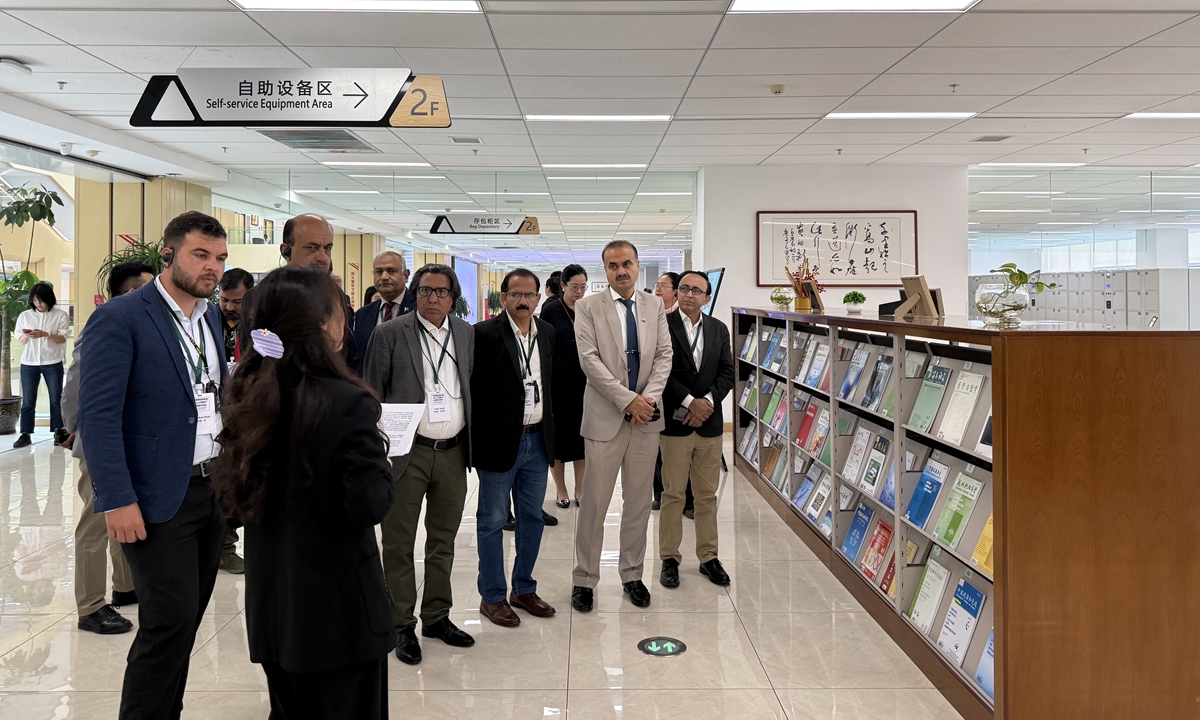
A delegation of Pakistani media and think tank representatives visits Xinjiang Medical University in Urumqi, Northwest China's Xinjiang Uygur Autonomous Region, on April 22, 2026. Photo: Ma Ruiqian
On Wednesday, a delegation of Pakistani media professionals and think tanks visited Xinjiang Medical University in Urumqi, Northwest China's Xinjiang Uygur Autonomous Region, gaining firsthand insight into China-Pakistan cooperation in medical education.
Rashida Shoukat, a journalist from Abb Takk News, told the Global Times that she had long been curious about the study environment, facilities and possible challenges faced by Pakistani students in China. The visit offered her an opportunity to interact with Pakistani students and better understand their real experiences of studying and living in Xinjiang.
Through conversations with the students, Shoukat found that the university attracts international students with a combination of strong government support, high-quality medical education, abundant clinical practice opportunities and a safe, welcoming environment with adequate language assistance, all of which help students integrate quickly and benefit both academically and professionally.
As a female journalist, Shoukat paid particular attention to female Pakistani students, noting that they feel comfortable studying in Xinjiang, with access to high-quality education and a supportive environment. "I will report this back in my country and encourage those who want to study in China to go ahead. It's a very positive initiative," she said.
Xinjiang Medical University is one of the top medical institutions in the region. As one of the first demonstration bases in Xinjiang for international education and among the first universities to accept Chinese government scholarship students, the university currently hosts 842 international students from 24 countries, including 315 from Pakistan. Generous scholarships are provided to Pakistani students, covering tuition, accommodation and living expenses. Xinjiang Medical University has also established a more efficient admission pathway for Pakistani students. To date, the pass rate of its graduates in the Pakistan Medical and Dental Council licensing examination has exceeded 90 percent, according to student representative Najeeb Ullah.
Ullah, a Pakistani PhD candidate in endocrinology and metabolism from the class of 2024, first came to the university in 2011 and has since completed his undergraduate and master's studies. "Since my enrollment, I have received scholarships and support from the Chinese government and the university, enabling me to focus on my studies without worries," he said.
"Here, I have met knowledgeable and patient teachers who constantly guide us to unlock our potential and pursue innovation. The advanced laboratories and abundant digital resources on campus have created an excellent learning environment. The student apartments are equipped with kitchens, gyms, laundry rooms and other facilities, bringing convenience to our daily life. This is not only a place for us to acquire professional knowledge, but also a place where we feel the warmth of home. China has become my second hometown," Ullah added.
Naureeta Yousaf, another Pakistani student, said she had multiple options for further study, including the UK and Australia, but ultimately chose Xinjiang Medical University because of its strong clinical training environment and proximity to hospitals. "I chose Xinjiang mainly because it has better opportunities, which provide strong clinical support for students. I would strongly suggest and encourage Pakistani students to come here," she said.
She added that students can experience a different culture, gain access to advanced technology and benefit from a welcoming environment where language is not a major barrier thanks to English support. "Since coming here, I have adapted well and gained a lot," she said, noting that her long-term goal is to return to Pakistan and contribute to improving the country's healthcare system by applying what she has learned in China.