


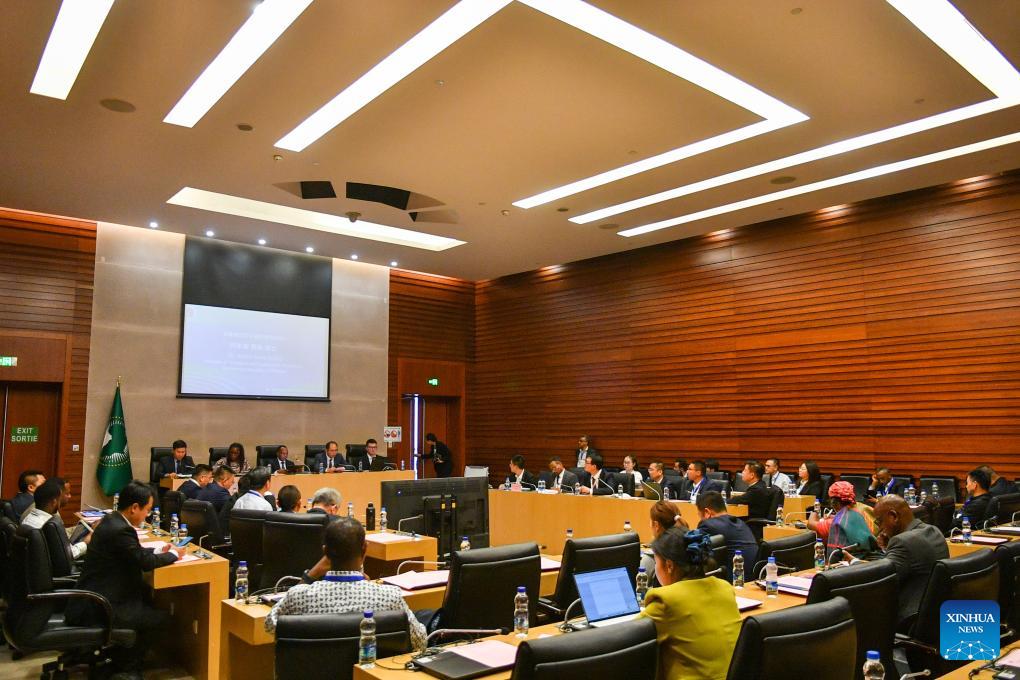
Guests attend the sidelines of the inaugural meeting of the China-Africa Entrepreneurs Summit at the African Union (AU) headquarters in Addis Ababa, Ethiopia, April 21, 2026. Officials and experts from China and Africa have called for further deepening China-Africa collaboration in infrastructure development, with the private sector taking a leading role in narrowing the widening infrastructure gap in Africa. The call was made on Tuesday on the sidelines of the inaugural meeting of the China-Africa Entrepreneurs Summit at the AU headquarters in Addis Ababa, the Ethiopian capital. (Photo: Michael Tewelde/Xinhua)
ADDIS ABABA, April 22 (Xinhua) -- Officials and experts from China and Africa have called for further deepening China-Africa collaboration in infrastructure development, with the private sector taking a leading role in narrowing the widening infrastructure gap in Africa.
The call was made on Tuesday on the sidelines of the inaugural meeting of the China-Africa Entrepreneurs Summit at the African Union (AU) headquarters in Addis Ababa, the Ethiopian capital.
The gathering brought together representatives of prominent Chinese companies operating in Africa, AU officials, and Chinese and African experts on infrastructure development.
Speaking at the event, Wang Ligui, counselor of the Chinese Mission to the AU, called for enhanced strategic alignment between the AU-led Program for Infrastructure Development in Africa and China's Belt and Road Initiative to accelerate infrastructure development on the continent.
"China and Africa need to make use of all cooperation platforms, such as the Forum on China-Africa Cooperation (FOCAC), to support infrastructure development in Africa. African countries need to improve the business environment, offer preferential policies and increase investment protection, so as to retain Chinese enterprises that are already doing business on the continent, and attract more," Wang said.
Nelisiwe Siphelele Mathabela, head of the administration and facilities management division at the AU Commission, said that Africa-China cooperation in infrastructure is a cornerstone of their partnership, driving industrialization and economic growth on the continent.
Noting that China has remained a leading infrastructure partner in Africa, she said China is a primary source of funding for infrastructure construction in Africa, with major roads, railways and energy developments having been financed either through the FOCAC or its financial institutions.
Ban Yongzhi, chief representative of the Southeast Africa Office of the Export-Import Bank of China, emphasized the significance of systematic thinking, integrated planning, and an optimized financing system to build a sustainable infrastructure development environment.
"Infrastructure projects are characterized by large investments, long cycles, broad social impact, and strong spillover effects. We must take a holistic and coordinated approach when planning strategically significant infrastructure projects," Ban said, advocating a balance of economic outcomes, social benefits, and livelihood impacts in infrastructure development.