


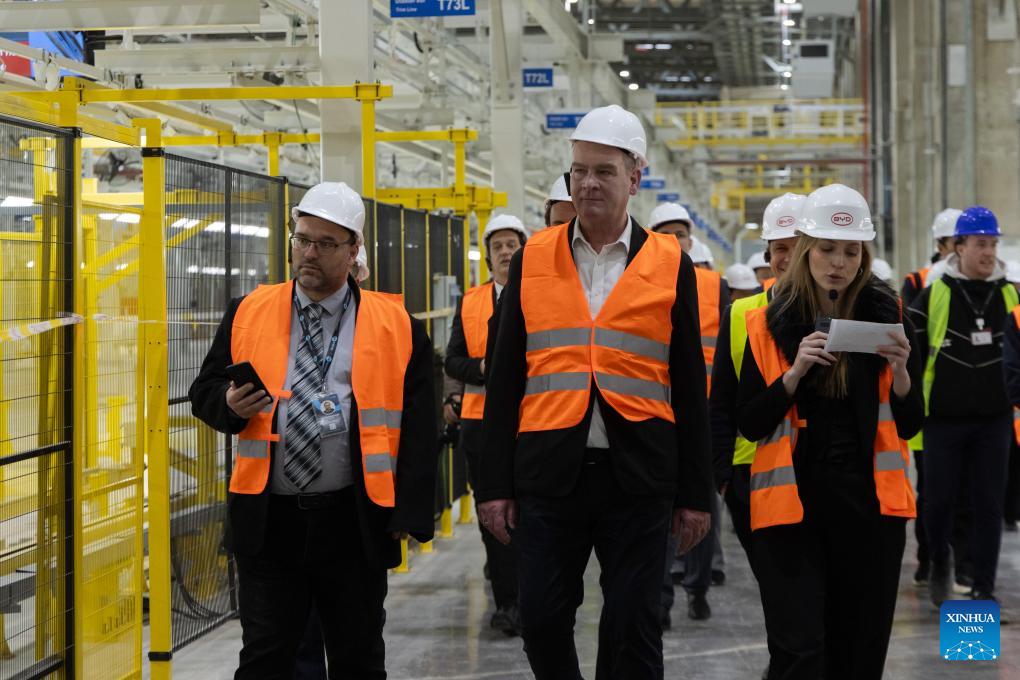
Szeged Mayor Laszlo Botka (C) visits BYD's new energy passenger vehicle factory in Szeged, Hungary, April 21, 2026. (Photo: Attila Volgyi/Xinhua)
SZEGED, Hungary, April 22 (Xinhua) -- The southern Hungarian city of Szeged welcomes Chinese investment and sees broad prospects for the cooperation with China, Szeged Mayor Laszlo Botka said in a recent interview with Xinhua.
Botka told Xinhua that Chinese automotive giant BYD's investment in Szeged has been "the largest industrial investment in the city's history," and said its success is in the interest "not only of Szeged, but of the entire Hungarian economy," and will help promote China-Hungary cooperation in advanced manufacturing and green industries.
Built on an area of about 3 million square meters, the plant will have an annual production capacity of 150,000 units in phase one. The final assembly facility of the plant has now entered the commissioning phase, while employee training is progressing in parallel.
Botka said that the factory is expected to create more than 10,000 jobs once completed, and the announcement in late 2023 that BYD would build its first passenger vehicle production base in Europe in Szeged, was widely welcomed by local residents.
Botka and Chinese Ambassador to Hungary Gong Tao visited BYD's new energy passenger vehicle factory in Szeged on Tuesday to learn about the progress of the project and exchanged views on deepening China-Hungary cooperation and promoting the development of green industries.
According to Botka, many local students who study in Szeged are willing to stay in the city if they can find suitable employment, creating a valuable labor pool for large-scale industrial projects such as BYD.
Beyond job creation, Botka said he expects the investment to bring wider benefits, including the development of local supply chains and cooperation with Hungarian companies.
"We expect that many companies in Szeged and the surrounding region will be able to establish partnerships with BYD," he said. "We also hope that advanced technologies will arrive in the city through this investment."
The BYD factory will contribute not only to the development of Szeged, but also to the entire region in the long term, he noted.
Botka also highlighted long-standing cultural and educational ties between Szeged and cities in China. The University of Szeged hosts a Confucius Institute, which he said plays an important role in promoting Chinese language and culture in the city.
Chinese language learning is particularly popular in the city, he said, adding that proportionally, one of the highest numbers of students studying Chinese in Hungary can be found in Szeged.
As to the upcoming new government in Hungary, Botka said that, based on his experience, successive Hungarian governments, regardless of political affiliation, have consistently sought to maintain strong economic relations with China, and he does not expect any significant change in this regard under the new government.
"Szeged is an open city," he said. "We support all investments that contribute to economic development, and we are open to further Chinese investments."