



Photo: CFP
Editor's Note: In this article, Huan Shitong and Zhou Qing'an, researchers from the Global Development and Health Communication Center at China's prestigious Tsinghua University, reflect on the life-saving progress vaccines have delivered across generations and the serious threats now undermining those hard-won gains. They argue that vaccine hesitancy is no longer driven solely by viral misinformation, but increasingly by the erosion of scientific authority at the highest institutional levels. They point out that only through trustworthy, independent and consistent health communication upheld by the broader global health community can public confidence in immunization be restored for the long run.
Every April, World Immunization Week reminds us of the life-saving power of vaccines. The 2026 theme, "For every generation, vaccines work," underscores a critical paradox of our time. Vaccines have saved over 150 million lives in the past five decades, yet global vaccination programs face an unprecedented crisis of confidence. The World Health Organization (WHO) warns that about 21% of the global population is vaccine-hesitant, and in 2024, over 14 million children never received any doses of vaccination. In 2019, vaccine hesitancy was already named one of the top 10 global health threats.
The most infamous case of vaccine hesitancy remains the now-debunked 1998 study by Andrew Wakefield, falsely linking the MMR (measles, mumps, rubella) vaccine to autism. Despite the study's retraction and decades of WHO research confirming no such link, the damage was lasting. MMR coverage in the UK plummeted from 92% (1995-1996) to 80% (2003-2004), leading to a resurgence of measles. The lesson is painful. Once misinformation takes hold, fear often outruns the truth.
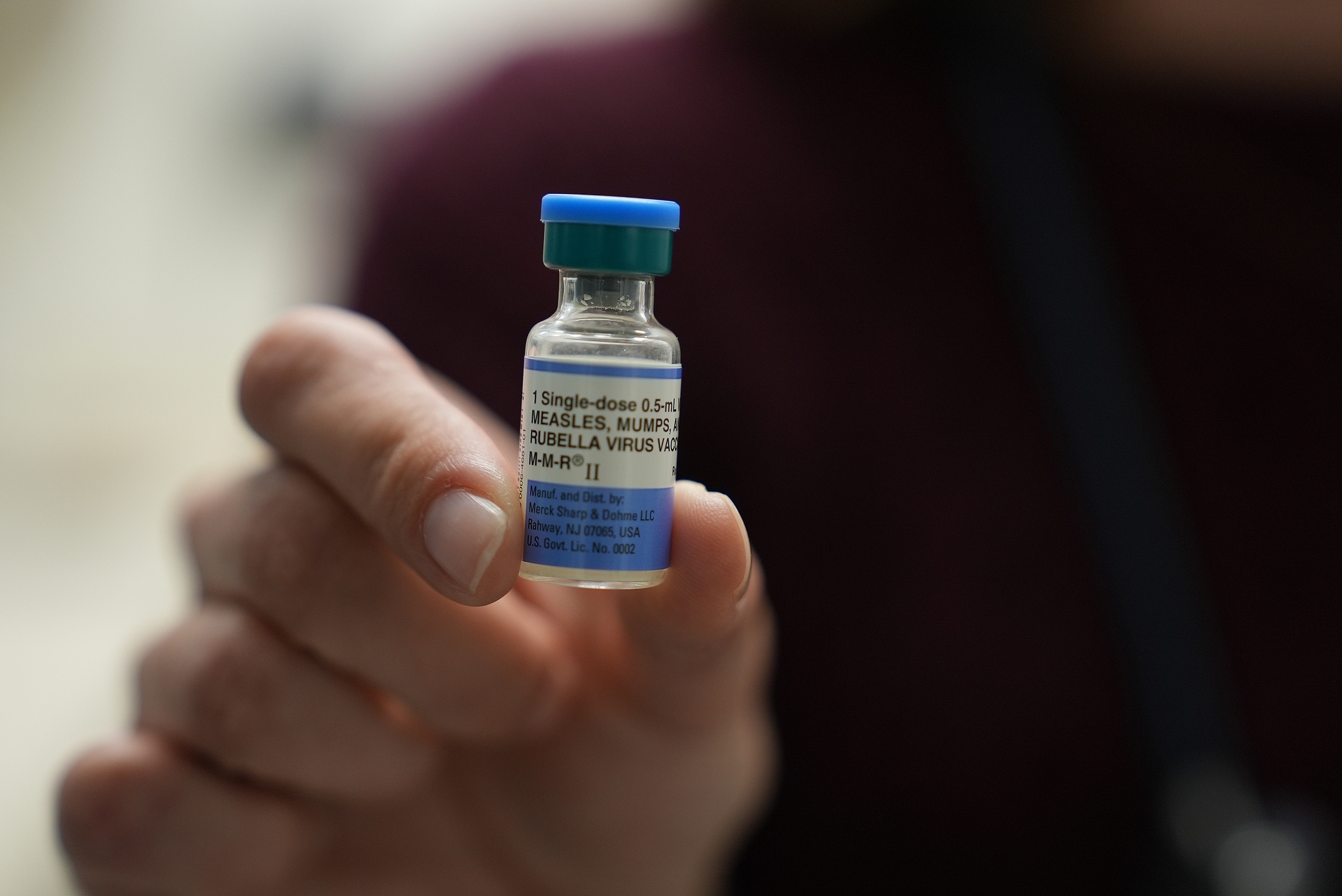
A doctor holds a vial of the combination measles, mumps and rubella vaccine at Prisma Health Pediatrics in Greer, South Carolina, United States, March 18, 2026. (Photo: CFP)
However, the problem is no longer just about viral falsehoods. A more alarming development has emerged: the erosion of scientific authority by national policy itself. In November 2025, the United States' Centers for Disease Control and Prevention (CDC), without public notice, altered a long-standing scientific conclusion on its official website. The original statement that "research shows no association between vaccination and autism spectrum disorder" was replaced with language suggesting that "the statement 'vaccines do not cause autism' is not an evidence-based claim" and that studies supporting a link have been "ignored by health authorities." This change was widely seen as a direct result of political pressure from a vaccine-skeptical health secretary.
The scientific community reacted with outrage. The American Academy of Pediatrics, along with over 60 medical organizations, condemned the move as promoting "outdated and disproven views." Dr. Michael Osterholm of the University of Minnesota called it "a tragic day for public health and for science." Dr. Jack Scott, clinical associate professor in the Division of Infectious Diseases and Geographic Medicine at Stanford University School of Medicine, warned that parents seeking reliable information would now find official language that seems to validate long-refuted fears, leading to delayed or skipped vaccinations. Concurrently, the CDC significantly reduced its pro-MMR vaccine messaging on social media.
The consequences are already visible. By April 2026, US measles cases reached 1,671 in just over three months – nearly 75% of the total cases for the entire previous year. Among these, 92% were unvaccinated or of unknown status. The US, which eliminated measles in 2000, is now at high risk of losing that status in the official 2026 assessment. When the very agency responsible for disease control begins to question settled science under political influence, vaccine hesitancy transforms from a social phenomenon into a state-endorsed behavior.
This brings us to the core of the problem: the collapse of informational authority. In an era of political polarization and short electoral cycles, national health policies can swing dramatically with each new administration. If even the CDC can retract decades of scientific consensus, no country's immunization policy is immune to similar interference.
Therefore, solving vaccine hesitancy cannot rely solely on national policy consensus. We must build a global health information public good – a science-based, transparent, and trustworthy infrastructure that transcends national politics. The WHO has already taken steps in this direction with platforms such as data.who.int, which offer health data as a free public good. Other organizations, including the World Bank, Gavi, the Global Fund, OECD, IHME, and academic centers like Tsinghua University's Global Development and Health Communication Center, are also working to ensure that best practices and scientific evidence are equally accessible to all countries and populations.
In a fragmented, polarized and trust-depleted world, the most critical resource may not be a new vaccine, but reliable information. We need a global commitment to protect public health communication from political interference – making factual, consistent and independent health guidance a public good available to every family.
Only then can parents make decisions based on evidence, not fear, and restore the confidence that immunization programs desperately need to save the next generation.