


Blending, reinterpreting and innovating: Chinese designs in Milan
MILAN, Italy, April 24 (Xinhua) -- During the ongoing 2026 Milan Design Week, Chinese designs are making frequent appearances across the streets of Milan. Some integrate into local communities by telling stories that connect China and Italy; others blend traditional Chinese elements with contemporary art, while still others reshape spaces using innovative materials and technologies.
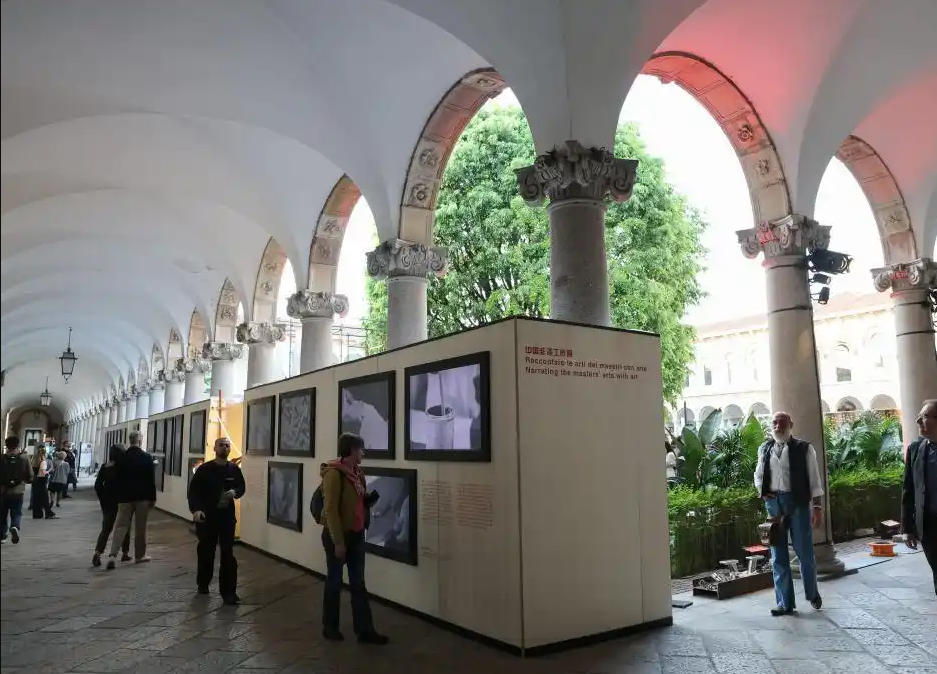
Photo: Xinhua
With growing experience on the international stage, Chinese designers are attracting increasing attention through urban installations, contemporary craftsmanship, material and technological innovations, and new lifestyle concepts.
BLENDING WITH CHINATOWN
Many Chinese designers have chosen Milan's Paolo Sarpi area, the city's historic Chinatown, as a starting point.
On Monday, the 2026 edition of China Week opened in the Zona Sarpi design district with the unveiling of a 100-meter painted scroll wrapping a local building. The street installation, titled Bridge of Civilizations, tells the story of Italian missionary Matteo Ricci, one of the most influential cultural bridges between East and West in the 17th century.
Sun Qun, one of the initiators of Milan Design Week China Week, told Xinhua that the event could turn the neighborhood into a window for Chinese design and a space for urban renewal. As more Chinese designers entered the district in recent years, local Chinese shop owners have been more active in redesigning storefronts and display windows.
Hu Yuehua from southwest China's Yunnan Province is among the artists showcasing her work at the China Street exhibition area. Inspired by nature, her designs draw on the colors, shapes and lines of plants, fungi, mountains and terraced fields. Yet rather than depicting these elements directly, her works present a contemporary, abstract aesthetic.
"I want to express these ideas in a way that is more contemporary and closer to people today," she said.
Milan's Chinatown has increasingly become a trendsetting space, as designs displayed there each year gradually integrated into the city's everyday visual and social fabric.
RESHAPING TRADITION
Traditional Chinese elements are prominently featured during Milan Design Week. At Palazzo Litta, one of Milan's historic buildings, Hong Yao intangible cultural heritage is reinterpreted in a carpet design.
Xie Molin, founder of Cybos Carpets, said her team worked with a national-level inheritor of Hong Yao intangible cultural heritage to translate traditional weaving techniques into contemporary carpet design.
"Only when a craft is used can it truly be inherited and remembered," she said, adding that she hopes to bring Chinese craftsmanship to a global audience by integrating it into modern design and everyday life.
At the Salone del Mobile fairgrounds, a group of emerging designers under 35 from Donghua University's College of Fashion and Design presented works combining ethnic minority motifs, embroidery techniques and digital tools.
Associate Professor Tian Yujing said she and her students regularly travel to rural areas to collect traditional patterns and craft methods, then reinterpret them through modern techniques and expressions that resonate with younger consumers.
Also at the fairgrounds, the exhibition Origins of Chinese Aesthetics: Liangzhu Culture and Contemporary Creation transformed imagery linked to Liangzhu civilization, including jade cong, rice cultivation and water motifs, into installations and contemporary artworks. Professor Zhang Junjie of the China Academy of Art said the exhibition aims not to present Liangzhu as archaeology, but to reactivate its creativity through contemporary aesthetics and new technologies.
CONNECTING WORLD AND FUTURE
At the main exhibition area of the Salone del Mobile, Chinese participation also drew attention. They are no longer limited to showcasing standalone products but are shifting toward offering integrated spatial solutions. Some Chinese companies used installations, material innovation and cross-sector collaboration to present visions of future lifestyles.
Ma Qingjiang, founder of Chinese outdoor lifestyle brand YARDCOM, said future competition will increasingly depend on the ability to integrate materials, technology, design, spatial solutions and service systems.
Stefan Antoni, founder of South African architecture firm SAOTA, told Xinhua that China has become "a very exciting country to follow." Chinese design stands out for its sense of culture, history and continuity, as well as its depth and connection to nature, he said, adding that "it is very inspiring" as China today provides not just products, but also ideas and creativity.
Francesco Leoni, a Milan-based attendee, said Chinese culture is being presented in a way that feels "very accessible" and "very interesting to explore."
Through Milan Design Week, it is difficult to define a single characteristic of today's Chinese design. It appears in standalone displays as well as across diverse urban and institutional settings. It reflects Chinese cultural identity while engaging with global lifestyle trends. It is both distinctive and universal, combining strong visual impact with cultural appeal.
These works reflect sustained engagement with China's cultural roots and the broader upgrading of Chinese manufacturing toward greener, higher-end and more integrated development. At one of the world's most influential design platforms, Chinese cultural confidence, craftsmanship, innovation, and international outlook are increasingly shaping a diverse design landscape -- offering a more vibrant image of China.