


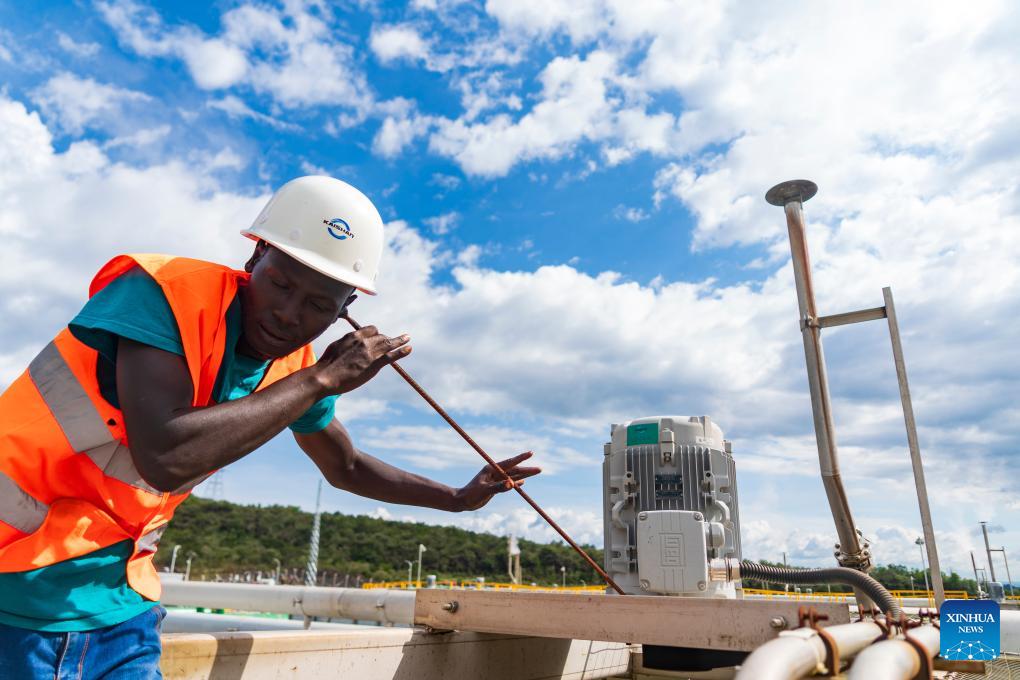
A staff member inspects at the Orpower 22 Geothermal Power Plant built by Chinese firm Kaishan Group in Nakuru County, Kenya, April 20, 2026. (Xinhua/Xie Jianfei)
NAIROBI, April 24 (Xinhua) -- Hell's Gate National Park, about 100 km northwest of Kenya's capital city of Nairobi, is famed for its dramatic, otherworldly landscape. Less known is its central role in powering Kenya's electricity grid.
Sheer red cliffs rise like walls carved by ancient volcanic forces. Between them, compact power units dot the savannah, while steel pipelines thread through acacia groves, channeling underground heat into turbines.
Zebras, antelopes and giraffes graze nearby, largely indifferent to occasional plumes of steam. Here, geothermal energy is converted into electricity and fed directly into the national grid.
This striking setting underpins a rare distinction: geothermal power supplies more than 40 percent of Kenya's electricity, which is widely regarded as the highest share in the world.
ANCHOR FOR POWER PRICES
Data from Kenya's Energy and Petroleum Regulatory Authority and the International Energy Agency show geothermal has consistently contributed 40 to 48 percent of Kenya's electricity in recent years. Much of this output comes from the Olkaria geothermal field within Hell's Gate.
Located along the Great Rift Valley, Olkaria hosts one of the world's most concentrated high-enthalpy geothermal reservoirs. Kenya's total geothermal potential is estimated at around 10,000 MW, yet by the end of 2025 installed capacity remained below 4,000 MW-leaving most resources untapped.
Once built, geothermal plants have near-zero fuel costs. In Kenya, generation costs about 0.07-0.08 U.S. dollar per kilowatt-hour, compared with over 0.2 dollar for heavy fuel oil. For a country with limited fossil fuel reserves, this gap has been transformative: expanding geothermal capacity has helped stabilize industrial tariffs, cushioning the economy from imported inflation and supporting manufacturing competitiveness.
Unlike wind and solar, geothermal provides reliable baseload power, operating around the clock with annual utilization exceeding 8,000 hours. During droughts, when hydropower output drops, it fills the gap and helps stabilize the grid.
Its applications extend beyond electricity. Near Lake Naivasha, the Oserian flower farm uses geothermal heat to warm its greenhouses, making it the country's only fully renewable-powered flower farm. The state-owned Geothermal Development Company (GDC) has also expanded direct-use projects across sectors, including milk pasteurization, aquaculture and greenhouse heating.
DISRUPTING MONOPOLY
Kenya's geothermal journey dates back to the 1950s. The commissioning of the Olkaria I plant in 1981 made it the first African country to generate electricity from geothermal energy.
For decades, however, progress was slow. That dynamic has shifted in recent years, with Chinese companies offering more cost-effective solutions. Leading the push is Kaishan Group, though its entry into the market was not easy.
"Initially, the Kenyan government was sceptical of us," Chairman of Kaishan Group Cao Kejian said. "So the company funded the construction of the first plant, over 53 million U.S. dollars."
The move paid off. As EPC contractor, Kaishan built the Sosian Menengai plant, the first privately operated geothermal facility in the Menengai field, which began operations in August 2023 after passing third-party assessments.
After establishing its credentials, Kaishan transitioned from contractor to investor. In late 2023, it acquired OrPower 22, an independent power producer at Menengai, and launched a new plant. Completed in 14 months, the facility began commercial operations in March 2026, becoming Africa's first geothermal project fully invested in, built and operated by a Chinese company. It is now regarded as one of the best-performing geothermal plants in Kenya.
The company is also expanding beyond power generation. At Olkaria, it is developing an integrated geothermal-to-hydrogen-and-ammonia project. A 165.4 MW plant will generate electricity to produce green hydrogen through electrolysis, which will then be combined with nitrogen and naturally occurring carbon dioxide to manufacture green ammonia and fertilizers.
The project is expected to produce 180,000 tonnes of urea and 300,000 tonnes of calcium ammonium nitrate annually, helping reduce Kenya's reliance on imported fertilizers and lower costs for farmers.
At the project ceremony, Kenyan President William Ruto said the investment is "efficient, reliable and sustainable," adding that it would enhance food security and "save Kenya vast sums of hard currency previously spent on importing fertilizer, marking a significant stride toward climate-resilient green industrialization."
Kaishan's General Manager Tang Yan said the company aims to deepen cooperation with Kenya. "We hope to work hand-in-hand with Kenya's energy sector," he said.
"We will jontly leverage Kaishan's modular geothermal technology and Kenya's extraordinary resources to build a green energy ecosystem covering clean power, green hydrogen, green ammonia and green methanol, and together lead Africa toward a greener and more sustainable future," he added.
BUILDING GREEN TOGETHER
Since taking office, the Kenya president has made "green industrialization" a central pillar of his agenda. At his inauguration, Ruto said Kenya is "on a transition to clean energy that will support jobs, local economies and sustainable industrialization," urging African nations to harness their renewable potential.
Kenya aims not only to meet its own energy needs but also to demonstrate that developing countries can achieve rapid growth while honoring climate commitments. In that effort, China has emerged as a key partner.
At the Forum on China-Africa Cooperation Beijing Summit, China announced 10 partnership actions to advance modernization, including a green development partnership focused on clean energy projects across Africa.
In Kenya, these efforts span multiple sectors. China Gezhouba Group is building the Thwake Dam to boost water security and irrigation. In Garissa County, a Chinese-built 50 MW solar plant supplies clean power to underserved communities. In Nairobi, Chinese firms are contributing to the Dandora waste-to-energy project, converting waste into electricity.
Grid infrastructure has also improved. China Energy Engineering Group constructed the Kenya-Tanzania 400 kV interconnector, while State Grid Corporation of China supported East Africa's first high-voltage direct current line linking Ethiopian hydropower to Kenya. Together, these projects have helped transform Kenya's grid into a regional network.
"As a global leader in this space," Ruto has said, "Kenya continues to demonstrate how every nation can achieve sustained, rapid and transformative growth while remaining true to climate action commitments."
Deep in the Rift Valley, steam continues to rise from beneath the earth. Turbines hum quietly among the acacia trees, converting this subterranean energy into light for millions, and soon, into nutrients for the nation's fields.