


How China-proposed Global Development Initiative safeguards global food security
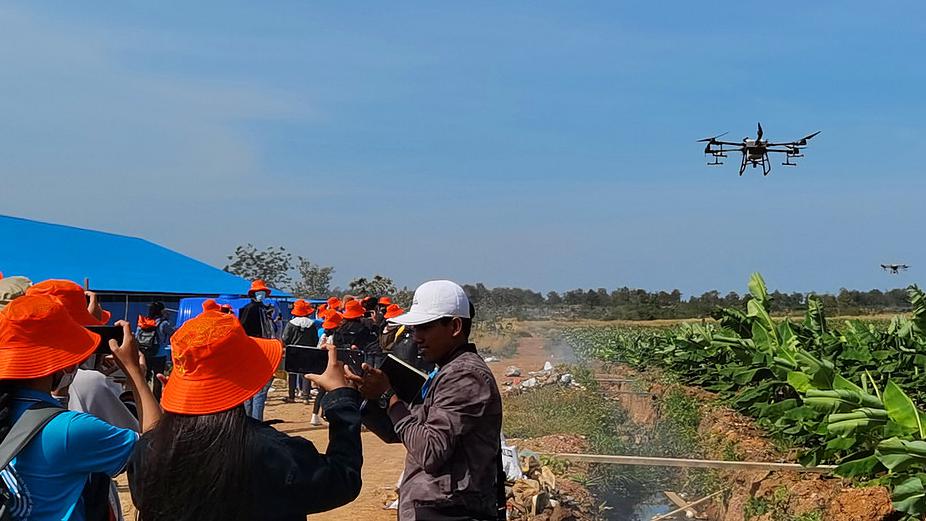
Local trainees observe a China-made drone spraying pesticide at a farm in Cambodia, December 4, 2021. (Photo: VCG)
Cambodia has seen improvements in farming efficiency with smart farm pilot projects featuring China's rice-shrimp co-culture and rotation methods.
Chinese agricultural experts introduced aeration, provided high-quality seed and implemented water-quality monitoring systems, which helped develop large-scale prawn seedling cultivation technology, enabling mass production of prawn seedlings.
The results have been promising. Sab Sarun, a local farmer in the Smart Farm Integrated Development Pilot Program, said that on an annual basis, each kilogram of shrimp sells for about $17, so 1 tonne generates $17,000 in revenue. "This is much higher than the income from traditional farming alone."
The successful agricultural development in Cambodia is part of a broader suite of agriculture-focused projects launched under the Global Development Initiative (GDI) across the Global South.
Proposed by Chinese President Xi Jinping in 2021, the GDI serves as a global platform focusing on key areas such as poverty reduction, food security, development financing, tackling climate change, green development and the digital economy.
The initiative's emphasis on food security has become even more critical as global challenges such as regional conflicts and climate fluctuations have exacerbated food insecurity.
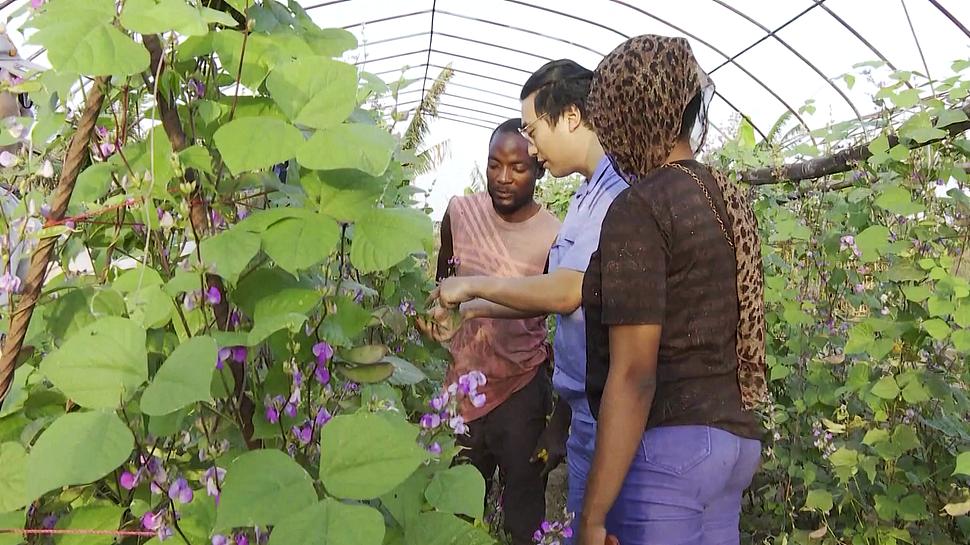
A Chinese agricultural technician teaches Africans grow crops. (Photo: VCG)
Shared development
The 2026 Global Report on Food Crises, released by an alliance of UN agencies, the European Union and other partners, revealed that 266 million people in 47 countries and regions faced high levels of acute food insecurity in 2025, nearly twice of the number in 2016.
This report underscores the growing persistence of food insecurity, highlighting it as a long-term global challenge rather than a series of temporary crises.
With food security and poverty reduction at the core of the GDI, China has actively fostered agricultural cooperation with the international community. In the past five years, China has increased its funding for the Global Development and South-South Cooperation Fund to $4 billion, according to the China International Development Cooperation Agency (CIDCA).
In collaboration with over 20 international organizations, including the United Nations Development Programme and the World Food Programme (WFP), more than 200 projects have been implemented across over 70 countries and regions, benefiting more than 40 million people, said the CIDCA.
In September 2022, China hosted the Ministerial Meeting of the "Group of Friends of the Global Development Initiative," unveiling the first batch of GDI projects. This included 50 practical cooperation projects in areas like poverty reduction, food security and industrialization, as well as 1,000 capacity-building programs.
Since September 2021, agricultural projects have been implemented in more than 10 countries, including Ethiopia and Zimbabwe, with more than 200,000 beneficiaries, according to a report titled Progress Report on the GDI 2025.
A total of 29 high-quality varieties of rice, corn and vegetables have been introduced to these countries, with nearly 5,000 new technologies shared in crops, poultry, animal husbandry and veterinary medicine, water conservancy and gardening, and more than 20,000 agricultural professionals trained, sowing the seeds for agricultural development in these countries, said the report.
Dima Al-Khatib, director of the United Nations Office for South-South Cooperation, spoke highly of GDI, describing it as a framework of cooperation that can support advancing agriculture and making good use of the expertise of China.
Simon Clements, deputy director of the WFP China Office, which established a Center of Excellence for Rural Transformation in China, echoed this sentiment, "We know there's a lot of expertise, best practices, technology and policies that we can share."