


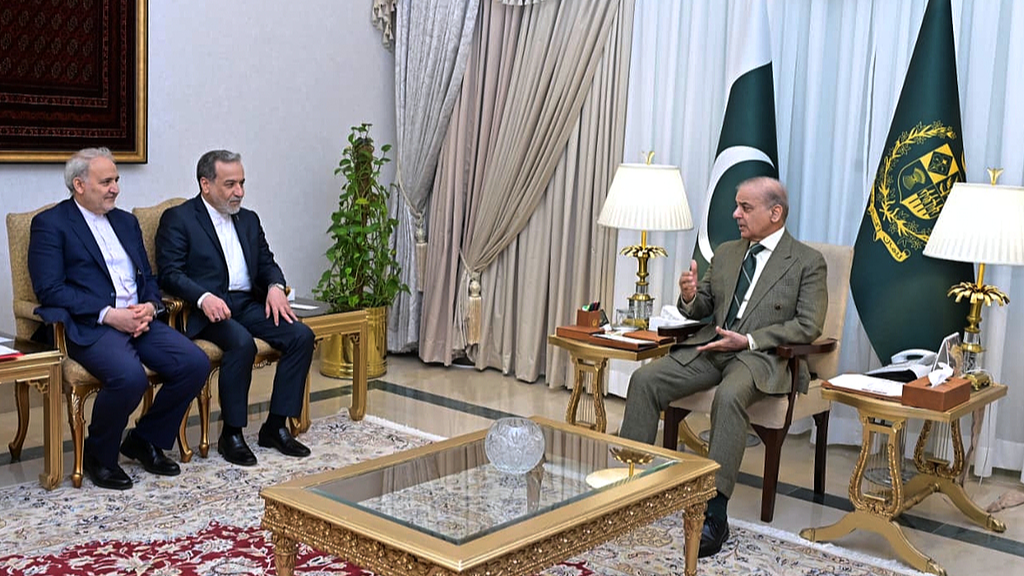
Iran's Foreign Minister Seyed Abbas Araghchi (2L) meets with Prime Minister Shehbaz Sharif (R), Islamabad, Pakistan, April 25, 2026. (Photo: VCG)
Iranian Foreign Minister Seyed Abbas Araghchi has conveyed Tehran's conditions for ending the war to the United States through Pakistan, presenting a three-stage proposal aimed at de-escalation, according to Iranian sources.
Araghchi arrived in Islamabad on Sunday following a brief stop in Oman, marking his second trip to the Pakistani capital in recent days as part of a broader regional diplomatic push.
According to the proposal, the first phase centers on a full cessation of hostilities and binding guarantees to prevent renewed attacks on Iran and Lebanon. Only after such commitments are secured would negotiations move to a second phase focused on the management and security of the Strait of Hormuz. A third phase would address Iran's nuclear program, though Tehran has stressed it will not engage in nuclear talks until progress is made in the earlier stages.
Iran's semi-official Fars News Agency reported that Araghchi also delivered written messages to Washington outlining Tehran's "red lines," particularly on its nuclear program and the Strait of Hormuz. The report said the message was intended to clarify Iran's position rather than serve as a formal negotiation.
Araghchi is expected to visit Russia next, concluding his regional tour.
Despite these diplomatic efforts, significant differences remain. US President Donald Trump said he had canceled a planned US delegation visit to Pakistan, calling further engagement "a waste of time."
"If they want to talk, they can come to us, or they can call us," Trump told Fox News. "We're not sending people to travel 18 hours to meet." He reiterated that Iran must not develop nuclear weapons. "Otherwise, there's no reason to meet."
Iranian President Masoud Pezeshkian criticized Washington's approach, saying continued pressure and hostile actions are eroding trust and hindering the prospects for renewed dialogue. In a statement, he said the United States cannot pursue negotiations while simultaneously escalating pressure, as such actions "disrupt the necessary atmosphere" for diplomacy.
Meanwhile, tensions around the Strait of Hormuz are intensifying, with growing concerns over global economic fallout. The disruption has sharply reduced shipping traffic through the corridor, pushed up global oil prices, and added strain to an already fragile world economy.
Trump on Sunday held a call with British Prime Minister Keir Starmer, emphasizing the "urgent need" to restore maritime traffic through the vital route.
Starmer warned that weeks of disruption have left many seafarers stranded in the Gulf and cautioned that prolonged blockage could have "serious consequences" for the global economy and drive up living costs in the United Kingdom.
Iran, however, signaled a firmer stance. Ebrahim Azizi, head of parliament's National Security and Foreign Policy Committee, said vessels passing through the strait would be required to pay fees, describing the waterway as a key pillar of Iran's strategic leverage.
On February 28, Israel and the United States launched joint strikes on Tehran and other Iranian cities, killing senior figures and civilians, including Iran's then-supreme leader Ali Khamenei. Iran responded with missile and drone attacks targeting Israel and US assets across the Middle East, while tightening control over the Strait of Hormuz.
A ceasefire declared on April 8 was followed by Iran-US talks in Islamabad on April 11-12, but the negotiations ultimately collapsed. The United States later imposed a blockade affecting transit to and from Iranian ports via the strait.