


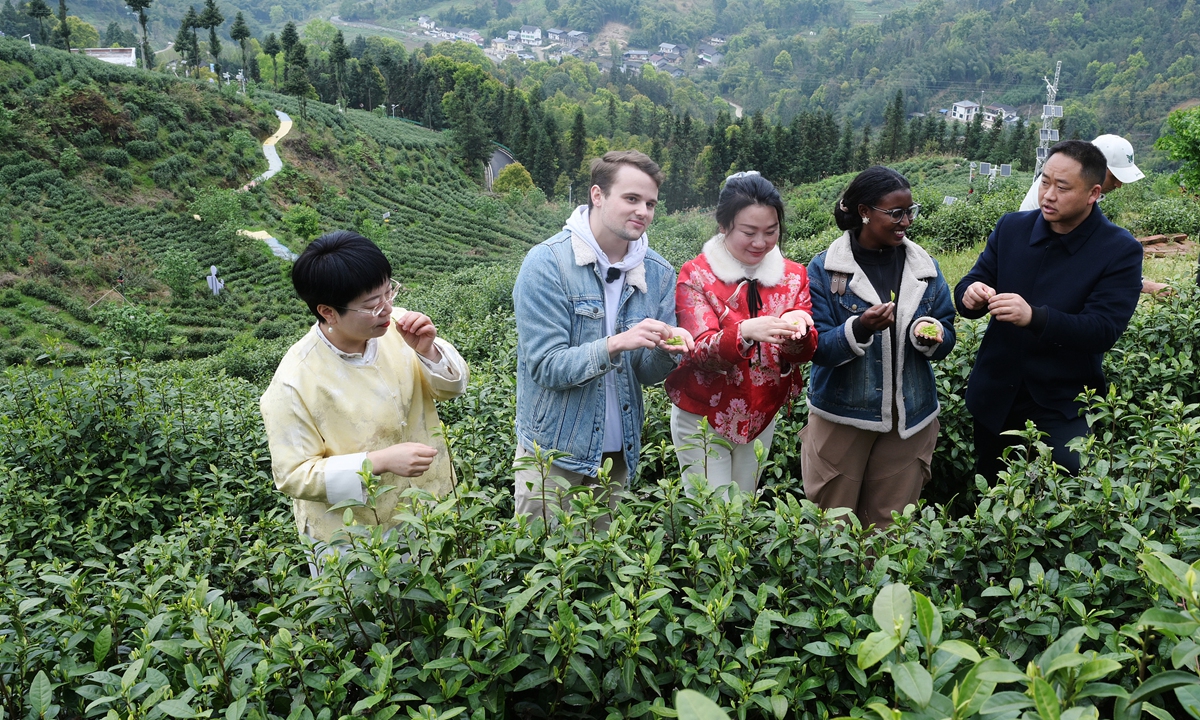
International students learn tea-picking skills at a tea plantation in Dazhou, Southwest China's Sichuan Province on March 20, 2026. (Photo: VCG)
At a time of profound global transformation, an increasing number of international students are coming to study China's development theories, models and practical experience. They use China's governance system as a reference point to rethink themselves, their home countries and the wider world. What motivates the journey of these foreign students as part of a young generation of sinologists, what questions guide their inquiry and what insights do they gain? The Global Times invites two young scholars, respectively from Germany and South Korea, to share their reflections.
Christian Wagner, PhD student at the School of New Media at Peking UniversityI worked as a mechatronics technician in Germany while pursuing a law degree. Later, despite having a stable and well-established career, I decided to study a Master of Laws at Renmin University of China.
My own path began far from academia. We are living in a time of profound transformation. Global strategies such as the 2030 Agenda, competition for land, water, and rare earths, as well as migration, wars, and military buildup, form a complex and potentially dangerous process. This makes one question ever more urgently: How can peace be achieved?
I am convinced that a logic of confrontation of "against one another" must not prevail. In a globalized world, we are structurally interconnected. Stability cannot be secured through confrontation, but only through cooperation. This is precisely why I came to China to contribute in a meaningful way.
Doing so requires, first of all, understanding the country's highly complex civilizational logic.
Law, as I came to understand it, reflects the ethical fabric, the public order and the underlying logic of a society. To understand China, one must look at its legal and institutional architecture, as well as laws, policy directives and the State Council white papers, which outline the strategic direction of the country's national development. Through these sources, what I saw is the principle of "serving the people," which I understand as an expression of a governing philosophy that places people at the center and views development as a collective process.
This perspective also shaped my intellectual trajectory. What began as a legal inquiry evolved into a deeper engagement with Marxist theory as developed in China. Contrary to common assumptions, Marxism in China is not a static doctrine, but a dynamic and continuously evolving framework in relation to historical conditions. Each phase reflects a recalibration of priorities in response to concrete economic and social realities.
In this sense, socialism in China is both old and new, rooted in tradition yet constantly adapting. It provides a dialectical model through which development is not only interpreted but actively shaped and guided. What distinguishes China's path of socialist modernization is precisely this capacity for continuity through transformation. Its Marxist foundation, centered on an objective, development-oriented approach, serves as a crucial anchor, emphasizing rational, evidence-based progress for improving people's living standards.
China's socialist modernization has convinced me that its development is not just about national progress but about uplifting humanity as a whole. It provides both a material foundation for understanding social development and a reference point for reflecting on myself and my environment. As a German, I have come to see my background more clearly - not as separate, but as part of a larger whole.
But China is often analyzed without acknowledging its core premises in the Western context. Marxism and socialism with Chinese characteristics are either ignored or prematurely judged in normative terms, rather than being taken seriously as the real foundation of societal organization. Yet when more than 100 million Communist Party of China members actively contribute to the development of their country on a daily basis, it is not an option to disregard this system.
At the same time, I observe global developments that generate new tensions. Digital platforms concentrate power, algorithms shape perception and technological infrastructures increasingly mediate reality itself. We have access to more information than ever before, yet mutual understanding is diminishing. That is why I am continuing my research at Peking University in New Media, focusing on truth in a technologically shaped world.
I did not come to China merely to study, but to build bridges between systems, modes of thought and cultures. My journey in China is a practical effort to bring perspectives together, overcome misunderstandings and contribute to a future shaped by cooperation rather than confrontation.
Kim Mirae, postdoctoral fellow at the School of International Relations and Public Affairs at Fudan UniversityIn 2008, the global financial crisis broke out, dealing a heavy blow to the South Korean economy and plunging the country into hardship.
Yet, at a time when most of the world was mired in recession, I observed that China continued to move forward with steady momentum. This contrast prompted me to rethink the unique significance of contemporary China.
I began to realize that China's strengths don't lie in the market itself, but rather in the "politics" that govern the market. Many foreign scholars focus only on China's marketization since its reform and opening-up, but what interests me more is the unique role that China's consistent socialist system and identity have played behind its market reforms and rapid growth in the course of modernization. That is why I came from South Korea to China to pursue a doctorate in political science.
During my studies, I co-authored the book Fifteen Lectures on Chinese Modernization with Professor Liu Jianjun, my supervisor. Through this work, I came to see what might be described as another form of "modernity" embodied by China - a path of modernization that maintains a problem-awareness throughout wealth accumulation. It neither rationalizes away "inevitable" problems nor leaves them unaddressed, but continuously responds to them through institutional innovation and theoretical integration.
Chinese modernization has undertaken a series of bold institutional innovations, the most representative of which is the socialist market economy. This system not only unleashes economic dynamism but also preserves a basic level of social cohesion.
In my view, it can be regarded as one of the most remarkable institutional innovations of the 21st century. The market dimension stimulates individual creativity and initiative, enabling ordinary people to contribute to national prosperity through entrepreneurship. Meanwhile, the socialist dimension ensures that the state is not "captured" by capital, maintains a consistent commitment to the disadvantaged and keeps "common prosperity" as a long-term goal.
Moreover, these institutional innovations are advanced in a gradual and long-term approach. Rather than pursuing short-term gains, they are guided by top-level design and strategic vision. This, to me, is one of the most distinctive strengths of Chinese socialist modernization.
The driving force of modernization lies in continuous transformation, which inevitably leaves some "vacuum zones" and marginalizes certain groups. After South Korea quickly embraced neoliberalism in 1997, excessive privatization and marketization have become two inescapable traps plaguing South Korean society, leading to the growing social and economic hardships faced by its people. Where China differs is that the country always retains the power, planning and organizational resources to fill those vacuums and support those vulnerable groups left behind.
For example, in contemporary China, issues such as poverty and environmental protection - once not considered core domains of governance - have been brought firmly into the national governance framework. These are the most visible yet easily neglected problems in capitalist modern societies. What makes Chinese modernization particularly precious is that it has never abandoned these issues.
My doctoral dissertation is on poverty alleviation politics. During my fieldwork in poor villages in [Central China's] Henan Province and [South China's] Guangxi Zhuang Autonomous Region, I saw that poverty alleviation in China is not a cold and impersonal welfare system. Countless grass-roots officials work tirelessly on the front lines, and the living conditions of the villagers improve visibly.
Modernization is a goal pursued by nearly all countries, and thus Chinese modernization can serve as a "common language" for better dialogue between China and the rest of the world. I believe it will offer valuable lessons for the Global South and other nations exploring their own paths to modernization.
Looking ahead, I hope to deepen my research in this field, strive to build an intellectual framework that allows people to understand Chinese modernization without prejudice, and make it a widely recognized and shared discourse system and reference point for the world.