


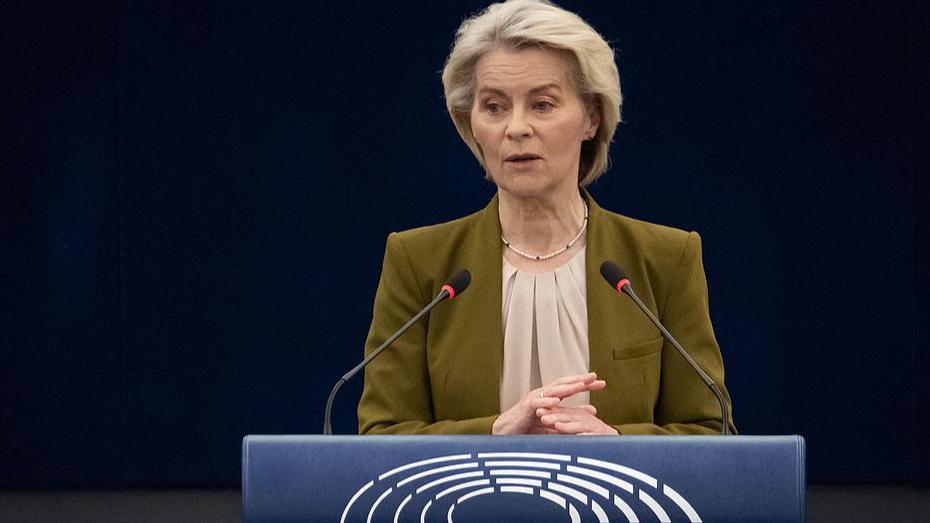
European Commission President Ursula von der Leyen delivers a speech at the European Parliament in Strasbourg, France, April 29, 2026. (Photo: AFP)
The European Commission on Wednesday adopted a temporary state aid framework to enable European Union (EU) member states to support sectors affected by the Middle East crisis and rising energy costs.
The Middle East Crisis Temporary State Aid Framework (METSAF) will apply until December 31, 2026. It targets some of the most exposed sectors of the EU economy, including agriculture, fisheries, transport and energy-intensive industries, the Commission said in a statement.
The Commission added that it will keep the framework's content, scope and duration under review throughout its application, in light of developments in the Middle East and the broader economic situation.
The move comes as EU officials warn that the conflict in the Middle East is significantly increasing Europe's energy import costs. European Commission President Ursula von der Leyen told EU lawmakers in Strasbourg, France, on Wednesday that in just 60 days of the Middle East conflict, the EU's fossil fuel import bill had risen by more than 27 billion euros ($31.57 billion), "without one single molecule of energy in addition."
EU Energy Commissioner Dan Jorgensen also warned last week that the crisis was not merely causing "a short-term, small increase in prices," but was "probably as serious as the 1973 and the 2022 crises combined."
According to the Commission, while the transition toward a clean economy remains the long-term solution to shield EU companies from global energy shocks, the temporary framework allows member states to act immediately to ensure that the growth of the most exposed companies is not irreparably hampered.
Under the framework, support will take various forms for companies active in agriculture, fisheries and transport. These include aid based on actual consumption to cover part of the increases in fuel or fertilizer costs, as well as a simplified approach for small amounts of aid.
METSAF also includes a temporary adjustment to the Clean Industrial Deal State Aid Framework (CISAF), allowing for greater flexibility and higher aid intensities to address electricity price spikes.
Teresa Ribera, executive vice-president of the European Commission for a Clean, Just and Competitive Transition, said the recent surge in energy prices requires an immediate response, adding that the new framework provides "easily applicable solutions" to cushion the impact on key EU sectors such as agriculture, fisheries and transport.