


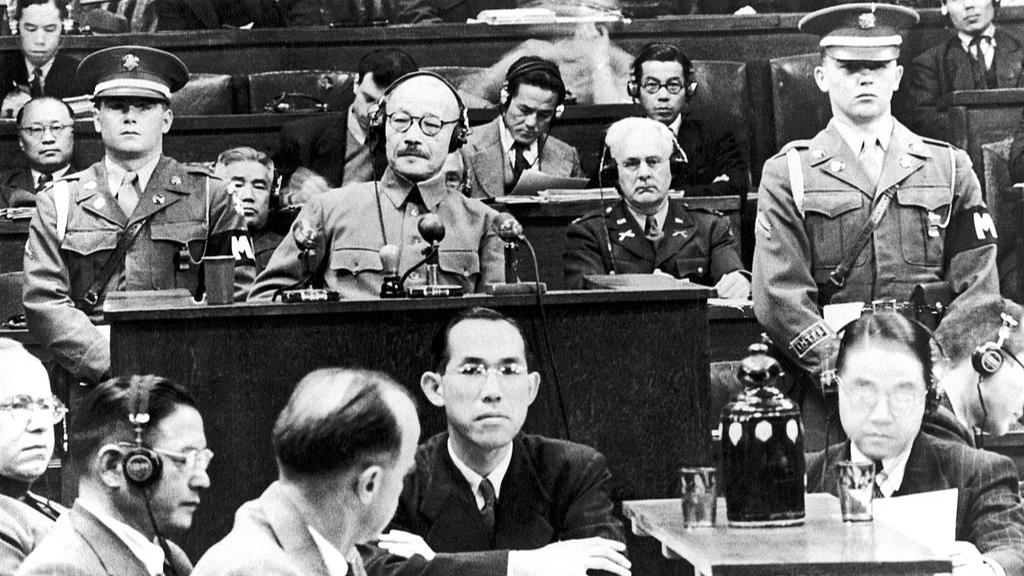
Former general and Japanese Prime Minister Hideki Tojo during the Tokyo Trials. (Photo: VCG)
The year 2026 marks the 80th anniversary of the opening of the International Military Tribunal for the Far East, or Tokyo Trials.
The Tokyo Trials convened on May 3, 1946, almost one year after Japan announced its unconditional surrender in World War II. In the following two and a half years, the tribunal, consisting of judges from 11 countries, revealed and addressed Japan's historical war crimes committed during its fascist expansion, based on substantial historical documents and testimonies.
With 818 court sessions, 419 witnesses, 4,336 pieces of evidence, and over 48,000 pages of trial records, the Tokyo Trials exposed Japan's unspeakable inhuman and anti-civilization war crimes such as the Nanjing Massacre and the Bataan Death March.
All 25 defendants were found guilty and seven of them, including Hideki Tojo, were sentenced to death by hanging while others were sentenced to life imprisonment or fixed-term sentences.
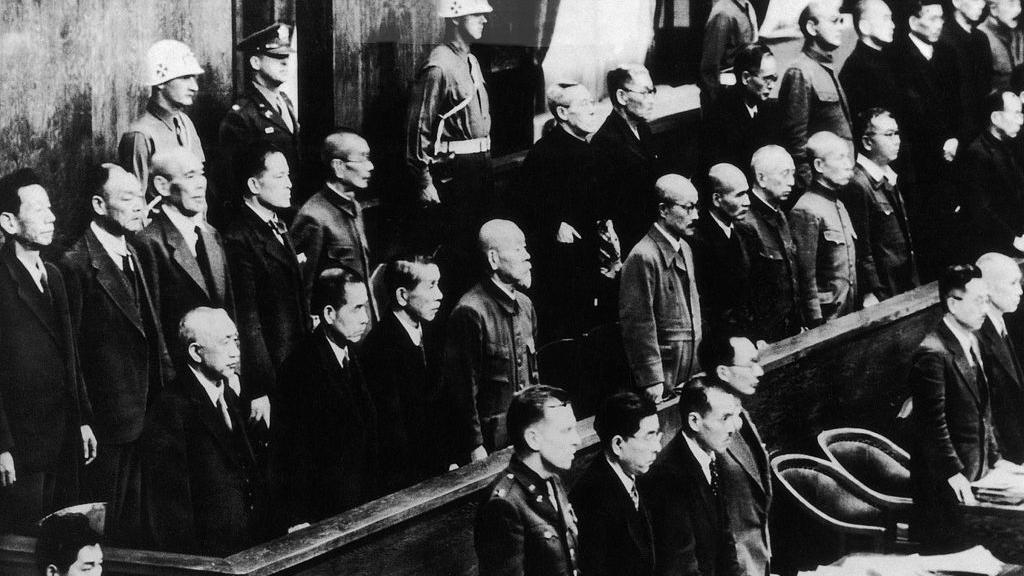
Japanese war ciminals during the Tokyo Trials. (Photo: VCG)
Historical significance
Although 80 years have passed since the Tokyo Trials, experts believe that these trials, alongside the Nuremberg Trials – famous for prosecuting major Nazi war criminals for their atrocities during World War II – not only solidified the victory of the global anti-fascist struggle through international law but also laid the foundation for the post-war international order.
He Qinhua, former president of East China University of Political Science and Law, told CMG the Tokyo Trials have at least two orders of significance for Japan: on the one hand, the trials decisively dismantled Japanese militarism ideologically and practically; on the other hand, they led to the introduction of Article 9 of the Japanese Constitution, namely the "Pacifist Constitution."
As for the international society, He emphasized that one of the most important contributions of the Tokyo Trials was to incorporate the concept of "crimes against peace" into the broader definition of "aggression," legally confirming the aggressive nature of Japan's actions and playing a vital role in establishing the international legal framework for defining "aggression."
Jiang Yue, assistant research fellow from the Academy of Military Sciences, noted that the Tokyo Trials, along with the Cairo Declaration, the Potsdam Proclamation, and the Japanese Instrument of Surrender, collectively formed the critical political and legal foundation for the post-war international order.
In Japan, there are also many voices highlighting the importance of the trials. The Japanese newspaper Asahi Shimbun remarked during the period of the Tokyo Trials that the trials were a scourge on past wrongs, warning that without confronting the past, Japan could never truly move forward.
In the post-war period, many Japanese politicians called for a reckoning with Japan's wartime responsibility. Universities like Waseda quickly formed study groups to promote reflection on Japan's imperial history, planting the seeds of peace in Japanese society.
Furthermore, the trial records and judgments remain vital sources for studying Japan's war crimes and continue to highlight the historical and contemporary significance of the Tokyo Trials.
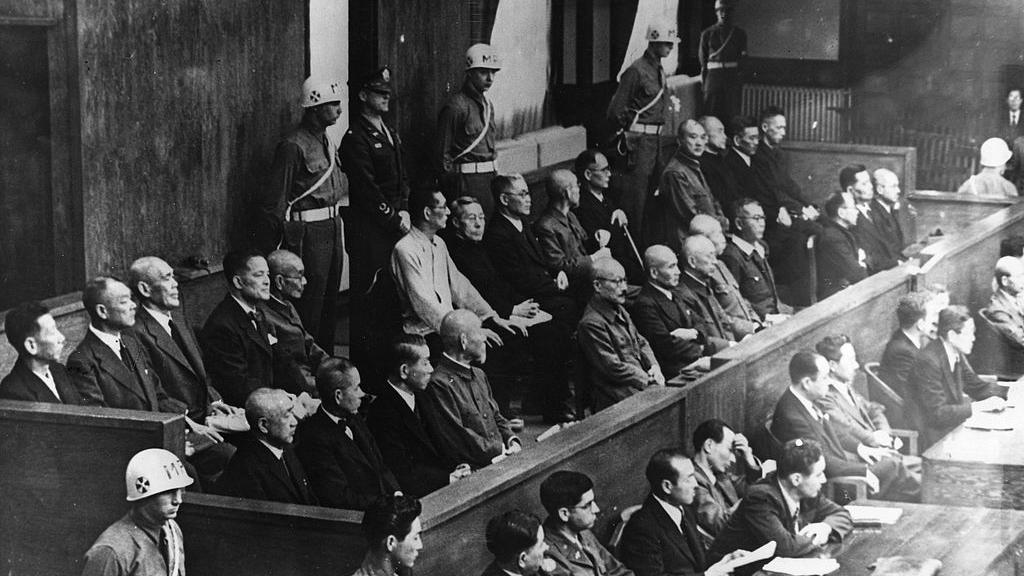
A scene during the Tokyo Trials. (Photo: VCG)
Warning about divergence of Japanese right-wing forces
However, since the 1970s, right-wing forces in Japan have repeatedly propagated the erroneous claim that Japan's surrender was "conditional," which starkly contradicts historical reality. Meanwhile, they have increasingly spread the argument that the Tokyo Trials were "a victor's justice," attempting to distort this legitimate trial into an unjust decision by the victorious powers.
Professor Guan Jianqiang from East China University of Political Science and Law pointed out that Japan's right-wing forces are clearly trying to negate the very concept of "crimes of aggression," attempting to shake the global consensus on Japan's war history using deceptive rhetoric.
Moreover, Japan has long harbored a disturbing trend of denial of aggression, war beautification, and attempts to rewrite history. Some politicians visited the Yasukuni Shrine, while certain textbooks and public discourse deliberately downplayed the word "aggression," even attempting to deny or minimize atrocities like the Nanjing Massacre, the forced recruitment of "comfort women," and the enslavement of laborers.
More alarmingly, in recent years, Japan has used the pretext of regional instability and supposed "threats" to significantly increase its defense budget, develop offensive weapons, relax restrictions on weapon exports, and push for security policies that go beyond the framework of "self-defense." There are even voices advocating revising the pacifist constitution, particularly Article 9, in a bid to transform Japan back into a "normal nation" capable of using military force abroad, and even discussing abandoning the "Three Non-Nuclear Principles," challenging the sensitive nuclear issue.
Jiang pointed out that erroneous views never stay confined to textbooks or rhetoric; instead they have a profound impact on national strategy and policy, influencing the direction of misguided decisions.
On the 80th anniversary of the opening of the trials, and with Japanese neo-militarism on the rise, "Forgetting past sufferings may lead to future disasters" – the warning of Chinese judge Mei Ru'ao, who represented China at the trials – resonates more deeply than ever before.