


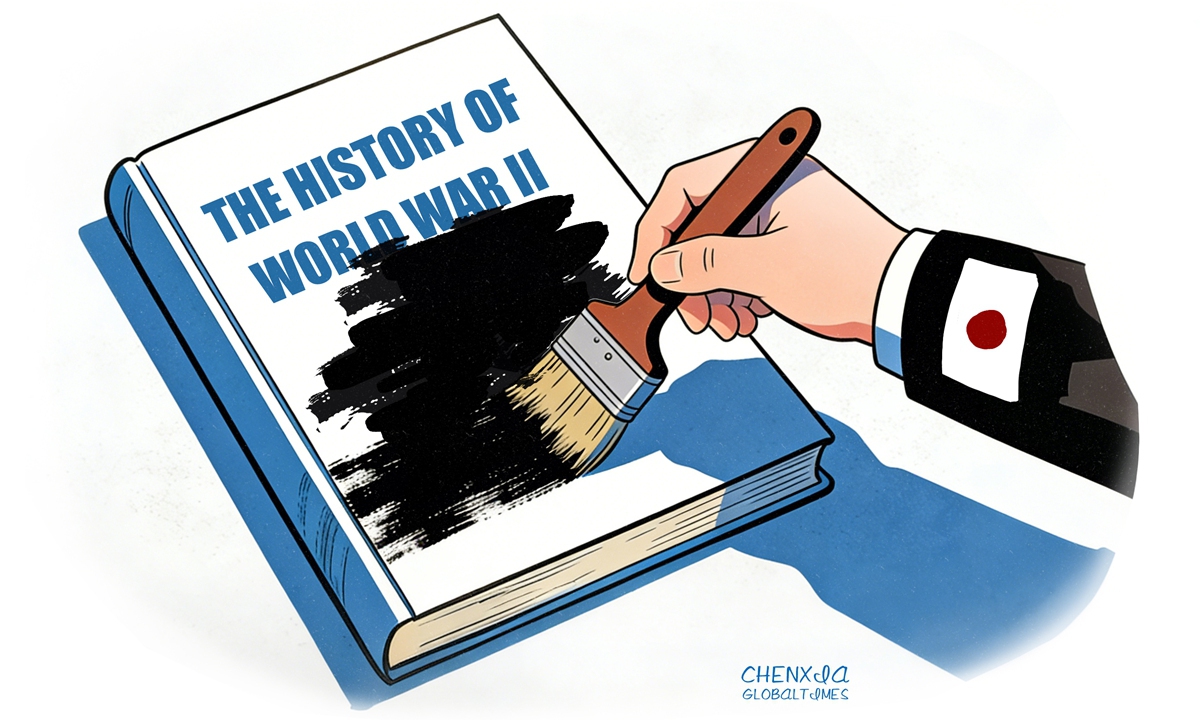
Illustration: Chen Xia/GT
The year 2026 marks the 80th anniversary of the beginning of the International Military Tribunal for the Far East (IMTFE), also known as the Tokyo Trial. Following the Nuremberg Trial, it was another large-scale, multinational judicial proceeding in human history to try crimes of aggression and war crimes.
As stated by Joseph Berry Keenan, chief prosecutor for the Tribunal, "this is no ordinary trial, for here we are waging a part of the determined battle of civilization to preserve the entire world from destruction." The Tokyo Trial sent out important messages and was expected to serve as a historical warning, with positive educational impact for post-war Japan. However, surveys show that in contemporary Japanese society, especially among younger generations, there is a lack of understanding of the Tokyo Trial.
What has led to this structural gap in historical awareness? In an interview with Global Times (GT) reporter Liu Xuandi, Issei Hironaka (Hironaka), associate professor at Aichi Gakuin University, shared how Japanese youth have been systematically deprived of the opportunity to fully understand this history due to the deficiencies of Japan's educational system and Japanese right-wing forces' long-standing attempts to promote historical revisionism throughout society.
GT: This year marks the 80th anniversary of the beginning of the Tokyo Trial. As a Japanese historian who has long been engaged in uncovering historical materials and clarifying the realities of the past, how would you assess the historical significance of the Tokyo Trial? Hironaka: Research on the Tokyo Trial has been extensively examined by numerous scholars and many aspects of the trial have been clarified. The Tokyo Trial holds great significance in clarifying Japan's wartime responsibilities and facilitating postwar reconciliation between Japan and the countries it fought, including China. GT: How do current Japanese textbooks present Japan's history of aggression during World War II, including the Tokyo Trial? To what extent does the younger generation in Japan understand this period of history? Hironaka: There are problems with the way Japanese textbooks are written. One issue is selective accounts of Japan's war of aggression against China in history textbooks, leaving many young people unfamiliar with modern history, including the Tokyo Trial.
Another issue is that Japanese schools have long prioritized subjects such as mathematics and English, resulting in fewer hours for social studies, including history. Consequently, courses that begin with ancient history often fail to reach the modern period, resulting in some students graduating even without ever studying the Tokyo Trial.
The widespread lack of understanding of modern history among young people, including the Tokyo Trial, points to broader deficiencies in Japan's educational system and may also reflect a longstanding tendency among successive Japanese governments to undervalue the teaching of modern history.
GT: In recent years, Japan's right-wing forces have sought to deny or overturn the Tokyo Trial, portraying it as a form of "victors' justice," and accelerated their efforts to revise Japanese history textbooks. How would you view this trend? Hironaka: Japanese right-wing forces have long persisted in promoting historical revisionism, seeking to downplay Japan's aggressive actions during the war and to fabricate a narrative that minimizes or denies its responsibility. One of their methods is to whitewash and glorify Japan's wartime record in history textbooks, and promote the use of these textbooks in schools, ensuring that students are educated through these narratives. In addition, right-wing forces also use social media and video platforms - channels that young people engage with on a daily basis - to present historical revisionist views in an accessible and easily understandable manner. Some young people who lack a solid grounding in modern history are particularly susceptible to these narratives, and support for historical revisionism appears to be rising. GT: You have previously pointed out that the government's stance on the issue of textbooks is a direct manifestation of the erroneous historical views of right-wing politicians, including some Japanese leaders. In light of the current rightward shift in Japanese society, what impact do you believe such historical views will have on Japanese society, particularly on the younger generation? Hironaka: Historical revisionism promoted by Japan's right-wing forces seeks to minimize Japan's war responsibility as much as possible and to justify its wartime actions. This approach stands in stark contrast to the historical understanding held by neighboring countries that once suffered from the war, including China, where memories of wartime aggression remain deeply rooted. If historical revisionism continues to spread within Japanese society and gains traction among younger generations, it could distort their perception of history. In turn, it is likely to have profoundly negative consequences for the international relations these young people will inherit, particularly Japan's ties with East Asian countries. GT: As a historian and educator, what significance do you see in strengthening education on the Tokyo Trial in Japanese society? What specific measures would you recommend to help the younger generation in Japan develop a more comprehensive and balanced understanding of the Tokyo Trial? Hironaka: To ensure that young people in Japan develop an accurate understanding of the Tokyo Trial, it is essential to prioritize teaching the truth about modern Japanese history in schools. In addition to using textbooks that present a comprehensive and accurate account of history, educators can incorporate contemporaneous newspaper articles and visual materials as teaching resources, enabling students to develop a more direct and authentic understanding of wartime realities.
However, to implement such education effectively, the Japanese government must correctly understand modern history and assume a strong sense of responsibility for teaching this content. This also reflects a responsibility that postwar Japanese society has yet to fulfill, as it has not engaged in thorough self-reflection, failing to fully confront the nature of its aggression and the extent of its wrongdoing. I believe this is precisely why the issue of historical perception between Japan and its neighboring nations that suffered from its aggression remains unresolved to this day.
On the 80th anniversary of the beginning of the Tokyo Trial, it is time for Japanese people to face and seriously reflect on the history of war and engage in a profound self-examination of the past.