


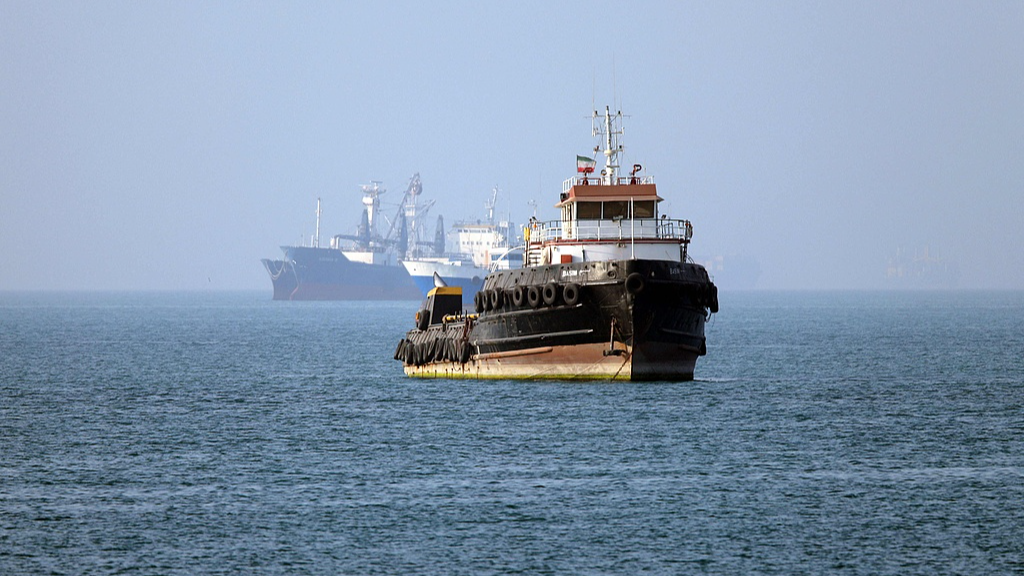
The Iran-flagged tugboat Basim sails near a ship anchored in the Strait of Hormuz off Bandar Abbas in southern Iran, May 4, 2026. (Photo: VCG)
Tensions sharply escalated in the Gulf on Monday as the United States launched a military operation to reopen the strategically vital Strait of Hormuz, prompting Iranian retaliation and missile and drone attacks on the United Arab Emirates (UAE).
The US military said it destroyed six Iranian small boats and intercepted multiple cruise missiles and drones fired by Tehran, as Washington sought to secure shipping lanes through the narrow waterway. However, Iran's semi-official Tasnim news agency, citing a senior military official, denied that any Iranian vessels had been sunk.
US President Donald Trump launched the operation, dubbed "Project Freedom," as part of efforts to restore navigation in the strait, which Iran effectively shut down following the outbreak of conflict with the US and Israel on February 28.
Admiral Brad Cooper, head of US Central Command, said American helicopters, including Apache and MH-60 Seahawk aircraft, struck Iranian boats during the operation. He emphasized that the Pentagon was providing "multiple layers" of protection for commercial shipping, rather than direct naval escorts.
"If you're escorting a ship, you're playing kind of one-on-one. I think we have a much better defensive arrangement in this process, where we have multiple layers that include ships, helicopters, aircraft, airborne early warning and electronic warfare," Cooper said.
The operation marks Washington's latest attempt to counter disruptions to global energy supplies. Before the conflict, roughly one-fifth of the world's oil and liquefied natural gas shipments passed through the strait. The US military has urged vessels to resume transit despite Iranian threats, though ships from at least 87 countries remain stranded in the Gulf.
On the same day, a South Korean vessel was hit by an explosion in the strait. Trump later suggested in a social media post that the ship was not part of the US operation and should consider joining American-led efforts to ensure safe passage.
Conflicting accounts at sea
Iranian forces said they carried out warning actions against a US destroyer approaching the strait. According to a military statement, Iranian naval units fired warning shots – including cruise missiles, rockets and drones – after the US vessel ignored initial warnings.
The US Central Command said no American ships were hit, adding later that a US Navy guided-missile destroyer had successfully transited the strait and was now operating in the Gulf to assist stranded vessels. Two US-flagged commercial ships were also reported to have safely passed through the waterway.
Iran's Islamic Revolutionary Guard Corps, however, rejected US claims that commercial vessels had resumed passage, stating that no ships had crossed the strait in recent hours.
UAE targeted in regional spillover
As the confrontation intensified, the UAE reported coming under missile and drone attack. Emirati authorities said air defense systems intercepted 12 ballistic missiles, three cruise missiles and four drones launched from Iran. Earlier, the UAE's Fujairah Media Office said that a fire erupted at the Fujairah Oil Industrial Zone following an Iranian attack, injuring three people.
This marked the first such incident in the UAE since a temporary ceasefire between the US and Iran on April 8.
The UAE Foreign Ministry condemned the strikes as a "dangerous escalation" and an "unacceptable act of aggression," asserting the country's "full and legitimate right" to respond.
Iranian state media, citing a senior military source, said Tehran had no pre-planned intention to strike UAE oil facilities, blaming "US military adventurism" – creating "a passage for ships to illegally pass through the forbidden passages of the Strait of Hormuz" – for provoking the situation.
Tasnim later quoted an informed source warning that if the UAE takes any "unwise" action, all its interests could become legitimate targets.
Wang Jin, director of the Center for Strategic Studies at Northwest University in China, says the US lacks a clear operational pathway to safely reopen the strait. Washington may rely heavily on military force to push ships through – a strategy that carries significant risks, including the potential for renewed large-scale conflict and the danger that commercial vessels could be caught in crossfire.