


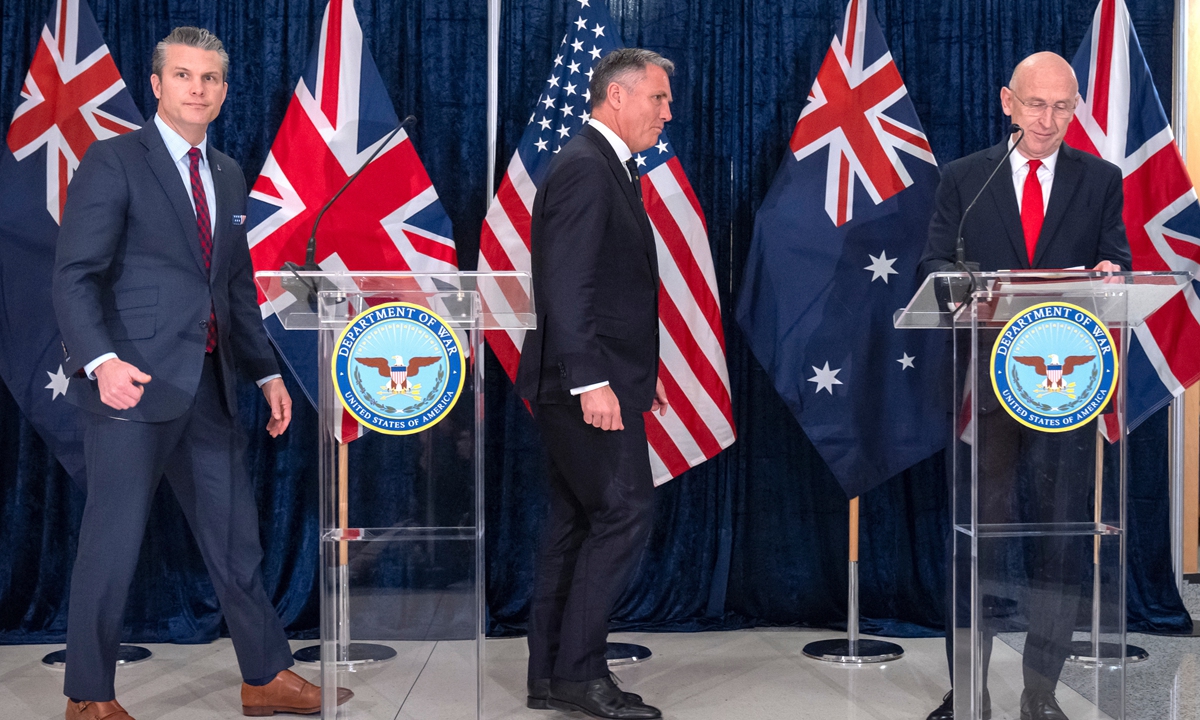
From left, US Defense Secretary Pete Hegseth, Australia's Deputy Prime Minister and Defense Minister Richard Marles, and British Defence Secretary John Healey (right), leave after giving remarks on the sidelines of the AUKUS Defense Ministers' Ministerial meeting at the Pentagon in Washington on December 10, 2025. (Photo: VCG)
A new poll released by The Australia Institute on Thursday shows that 59 percent of Australian believe the country's interests are better served by a more independent foreign policy rather than a closer alliance with the US.
Conducted for the Australia Institute, a public policy think tank based in Canberra, the YouGov poll of 1,502 people found that 59 percent of Australians now believe Australia's interests are better served by a more independent foreign policy rather than a closer alliance with the US (23 percent). Only 13 percent of Australians believe the US is a "very reliable" security ally.
"This poll represents a seismic shift in the way Australians think about the US," said Dr Emma Shortis, Director of The Australia Institute's International & Security Affairs Program, according to the institute.
A Chinese expert noted that the finding suggests that Australians refuse to prioritize alliance with the US at the expense of national interests and strategic autonomy.
Chen Hong, director of the Australian Studies Center of East China Normal University, told the Global Times on Thursday that Australians' lack of trust in the US is not merely a momentary emotional reaction, rather, it stems from Australian society's reassessment of the costs and benefits of its alliance with the US.
In a wide-ranging interview reflecting on the first year of his second term, Australian Prime Minister Anthony Albanese said that the "America first" mandate, which has included imposing punishing tariffs on allies and not giving them a heads-up before launching military strikes on Iran, has seen Australia band together more closely with other middle powers, Australian Broadcasting Corporation (ABC) reported on May 2.
He said that while the US remained Australia's "most important ally", it did not mean "that we're not out there engaging with others," per ABC.
Chen said that Australia has long followed the US out of strategic inertia. Yet Washington's successive moves, including its disrespect for allies, have led many Australians to realize that the alliance may no longer guarantee security. Instead, it may drag Australia into conflicts contrary to its core national interests.
Australia's public sentiment reflects a deep-seated contradiction, the expert continued. While it still recognizes the US as a traditional ally, it increasingly worries that this ally is turning from a security guarantee into a source of risk.
Besides, the poll also found that one third of Australians now believe the AUKUS security agreement is not in Australia's best interests.
The US Navy's submarine-building program — which Australia is relying on for its naval fleet — risks another slowdown due to delays awarding a critical construction contract, according to a report by ABC News on April 23. Meanwhile, new research says construction timelines for the nuclear-powered submarines keep blowing out, and they are now being built four years behind schedule.
The report by the Australian media outlet Financial Review also noted on Thursday that the unpredictability of the US administration has fueled unease among defense experts about whether Australia can rely on the US to deliver its side of the AUKUS bargain.
These findings by the poll serve as a wake-up call for Australian society to rethink its overreliance on the US alliance, Chen said, adding that it demonstrates that the Australian public rejects pursuing an alliance at the cost of national interests and strategic autonomy.