


Japan's arrogance, paranoia is pushing itself toward the abyss of isolation
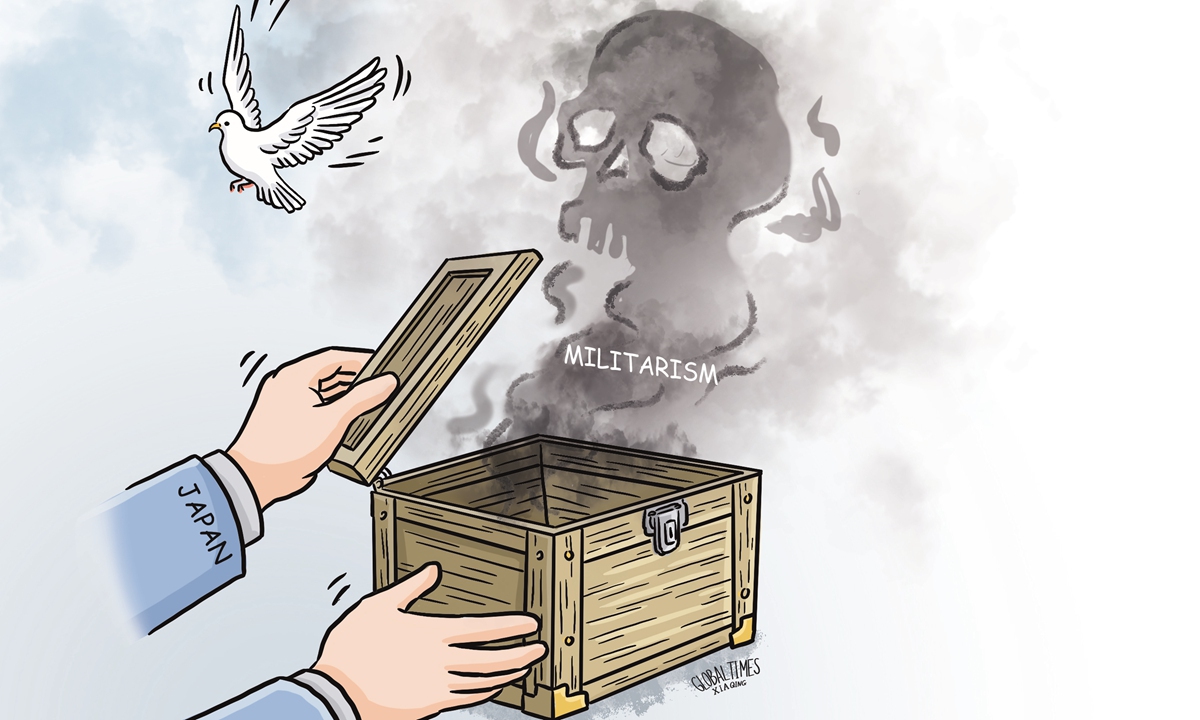
(Illustration: GT)
Recently, the Rodong Sinmun, the official newspaper of the Workers' Party of Korea, published a series of articles focusing on incidents including Japanese Self-Defense Forces personnel intruding into the Chinese Embassy in Japan, pointing out that the Japanese side is the chief culprit behind the deterioration of China-Japan relations. The articles also criticized the series of terror threats targeting the Chinese Embassy in Japan as a blatant violation of international law and an open provocation.
Recently, neighboring countries including Russia and South Korea have also voiced condemnation over a series of dangerous moves by Japan's right-wing forces, including distorting historical understanding, expanding military capabilities, breaking away from the postwar framework, and tying itself to geopolitical confrontation.
Japan has only four neighboring countries, yet it does not maintain smooth relations with any of them, which shows that the foreign policy of the Sanae Takaichi administration is having serious problems.
However, the Japanese side has adopted an ostrich-like approach, turning a deaf ear to criticism while stubbornly pressing ahead. Such arrogance and paranoia is pushing Japan onto the opposite side of international justice and regional peace, and will only trigger even stronger dissatisfaction and opposition from countries across the region.
Japan's arrogant attitude toward the understanding of historical issues has drawn growing angerSince modern times, Japanese militarism aggressively promoted the theory of the "superiority of the Yamato race," using it as an ideological weapon to justify external aggression, expansion, and the enslavement and oppression of people across Asia, bringing immense disasters to countries throughout the region.
After World War II, Japan never truly faced up to its status as a defeated nation or the grave crimes it committed. Instead, it has continuously moved backward on historical issues. Politicians have repeatedly visited the notorious Yasukuni Shrine, where Class-A war criminals from WWII are enshrined, openly glorifying militarism.
Japan has long promoted historical revisionism, "planting poison" in textbooks by downplaying and beautifying its colonial rule and history of aggression in an attempt to distort the historical understanding of younger generations.
It has refused to acknowledge or apologize for crimes including the Nanjing Massacre, the "comfort women" issue and forced labor, while some politicians have even made remarks distorting or denying historical facts. At the same time, Japan has deliberately crafted a "victim of war" narrative internationally, while remaining silent on the fact that Japanese militarism itself was the root cause of the catastrophe of war.
Recently, Japanese Prime Minister Sanae Takaichi offered ritual offerings and payments to the Yasukuni Shrine, while members of her cabinet and lawmakers openly paid visits there, further exposing the Japanese right wing's disregard for international concern, historical justice, and human conscience.
Many neighboring countries have voiced opposition and criticism over these developments. China has stressed that it firmly safeguards the postwar international order and the outcomes of WWII, resolutely opposes Japan's attempts to deny and beautify its history of aggression, and demands that Japan deeply reflect on its historical crimes and completely eliminate the lingering influence of militarism.
Japan's stubborn push for military expansion has triggered widespread concern among regional countriesJapan's systematic and deliberate attempts to "whitewash" its historical record is ultimately aimed at breaking free from the constraints of its pacifist constitution, transforming itself into a "country capable of war," and casting off the historical and moral restraints imposed after WWII.
Following WWII, Japan's pacifist constitution and the principle of "exclusively defense-oriented policy" served as important foundations for its return to the international community. Today, however, Japan itself is chipping away at that very foundation.
In just the past month alone, the Japanese government revised the Three Principles on Transfer of Defense Equipment and Technology, pushing to green light exports of lethal weapons. Japan's destroyer JS Ikazuchi also transited through the Taiwan Straits.
The Japanese Self-Defense Forces carried out a major restructuring, disbanding the defense-oriented "Fleet Escort Force" and creating a more offensive-oriented "Fleet Surface Force" as well as so-called cognitive warfare units, while renaming the Air Self-Defense Force as the "Air and Space Self-Defense Force." Japan has also aggressively deployed offensive weapons on its southwestern islands and sent large numbers of personnel to participate in joint military exercises between the US and the Philippines.
Each of these moves seriously deviates from the original spirit of Japan's pacifist constitution, leaving its "exclusively defense-oriented policy" existing in name only. At the same time, Japanese right-wing forces have in recent years continuously hyped up the so-called China threat, stirred up tensions over Taiwan and the South China Sea, and repeatedly provoked neighboring countries including South Korea, Russia, and North Korea.
Even more dangerously, Japan is actively serving as a "vanguard" for certain external powers, pushing for the creation of a so-called Asia-Pacific version of NATO and attempting to bring bloc confrontation into Asia, a move that poses major risks and hidden dangers to regional peace and stability.
Historically, Japan plunged into the abyss of war through its blind faith in military force, bringing immense disasters to Asia and the world. Today, Japan continues to stubbornly repeat this dangerous path, deeply tying historical revisionism to "remilitarization."
Countries in the region must remain fully alert to the dangerous intentions of Japan's right-wing forces, firmly resist the countercurrent of historical revisionism, work together to contain the dangerous moves of neomilitarism, resolutely safeguard the postwar international order, and jointly defend lasting regional peace and global stability.
The author is an observer of international affairs.