


Inside a worn-out tent in a displacement camp in Gaza City, Palestinian woman Maram Hussein tries to cool her infant son with a piece of cardboard as hot air circulates through the confined space where her family has lived for more than a year and a half.
As summer temperatures rise across the Gaza Strip, thousands of displaced families living in makeshift tents are facing increasingly harsh conditions.
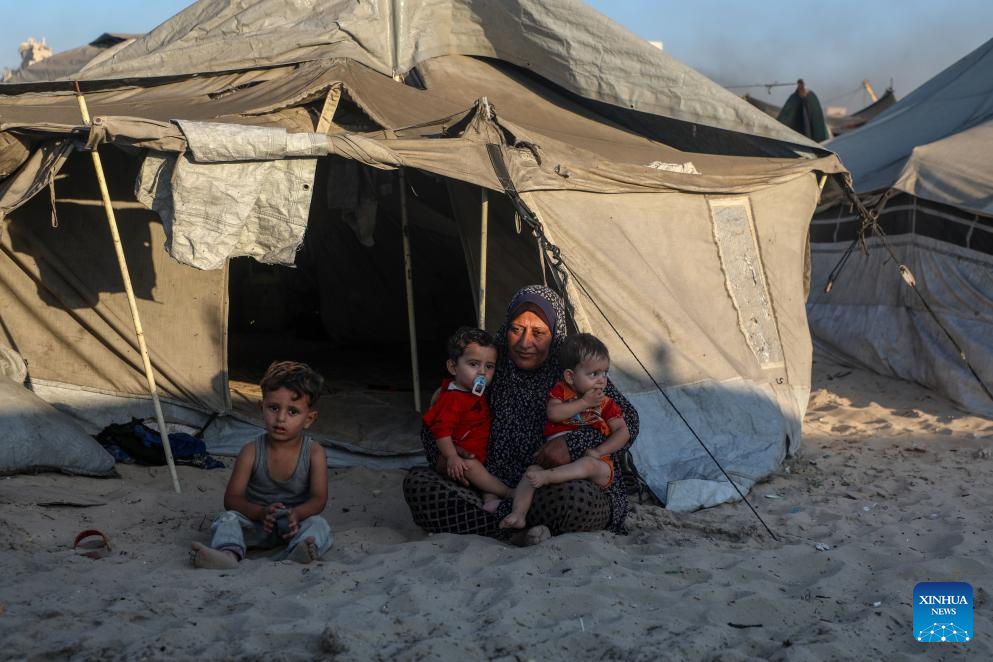
Palestinian children are seen among tents for displaced people on the shores of Gaza City, on July 18, 2025. (Photo: Xinhua)
"The tent offers no protection from the winter cold or the summer heat," Hussein, 35, told Xinhua while holding her six-month-old baby. "It has become like an unbearable human oven."
Most of these shelters, constructed primarily from nylon and lightweight fabric, absorb heat during the day and retain it overnight, while poor ventilation further worsens the indoor conditions.
To cope with the extreme heat, she noted that her family spends most of the day outside the tent, while at night her husband and children often sleep outdoors.
"Sleeping outside exposes them to mosquito bites, insects, and sometimes rodents," Hussein said. "But staying inside is even more difficult."
In the al-Mawasi area west of Khan Younis in southern Gaza, where large numbers of tents line the coastal strip, Ibrahim al-Hajj and his wife, who suffers from asthma, sit beneath a small cloth he has set up over their tent to provide limited shade.
"As noon approaches, the tent becomes uninhabitable," the 67-year-old told Xinhua. "The heat inside is stifling."
He said his wife has fainted several times due to high temperatures, forcing them to spend most of the day outside despite the difficult conditions.
The lack of electricity and cooling devices, including fans, has significantly increased the suffering of the displaced families in the war-torn enclave, particularly the elderly and those with chronic illnesses, amid limited access to healthcare services.
In the northern Gaza Strip, particularly in the Jabalia area, which was heavily damaged during the conflict, children are often seen playing with water to cool off.
Ruba al-Zubda, a mother of three, said that women in displacement camps are forced to pour water over their children several times a day to prevent heat-related illnesses.
"With the arrival of summer, we need more water for bathing, washing, and cooling the children, but water itself is scarce," she said.
"In winter, rainwater flooded our tents, and now we are suffering from extreme heat. Our lives have become a continuous struggle," al-Zubda said.
Medical workers warn that rising temperatures in crowded camps are increasing health risks, particularly among children, the elderly, and people with chronic diseases.
The current heat wave is contributing to the spread of skin diseases, dehydration, and heat exhaustion, especially amid water shortages, a deteriorating health system, and limited access to medicines, said Ismail al-Thawabta, director general of the Hamas-run government media office in Gaza.
According to al-Thawabta, field estimates show that around 135,000 tents are currently spread across the Gaza Strip, sheltering more than one million displaced people who lost their homes during the conflict, while fewer than 5 percent of these tents are considered relatively suitable for habitation.
With no immediate prospects for large-scale reconstruction or adequate alternative housing, displaced families in Gaza have to face another summer under increasingly unbearable conditions.
"It's already this hot now. I don't know what the coming months will bring," Hussein said.