


In a meeting closely watched by the world, Chinese President Xi Jinping and U.S. President Donald Trump on Thursday agreed on a new vision of building a constructive bilateral relationship of strategic stability.
The new vision will provide strategic guidance for China-U.S. relations over the next three years and beyond, Xi said when holding talks with Trump, who just concluded a three-day state visit to China.
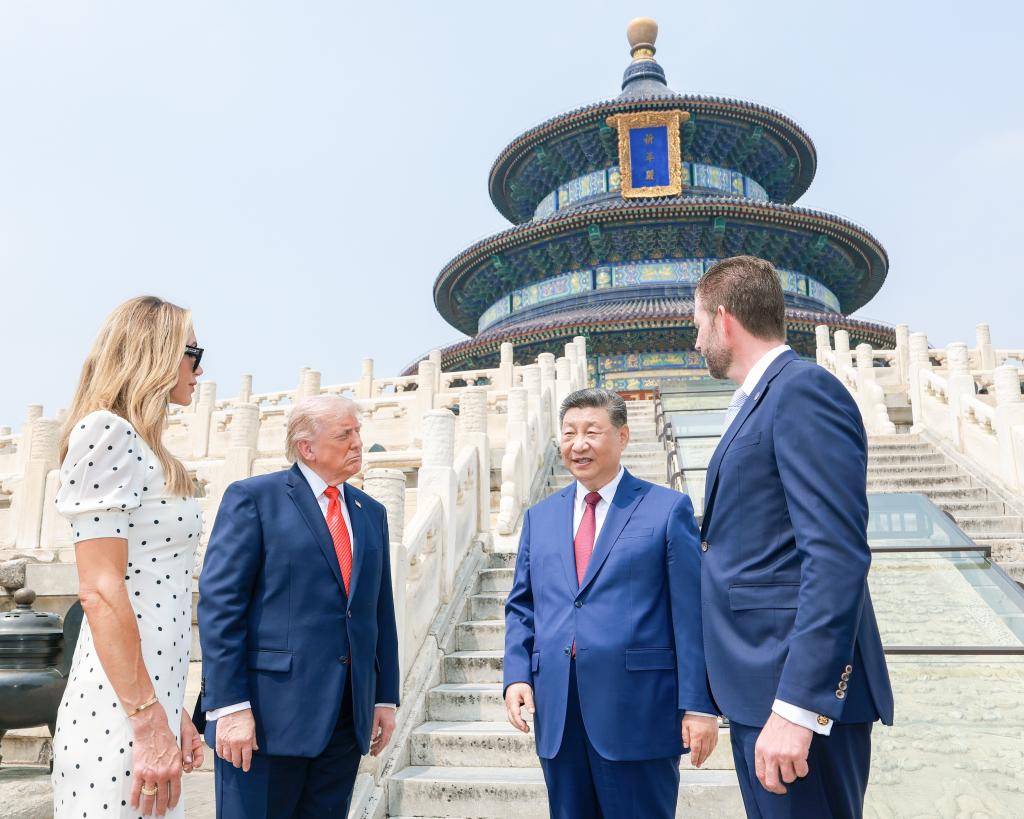
Chinese President Xi Jinping and U.S. President Donald Trump visit the Temple of Heaven in Beijing, capital of China, May 14, 2026. (Photo: Xinhua)
Xi defined the nature of "constructive strategic stability" as a positive stability with cooperation as the mainstay, a sound stability with moderate competition, a constant stability with manageable differences, and an enduring stability with promises of peace.
The international community has spoken positively of the progress, saying the new vision is not only important for the development of China-U.S. relations, but also valuable for promoting peace, stability and prosperity of the entire world.
The United Nations welcomes any positive movement in China-U.S. relations, Farhan Haq, deputy spokesman for UN Secretary-General Antonio Guterres, said on Thursday.
"A strong relationship between the two countries would have a positive net effect for the world," the spokesman added.
Mainstream media outlets and analysts in the United States paid close attention to the visit, focusing on the important progress made in bilateral ties as well as world affairs.
Robert Lawrence Kuhn, chairman of the Kuhn Foundation, elaborated on the "significance of the new, mutually agreed, defining phrase, 'constructive strategic stability.'"
"Taken together, 'constructive strategic stability' provides overall policy guidelines from the two presidents to officials on both sides in all sectors of U.S.-China relations," Kuhn said.
Kenneth Quinn, president emeritus of the World Food Prize Foundation, said the "constructive strategic stability" initiative has the potential to change the trajectory of U.S.-China relations, with positive implications for the global community for decades to come.
"It is the type of dramatic change that can only come from the actions of the two most significant leaders on the planet and is critically important in turning the world from conflict to cooperation and peace," Quinn said.
The talks between the two presidents not only charted a course for bilateral relations but also boosted optimism about the world's future, said William Jones, an international relations expert and former White House correspondent for Executive Intelligence Review.
In Bulgaria, mainstream newspaper 24 Chasa said people expect the meeting between Chinese and U.S. leaders to continue steering the ship of China-U.S. relations through storms, ensuring smooth progress and bringing valuable stability and security to a turbulent world.
Nenad Stekic, senior research fellow at Serbia's Institute of International Politics and Economics, said Xi's remarks present a highly pragmatic and forward-looking vision for China-U.S. relations.
The concept of "constructive strategic stability" emphasizes that the two largest economies and most influential countries can coexist through cooperation, mutual respect and responsible management of differences, the scholar said.
Balew Demissie, senior consultant at the Policy Studies Institute of Ethiopia, said the world expects China and the United States to manage competition responsibly and cooperate on global issues such as peace, economic stability, climate change, global health, digital governance and multilateral cooperation.
Dennis Munene Mwaniki, executive director of the China-Africa Center at the Africa Policy Institute in Kenya, said the meeting between the two presidents is extremely important amid the ongoing geopolitical tensions around the world.
Cooperation between China and the United States will not only benefit the two countries in fields such as health cooperation, but also allow the global community to benefit from greater access to global public goods, Mwaniki said, adding that such strategic cooperation will create more opportunities worldwide.
Virdika Rizky Utama, executive director of Jakarta-based think-tank PARA Syndicate, said that by articulating "constructive strategic stability," Beijing is offering a framework through which both countries can manage their competition.
This is not just about bilateral ties, but about reassuring the international community that the world's two largest economies are committed to stability, he said.