


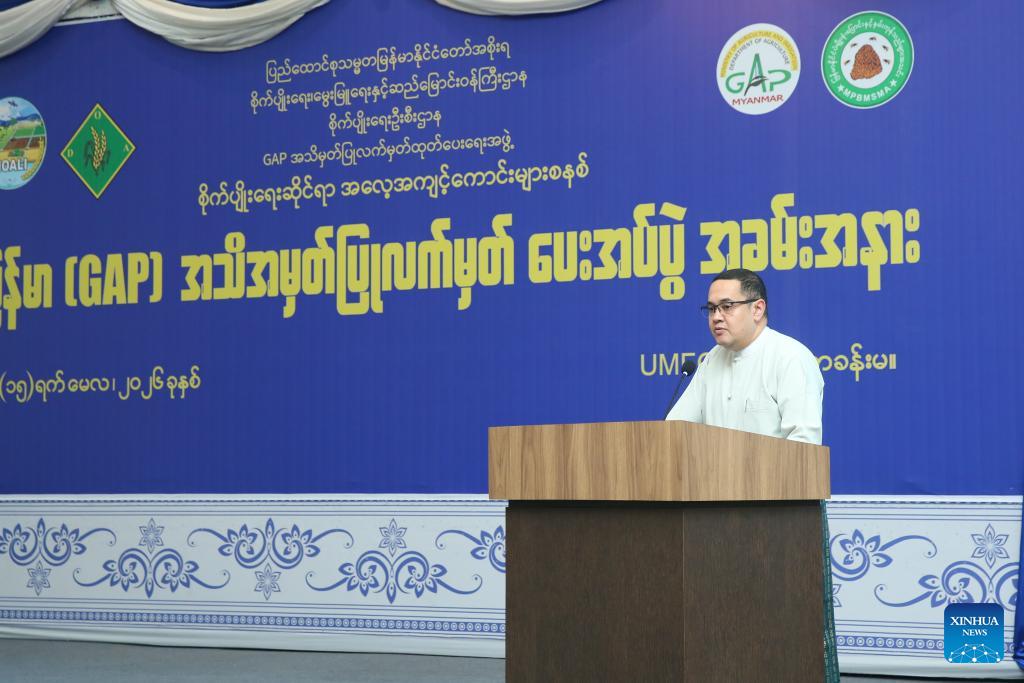
U Ye Min Aung, vice president of the Union of Myanmar Federation of Chambers of Commerce and Industry (UMFCCI), speaks during a Good Agricultural Practices (GAP) certificate presentation ceremony in Yangon, Myanmar, May 15, 2026. (Photo: Xinhua/Myo Kyaw Soe)
YANGON, May 16 (Xinhua) -- As countries increasingly emphasize food safety, Myanmar is promoting Good Agricultural Practices (GAP) to produce safer agricultural products and strengthen export standards, U Ye Min Aung, vice president of the Union of Myanmar Federation of Chambers of Commerce and Industry (UMFCCI), told Xinhua during the GAP certificate presentation ceremony held on Friday in Yangon.
Myanmar's GAP system has been in place for more than 10 years. In the past, trading partners did not require GAP certificates, but later began requesting them as food safety standards became more important in international trade, he said.
He added that implementing the GAP system with proper farming methods is essential for meeting international export standards, ensuring sustainable exports and avoiding trade difficulties in foreign markets.
To further expand the GAP system, farmers, government agencies and exporting companies need to cooperate closely. Through such collaboration, agricultural exports could increase and farmers' incomes could improve, he said.
Among Myanmar's agricultural exports, pulses and beans account for the second-largest cultivated area after rice, covering about 20 percent of the country's crop area. Among them, green mung beans occupy the largest share, he said.
Green mung beans are one of Myanmar's most promising export crops and generate significant foreign income. Therefore, the GAP system is being promoted in green mung bean cultivation, he added.
Farmers in Khayan township and Thongwa township in the Yangon region practicing GAP said the system had improved both food safety awareness and their livelihoods.
"I adopted the GAP system one year ago. After that, I received better prices and increased my income," said U Kyaw Oo, 54, a green mung bean farmer.
"Through GAP-related training, discussions and field surveys, we improve product quality, gain better market opportunities and earn higher income while reducing chemical residues."
Zayyar Htwe, 37, who has practiced GAP farming for about two years, said the system is important for the country's food safety.
"Unsafe food can cause many diseases," he said. "Through the GAP system, farmers learn proper pesticide use and how to reduce chemical residues. It is good for consumers' health."
He added that GAP also benefits trade and market access because products are safer and meet international standards.
According to U Ye Min Aung, some exporting companies are implementing contract farming systems under the GAP framework to provide technical support, quality assurance, stable market access and better income for farmers.
"Contract farming under the GAP scheme ensures sustainability, food safety and better income for farmers," he said.
"The Myanmar government has also banned harmful pesticides and chemicals, so GAP-certified green mung beans are now very safe for consumers," he added.
GAP-certified green mung beans from Myanmar are exported to China, Indonesia, Vietnam, Japan and several European countries, he said.
In the 2025-2026 fiscal year, Myanmar exported nearly 360,000 metric tons of green mung beans. "This fiscal year, we plan to export more than 400,000 metric tons of green mung beans and generate around 500 million U.S. dollars in export earnings," he said.
Highlighting the importance of maintaining product quality and safety to support such export growth, U Tint Naing, head of the Yangon Region Agriculture Department, said food safety and quality are important not only for protecting local consumers from health risks but also for expanding exports by guaranteeing product standards.
"The whole supply chain involved in the Myanmar GAP system plays a role in maintaining food safety," he said.